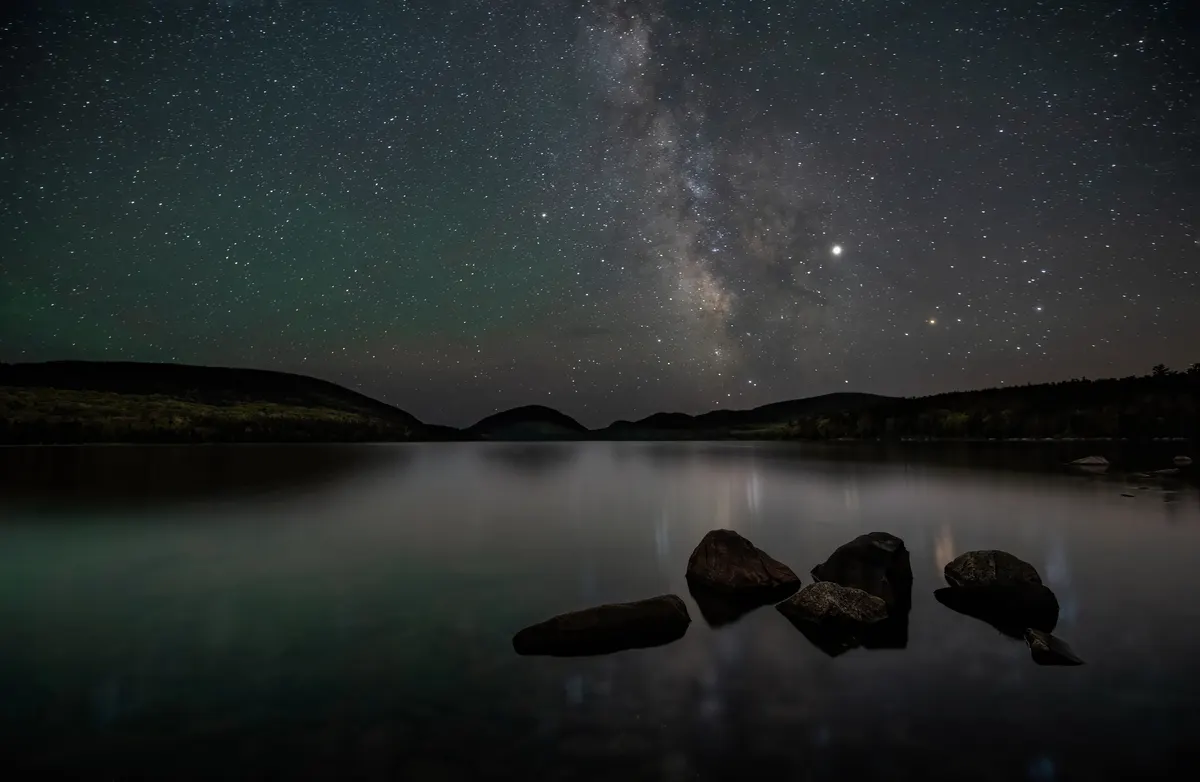
The core clears 10 degrees during full darkness on most nights from March to September. In January, February, October, November and December it's out of reach, either too close to the Sun or too low in the dark.
Core score by month
| Month | Core score | Best week | Moon-free core hours a night | Average cloud |
|---|---|---|---|---|
| January | 0 | Core not visible | 0 | 71% |
| February | 0 | No moon-free core hours | 0 | 69% |
| March | 5 | March 10 to 16 | 0.6 | 65% |
| April | 12 | April 7 to 13 | 1.4 | 66% |
| May | 19 | May 4 to 10 | 2.3 | 67% |
| June | 28 | June 1 to 7 | 3.3 | 66% |
| July | 29 | July 1 to 7 | 3.0 | 62% |
| August | 20 | August 1 to 7 | 1.8 | 56% |
| September | 8 | September 1 to 7 | 0.6 | 53% |
| October | 0 | October 1 to 7 | 0.1 | 62% |
| November | 0 | Core not visible | 0 | 66% |
| December | 0 | Core not visible | 0 | 72% |
Times are for the best seven nights in each month. Moon-free means the moon is below the horizon. The core counts as visible above 10 degrees in full darkness, when the Sun is more than 18 degrees below the horizon.
The best nights in 2027
- June: June 6 is the best night. The core is above 10 degrees and the moon is down from 11:02 pm to 2:22 am, with the moon 8% lit that night.
- July: July 1 is the best night. The core is above 10 degrees and the moon is down from 10:52 pm to 1:52 am, with the moon 6% lit that night.
- August: August 1 is the best night. The core is above 10 degrees and the moon is down from 10:02 pm to 11:52 pm, with the moon 0% lit that night.
Clock times are Eastern time with daylight saving applied. The best nights fall around the new moon, so the dates shift by about 11 days each year.
About Acadia National Park
Acadia is the rocky, spruce-covered chunk of the Maine coast that most people picture when they think of New England in a postcard. Granite headlands drop straight into the Atlantic, and the 45 miles of carriage roads wind through woods that smell of balsam. Cadillac Mountain is the star turn, and for part of the year it catches the first sunrise in the United States.
The land was assembled from gifts by local residents, with George Dorr, known as the Father of Acadia, doing most of the legwork and John D. Rockefeller Jr. paying for the carriage roads. It became a national monument in 1916 and Lafayette National Park in 1919, the first national park east of the Mississippi. It took the name Acadia in 1929.
The National Park Service describes Acadia as having "remarkably dark skies for its proximity to Portland, Boston, and New York." The core of the Milky Way stays low in the sky from this latitude, which is why the scores here are lower than at the darker, more southerly parks. National Park Service (opens in a new tab).
How Acadia National Park compares
Its best monthly core score of 29 ranks 48 of 54 national park units that can see the core. The highest is Lassen Volcanic National Park at 86, and the lowest is Voyageurs National Park at 13. Cloud at Acadia National Park runs from 53% in September to 72% in December.
The score ranks months and parks. It isn't a forecast for any night, and it leaves out local weather, smoke and light from nearby towns. How the core score works.
How dark is the sky?
The Park Service models how much artificial light brightens the sky across the lower 48. At the point used for Acadia National Park, it puts the added glow at about 47% of the natural brightness of a moonless sky (a ratio of 0.474). That makes it 30th darkest of the 47 parks it covers. Lower is darker. This is a model, not a reading taken at the park, and it describes one point, so the edges of a large park can differ.
Questions people ask
When is the best time to see the Milky Way at Acadia National Park?
June, July and August are the best months. The best week of 2027 is July 1 to 7.
Can you see the Milky Way at Acadia National Park all year?
The core clears 10 degrees during full darkness on most nights from March to September. In January, February, October, November and December it's out of reach, either too close to the Sun or too low in the dark.
How dark is the sky at Acadia National Park?
The Park Service models how much artificial light brightens the sky across the lower 48. At the point used for Acadia National Park, it puts the added glow at about 47% of the natural brightness of a moonless sky (a ratio of 0.474). That makes it 30th darkest of the 47 parks it covers. Lower is darker. This is a model, not a reading taken at the park, and it describes one point, so the edges of a large park can differ.
Does the moon matter at Acadia National Park?
Yes. A bright moon hides the Milky Way. The best night in July is July 1, when the moon is 6% lit and the core is above 10 degrees from 10:52 pm to 1:52 am.
Looking south over the Atlantic
The Park Service names four dark-sky spots in Acadia: Sand Beach, Otter Point, Cadillac Mountain and Eagle Lake. Its advice for photographing the Milky Way is simple, which is to point your camera south.
The park's best-known sky event is the Acadia Night Sky Festival. The 11th annual festival ran from September 25 to 29, 2019, and its Cadillac Mountain Star Party ran from 8 to 11 pm on Saturday, September 28, with more than 50 volunteer astronomers and park rangers. The summit road was closed to other traffic at 6:45 pm, people reached the top by shuttle from Mount Desert Island High School, and a reservation cost $5 per vehicle. The Park Service said the best viewing was after 9 pm.
Plan around the festival rules
That was the 2019 format, and the rules may have changed, so check the park before you go. The lesson holds: Cadillac Mountain is popular, and a star party is a managed event, not a drop-in. For a quieter eastern sky, try Shenandoah, or see how the whole country ranks on our Milky Way season page.
How it fits our numbers
In our 2027 numbers, Acadia peaks in July with a core score of 29 out of 100. The best week is July 1 to 7, with about 3.0 moon-free hours a night and average cloud near 62 percent. That's a coastal sky, so the sea fog and cloud figures matter. Our data are monthly averages, not a forecast.