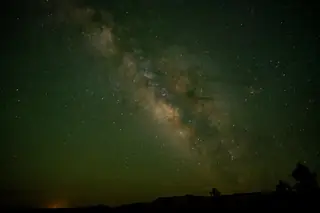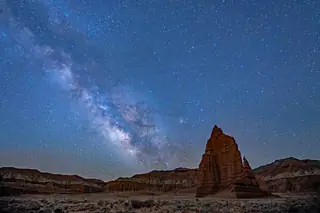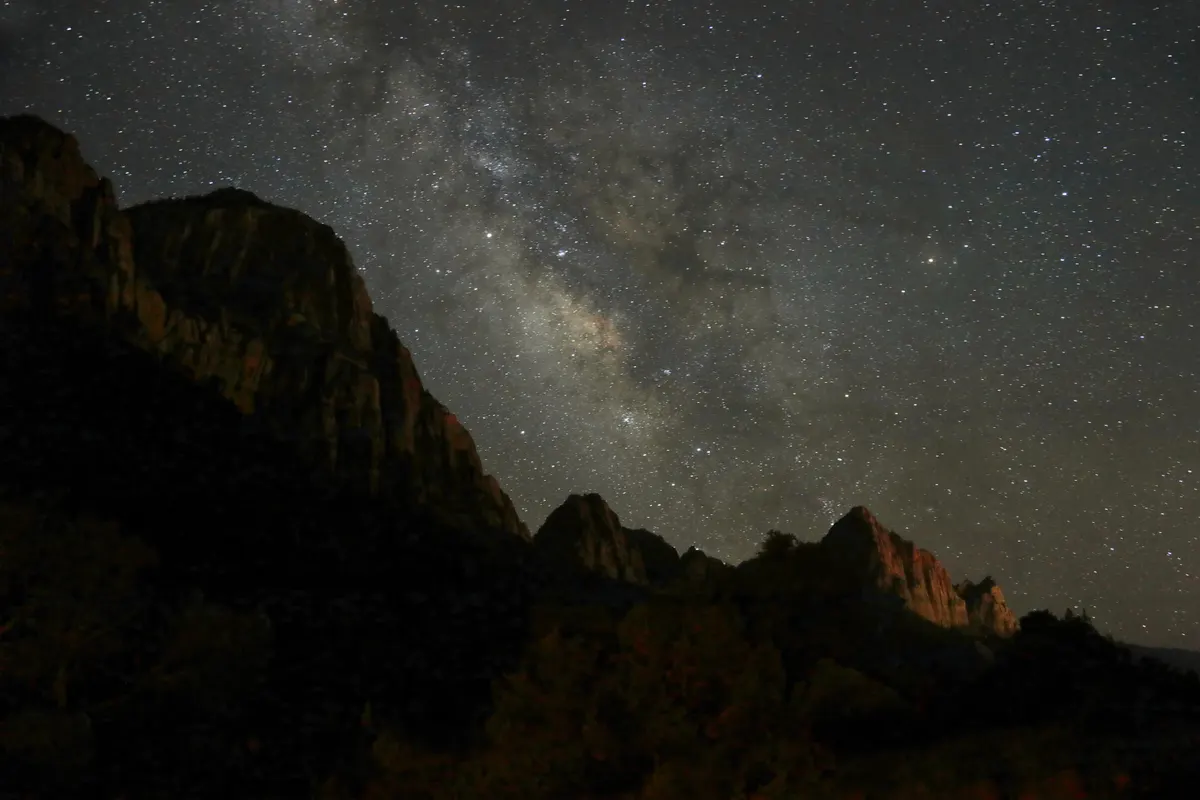
The core clears 10 degrees during full darkness on most nights from February to October. In January, November and December it's out of reach, either too close to the Sun or too low in the dark.
Core score by month
| Month | Core score | Best week | Moon-free core hours a night | Average cloud |
|---|---|---|---|---|
| January | 0 | Core not visible | 0 | 47% |
| February | 5 | February 10 to 16 | 0.4 | 49% |
| March | 21 | March 10 to 16 | 1.6 | 47% |
| April | 39 | April 6 to 12 | 2.6 | 41% |
| May | 60 | May 3 to 9 | 3.7 | 35% |
| June | 78 | June 1 to 7 | 4.9 | 22% |
| July | 62 | July 1 to 7 | 4.7 | 38% |
| August | 54 | August 1 to 7 | 3.0 | 30% |
| September | 27 | September 21 to 27 | 1.4 | 23% |
| October | 7 | October 1 to 7 | 0.4 | 30% |
| November | 0 | Core not visible | 0 | 38% |
| December | 0 | Core not visible | 0 | 51% |
Times are for the best seven nights in each month. Moon-free means the moon is below the horizon. The core counts as visible above 10 degrees in full darkness, when the Sun is more than 18 degrees below the horizon.
The best nights in 2027
- May: May 8 is the best night. The core is above 10 degrees and the moon is down from 1:02 am to 4:42 am, with the moon 11% lit that night.
- June: June 5 is the best night. The core is above 10 degrees and the moon is down from 11:12 pm to 4:12 am, with the moon 3% lit that night.
- July: July 1 is the best night. The core is above 10 degrees and the moon is down from 10:52 pm to 3:42 am, with the moon 5% lit that night.
Clock times are Mountain time with daylight saving applied. The best nights fall around the new moon, so the dates shift by about 11 days each year.
About Zion National Park
Zion in southwestern Utah is a narrow canyon with red and cream sandstone cliffs, some of them 2,000 feet tall, above the Virgin River. You can wade the Narrows, hike up to Angels Landing, or just take the shuttle and look up. The canyon floor stays green, a contrast to the desert around it.
Mormon settlers gave Zion its name in the 1860s, a word meaning refuge. The Southern Paiute people had lived here long before. It became Mukuntuweap National Monument in 1909 and was renamed Zion National Park in 1919.
Zion National Park is a national park in Utah. The National Park Service places its center at 37.30 degrees north and 113.03 degrees west, and the sky calculations on this page use that point. Visitor information, fees and alerts are on the park's own page. National Park Service (opens in a new tab).
How Zion National Park compares
Its best monthly core score of 78 ranks 5 of 54 national park units that can see the core. The highest is Lassen Volcanic National Park at 86, and the lowest is Voyageurs National Park at 13. Cloud at Zion National Park runs from 22% in June to 51% in December.
The score ranks months and parks. It isn't a forecast for any night, and it leaves out local weather, smoke and light from nearby towns. How the core score works.
How dark is the sky?
The Park Service models how much artificial light brightens the sky across the lower 48. At the point used for Zion National Park, it puts the added glow at about 28% of the natural brightness of a moonless sky (a ratio of 0.285). That makes it 24th darkest of the 47 parks it covers. Lower is darker. This is a model, not a reading taken at the park, and it describes one point, so the edges of a large park can differ.
Questions people ask
When is the best time to see the Milky Way at Zion National Park?
May, June and July are the best months. The best week of 2027 is June 1 to 7.
Can you see the Milky Way at Zion National Park all year?
The core clears 10 degrees during full darkness on most nights from February to October. In January, November and December it's out of reach, either too close to the Sun or too low in the dark.
How dark is the sky at Zion National Park?
The Park Service models how much artificial light brightens the sky across the lower 48. At the point used for Zion National Park, it puts the added glow at about 28% of the natural brightness of a moonless sky (a ratio of 0.285). That makes it 24th darkest of the 47 parks it covers. Lower is darker. This is a model, not a reading taken at the park, and it describes one point, so the edges of a large park can differ.
Does the moon matter at Zion National Park?
Yes. A bright moon hides the Milky Way. The best night in June is June 5, when the moon is 3% lit and the core is above 10 degrees from 11:12 pm to 4:12 am.
A canyon with walls in the way
Zion was certified as an International Dark Sky Park in a Park Service announcement dated June 3, 2021. The Service describes the program as non-regulatory and voluntary, which means it rests on the park choosing to keep its lighting down.
Canyon walls change how the night plays out. From the Pa'rus Trail the Moon can take more than an hour to clear the walls after its listed moonrise, so the dark window can start later than a moonrise table suggests. In June and July it isn't fully dark until after 10 pm Mountain Time. The sky is darkest from about 1.5 hours after sunset until 1.5 hours before sunrise, and your eyes need 20 to 30 minutes to adjust.
Where to go
The Park Service lists Pa'rus Trail and the Human History Museum patio in the canyon, reached by shuttle for most of the year, and says the darkest areas are on the east side and along Kolob Terrace Road. Checkerboard Mesa pull-off, Lava Point Overlook and the Timber Creek lot suit telescopes. Lava Point closes seasonally when snow falls.
Seasons help you plan. The Milky Way is best in August and September, the Perseids peak in mid-August and the Geminids in mid-December. Our pages on the Perseids and Geminids give the dates.
How it fits our numbers
In our 2027 numbers, Zion peaks in June with a core score of 78 out of 100. The best week is June 1 to 7, with about 4.9 moon-free hours a night and average cloud near 22 percent. That lines up with the Park Service's August and September advice for the Milky Way overhead, and the canyon walls mean the real window can start later than the table says.