What this guide is for
This guide ranks national park units by how good their best month is for seeing the Milky Way core, and gives each park its own best dates. Each score counts the dark hours when the core is above the horizon and the Moon isn't, then reduces it by the typical cloud over the park. The method is explained at the end of this page, and each park page repeats the inputs for its own location.
Beyond the Milky Way
The core is only one thing overhead. For events with fixed dates, see the sky calendar, which covers eclipses, planets and meteor showers. For what the galaxy is made of and what we still don't know about it, start with the mysteries section.
The top six
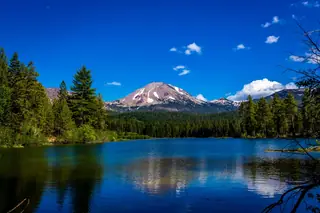 Lassen Volcanic National ParkBest months: June, July and August. Top score 86.
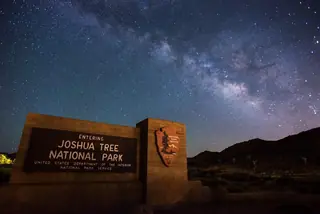 Joshua Tree National ParkBest months: May, June and July. Top score 85.
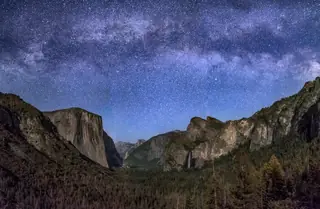 Yosemite National ParkBest months: June, July and August. Top score 82.
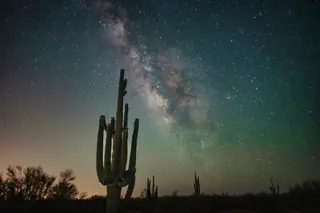 Saguaro National ParkBest months: April, May and June. Top score 79.
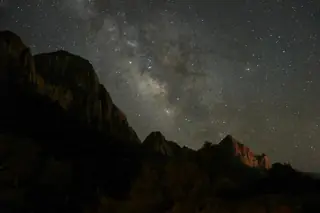 Zion National ParkBest months: May, June and July. Top score 78.
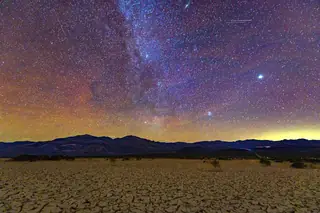 Death Valley National ParkBest months: May, June and July. Top score 77.
Every park, ranked
| Rank | Park | State | Core height | Best months | Top score |
|---|---|---|---|---|---|
| 1 | Lassen Volcanic National Park | CA | 21° | June, July and August | 86 |
| 2 | Joshua Tree National Park | CA | 27° | May, June and July | 85 |
| 3 | Yosemite National Park | CA | 23° | June, July and August | 82 |
| 4 | Saguaro National Park | AZ | 29° | April, May and June | 79 |
| 5 | Zion National Park | UT | 24° | May, June and July | 78 |
| 6 | Death Valley National Park | CA, NV | 25° | May, June and July | 77 |
| 7 | Sequoia & Kings Canyon National Parks | CA | 24° | June, July and August | 77 |
| 8 | Bryce Canyon National Park | UT | 24° | May, June and July | 74 |
| 9 | Grand Canyon National Park | AZ | 25° | May, June and July | 74 |
| 10 | Pinnacles National Park | CA | 25° | May, June and July | 74 |
| 11 | Petrified Forest National Park | AZ | 26° | April, May and June | 73 |
| 12 | Crater Lake National Park | OR | 18° | June, July and August | 72 |
| 13 | Great Basin National Park | NV | 22° | June, July and August | 71 |
| 14 | Mesa Verde National Park | CO | 24° | May, June and July | 70 |
| 15 | Arches National Park | UT | 22° | May, June and July | 69 |
| 16 | Canyonlands National Park | UT | 23° | May, June and July | 69 |
| 17 | White Sands National Park | NM | 28° | April, May and June | 69 |
| 18 | Big Bend National Park | TX | 32° | April, May and June | 68 |
| 19 | Guadalupe Mountains National Park | TX | 29° | April, May and June | 67 |
| 20 | Carlsbad Caverns National Park | NM | 29° | May, June and July | 65 |
| 21 | Capitol Reef National Park | UT | 23° | May, June and July | 64 |
| 22 | Haleakalā National Park | HI | 40° | May, July and August | 64 |
| 23 | Black Canyon of the Gunnison National Park | CO | 22° | May, June and July | 61 |
| 24 | Great Sand Dunes National Park & Preserve | CO | 23° | May, June and July | 61 |
| 25 | Dry Tortugas National Park | FL | 36° | April, May and June | 60 |
| 26 | Virgin Islands National Park | VI | 43° | April, July and August | 57 |
| 27 | Gateway Arch National Park | MO | 22° | June, July and August | 53 |
| 28 | Channel Islands National Park | CA | 27° | April, May and June | 51 |
| 29 | Hot Springs National Park | AR | 26° | June, July and August | 51 |
| 30 | Biscayne National Park | FL | 36° | April, May and July | 50 |
| 31 | Everglades National Park | FL | 36° | April, May and July | 50 |
| 32 | Grand Teton National Park | WY | 17° | June, July and August | 50 |
| 33 | Hawaiʻi Volcanoes National Park | HI | 42° | June, July and August | 50 |
| 34 | Indiana Dunes National Park | IN | 19° | June, July and August | 50 |
| 35 | Congaree National Park | SC | 27° | May, June and July | 49 |
| 36 | Rocky Mountain National Park | CO | 21° | June, July and August | 49 |
| 37 | Badlands National Park | SD | 17° | June, July and August | 48 |
| 38 | Mammoth Cave National Park | KY | 24° | June, July and August | 48 |
| 39 | Wind Cave National Park | SD | 18° | June, July and August | 47 |
| 40 | National Park of American Samoa | AS | 75° | July, August and September | 45 |
| 41 | Yellowstone National Park | ID, MT, WY | 16° | June, July and August | 45 |
| 42 | Great Smoky Mountains National Park | NC, TN | 26° | May, June and July | 43 |
| 43 | Shenandoah National Park | VA | 23° | May, June and July | 42 |
| 44 | New River Gorge National Park & Preserve | WV | 23° | May, June and July | 39 |
| 45 | Cuyahoga Valley National Park | OH | 20° | June, July and August | 38 |
| 46 | Mount Rainier National Park | WA | 14° | June, July and August | 37 |
| 47 | Redwood National and State Parks | CA | 20° | May, June and July | 36 |
| 48 | Acadia National Park | ME | 17° | June, July and August | 29 |
| 49 | Theodore Roosevelt National Park | ND | 14° | May, June and July | 28 |
| 50 | Olympic National Park | WA | 13° | June, July and August | 21 |
| 51 | Glacier National Park | MT | 12° | May, June and July | 14 |
| 52 | Isle Royale National Park | MI | 13° | May, June and July | 13 |
| 53 | North Cascades National Park | WA | 12° | May, June and July | 13 |
| 54 | Voyageurs National Park | MN | 13° | May, June and July | 13 |
Darkest and brightest skies
Separate from the core score, the Park Service has modelled how much artificial light brightens the sky over the lower 48. Lower numbers are darker.
Darkest five
- Big Bend National Park: ratio 0.011
- Yellowstone National Park: ratio 0.016
- Great Basin National Park: ratio 0.02
- Capitol Reef National Park: ratio 0.029
- Canyonlands National Park: ratio 0.036
Brightest five
- Gateway Arch National Park: ratio 60.991
- Cuyahoga Valley National Park: ratio 21.352
- Indiana Dunes National Park: ratio 16.208
- Saguaro National Park: ratio 12.415
- Hot Springs National Park: ratio 7.367
The ratio compares artificial sky brightness with the natural brightness of a moonless sky. 47 parks are covered. Hawaii, American Samoa, the Virgin Islands and a few offshore parks have no value in the model. Source: National Park Service, read at each park's reference point.
Eight of Alaska's national parks aren't in the table, because from there the core never gets high enough to see. Why, and what you can see instead.
How the core score works
The score runs from 0 to 100. For each month it takes the best seven nights and averages the hours when the galactic core is more than 10 degrees above the horizon, the Sun is more than 18 degrees below it and the Moon is below the horizon. It caps that at four hours, then multiplies by the share of the month the park isn't under cloud on average. A score of 0 means the core can't be seen that month, or the Moon is up whenever it is.
The positions of the Sun, Moon and core are calculated from published formulas and checked against known moon phases and equinoxes. Cloud is a monthly NASA satellite average from 2001 to 2025 for a grid cell roughly 100 km across, covering day and night. The score doesn't include local weather, smoke, haze, light from nearby towns. The modelled sky glow figures are shown separately. It ranks months and parks. It isn't a forecast for any night.
The core is the brightest part of the Milky Way. The fainter band through Cygnus and Cassiopeia is high in the evening sky from late summer into autumn, when the core is out of reach.