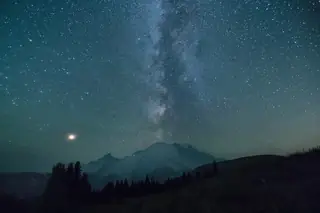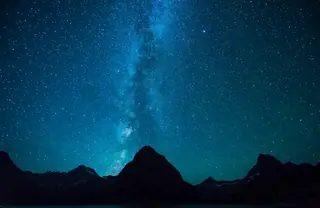
The core clears 10 degrees during full darkness on most nights from April to August. In January, February, March, September, October, November and December it's out of reach, either too close to the Sun or too low in the dark.
Core score by month
| Month | Core score | Best week | Moon-free core hours a night | Average cloud |
|---|---|---|---|---|
| January | 0 | Core not visible | 0 | 76% |
| February | 0 | Core not visible | 0 | 71% |
| March | 0 | No moon-free core hours | 0 | 76% |
| April | 2 | April 8 to 14 | 0.3 | 74% |
| May | 6 | May 4 to 10 | 0.9 | 70% |
| June | 11 | June 1 to 7 | 1.3 | 67% |
| July | 13 | July 1 to 7 | 0.9 | 42% |
| August | 6 | August 1 to 7 | 0.4 | 44% |
| September | 0 | Core not visible | 0 | 52% |
| October | 0 | Core not visible | 0 | 68% |
| November | 0 | Core not visible | 0 | 76% |
| December | 0 | Core not visible | 0 | 76% |
Times are for the best seven nights in each month. Moon-free means the moon is below the horizon. The core counts as visible above 10 degrees in full darkness, when the Sun is more than 18 degrees below the horizon.
The best nights in 2027
- May: May 9 is the best night. The core is above 10 degrees and the moon is down from 2:14 am to 3:04 am, with the moon 19% lit that night.
- June: June 1 is the best night. The core is above 10 degrees and the moon is down from 12:44 am to 1:54 am, with the moon 8% lit that night.
- July: July 1 is the best night. The core is above 10 degrees and the moon is down from 12:44 am to 1:34 am, with the moon 5% lit that night.
Clock times are Pacific time with daylight saving applied. The best nights fall around the new moon, so the dates shift by about 11 days each year.
About North Cascades National Park
North Cascades is a steep, wild park in northern Washington that people call the American Alps. It has more than 300 glaciers and jagged peaks, and many are seen only on long hikes. Diablo Lake and Ross Lake, in the recreation area between the park's two halves, are turquoise from glacial silt.
The park was created in 1968 after years of debate between conservationists and the logging industry. Stehekin, a small community at the head of Lake Chelan, can be reached only by boat, floatplane or foot.
North Cascades National Park is a national park in Washington. The National Park Service places its center at 48.71 degrees north and 121.21 degrees west, and the sky calculations on this page use that point. Visitor information, fees and alerts are on the park's own page. National Park Service (opens in a new tab).
How North Cascades National Park compares
Its best monthly core score of 13 ranks 53 of 54 national park units that can see the core. The highest is Lassen Volcanic National Park at 86, and the lowest is Voyageurs National Park at 13. Cloud at North Cascades National Park runs from 42% in July to 76% in November.
The score ranks months and parks. It isn't a forecast for any night, and it leaves out local weather, smoke and light from nearby towns. How the core score works.
How dark is the sky?
The Park Service models how much artificial light brightens the sky across the lower 48. At the point used for North Cascades National Park, it puts the added glow at about 22% of the natural brightness of a moonless sky (a ratio of 0.216). That makes it 21st darkest of the 47 parks it covers. Lower is darker. This is a model, not a reading taken at the park, and it describes one point, so the edges of a large park can differ.
Questions people ask
When is the best time to see the Milky Way at North Cascades National Park?
May, June and July are the best months. The best week of 2027 is July 1 to 7.
Can you see the Milky Way at North Cascades National Park all year?
The core clears 10 degrees during full darkness on most nights from April to August. In January, February, March, September, October, November and December it's out of reach, either too close to the Sun or too low in the dark.
How dark is the sky at North Cascades National Park?
The Park Service models how much artificial light brightens the sky across the lower 48. At the point used for North Cascades National Park, it puts the added glow at about 22% of the natural brightness of a moonless sky (a ratio of 0.216). That makes it 21st darkest of the 47 parks it covers. Lower is darker. This is a model, not a reading taken at the park, and it describes one point, so the edges of a large park can differ.
Does the moon matter at North Cascades National Park?
Yes. A bright moon hides the Milky Way. The best night in July is July 1, when the moon is 5% lit and the core is above 10 degrees from 12:44 am to 1:34 am.