Seven spacecraft, forty-four years
The spacecraft on this hub were launched across more than four decades, from the two Voyagers in 1977 to the James Webb Space Telescope in 2021, and between them they've visited Jupiter, Saturn, Uranus, Neptune and Pluto, flown through the Sun's atmosphere and reached the edge of interstellar space. Each has its own page, written the same way: the mission in plain terms, a table of dates and numbers, a ledger that separates what was measured from what's inferred, and a note on what's still unknown.
Voyager 1 and Voyager 2 are the oldest, and both are now in interstellar space. Voyager 2 is still the only spacecraft to have visited Uranus and Neptune. Cassini spent 13 years at Saturn and ended with a deliberate dive into the planet in 2017. New Horizons gave us the first close look at Pluto and then flew on to a much smaller object in the Kuiper Belt. Juno is mapping the inside of Jupiter, and Parker Solar Probe flew through the Sun's corona.
The James Webb Space Telescope is a different kind of probe: it doesn't visit anything. It sits about 1.5 million kilometers from Earth and looks outward in infrared light, which is how it can see the faint, stretched light of very distant galaxies.
Figures come from NASA and ESA mission pages, and every page lists its sources at the end. Where a figure is a calculation of ours rather than a published number, the text says so. The spacecraft also connect to the rest of the site: several of them are the reason we know anything about the moons on the next hub, and the longest-lived ones are the best way to feel the distances on the scale of the solar system page. If you're new to the subject, a good order is to start with Voyager 1, because its numbers are the easiest to picture, then Cassini and New Horizons for the outer planets, and finish with Webb, which asks the biggest questions. Nothing here needs any background, and every table is there to be skimmed.
| Mission | Launched | Where | Why it matters |
|---|---|---|---|
| Voyager 1 | 5 September 1977 | Interstellar space | The most distant object humans have made |
| Voyager 2 | 20 August 1977 | Jupiter, Saturn, Uranus, Neptune | The only visit to Uranus and Neptune |
| Cassini-Huygens | 15 October 1997 | Saturn and Titan | Ocean worlds at Saturn, then a planned dive |
| New Horizons | 19 January 2006 | Pluto and the Kuiper Belt | First look at Pluto, then Arrokoth |
| Juno | 5 August 2011 | Jupiter | What's inside the giant planet |
| Parker Solar Probe | 12 August 2018 | The Sun's corona | The first spacecraft to fly through the Sun's atmosphere |
| James Webb Space Telescope | 25 December 2021 | The second Sun-Earth Lagrange point | An infrared telescope with an 18-segment mirror |
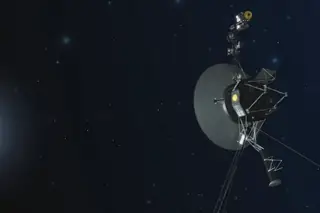 Voyager 1The most distant object humans have made.
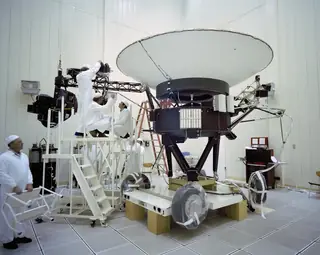 Voyager 2The only spacecraft to visit Uranus and Neptune.
 Cassini-HuygensThirteen years in orbit at Saturn.
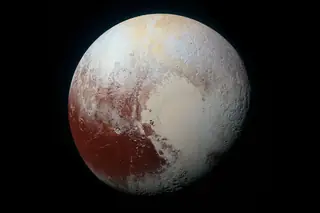 New HorizonsPluto, Arrokoth and the long way out.
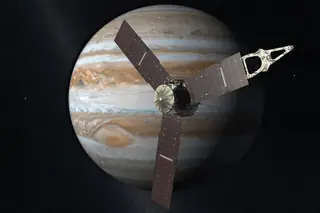 JunoInside Jupiter.
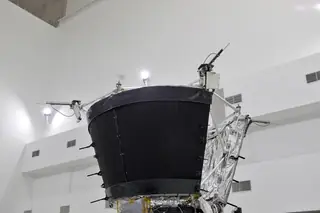 Parker Solar ProbeFlying through the Sun's atmosphere.
 James Webb Space TelescopeAn infrared observatory a million miles away.
Each page keeps measured results apart from inferences and open questions. Where a result is new or disputed, the page says so, and the sources box lists the NASA page or paper behind every figure.
Questions people ask
Which spacecraft are in interstellar space?
Voyager 1 and Voyager 2. Voyager 2 crossed the heliopause on 5 November 2018, and Voyager 1 crossed in 2012.
Which spacecraft has been closest to the Sun?
Parker Solar Probe, the first spacecraft to fly through the Sun's corona.
Which probe visited Pluto?
New Horizons, on 14 July 2015.