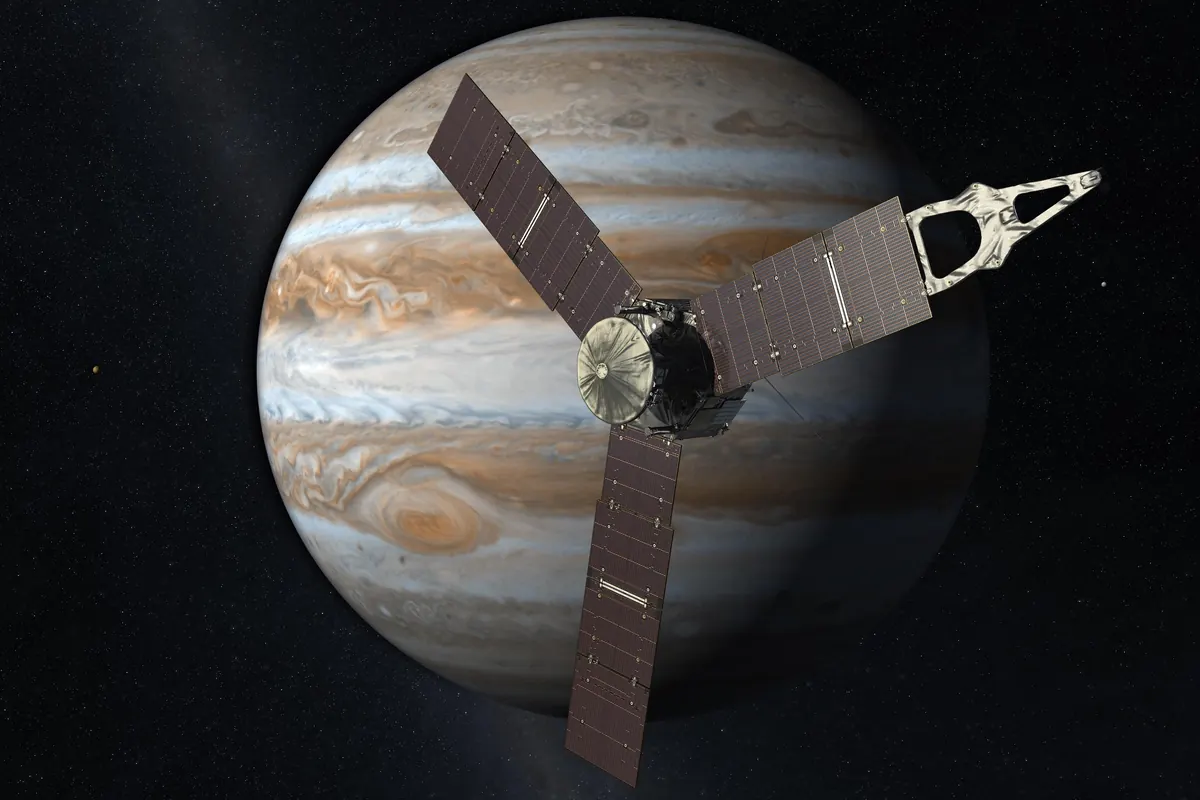
Putting the depth in proportion
Juno's headline numbers sound deep until you set them against the size of Jupiter. The planet's radius is roughly 70,000 kilometers. The belts and zones reach down about 3,000 kilometers, which is only around four percent of the way to the center. The Great Red Spot goes down about 320 kilometers while being roughly 16,000 kilometers across, so it's a very wide, very thin storm, closer to a pancake than a column.
That's why Juno matters for the old question of what Jupiter is made of. Weather is only the outermost layer. The gravity measurements are what see through it, because the spacecraft feels the pull of whatever is down there, and the result, a core that looks dilute, or fuzzy, rather than a small solid ball, is a statement about the whole planet.
A long road and a few small passengers
Getting there was slow. Juno left on 5 August 2011 and arrived on 4 July 2016, covering about 2.8 billion kilometers (1.7 billion miles) in just under five years, which works out to a bit over 65,000 kilometers per hour on average. Juno is named for the Roman goddess who was Jupiter's wife and, in the myth, could see through the clouds he hid behind. The spacecraft carries three small LEGO figures of Juno, Jupiter and Galileo, a detail NASA has shared about the mission.
Its electronics sit in a titanium vault, because Jupiter's radiation is harsh enough to damage ordinary hardware. That radiation is also why the orbit is so stretched: the spacecraft spends most of each loop far from the planet and darts in for a short, fast pass.
A spacecraft that spins like a top
Juno's main body is about 3.5 m across, and its three solar arrays give it a width of more than 20 m. It spins twice a minute, which keeps it steady and lets its fixed instruments sweep across Jupiter. It was the first solar-powered spacecraft to operate at Jupiter, the first to orbit an outer planet from pole to pole, and the closest orbiter to Jupiter, grazing the planet's radiation belts. A pass from pole to pole takes about two hours, and its first orbit took 53 days.
What it measured inside Jupiter
| Where | What Juno found |
|---|---|
| Belts and zones | The jet streams extend about 3,000 km below the cloud tops. |
| Core | NASA says it's dilute, or fuzzy, rather than a small solid ball. |
| North pole | A central cyclone surrounded by eight more, 4,000 km across each, that don't merge. |
| South pole | A central cyclone with others around it, a pattern a new cyclone later muscled into. |
| Magnetic field | In places more than 30 times as strong as Earth's. |
| Great Red Spot | Roots about 320 km deep, and shrinking from twice Earth's size in 1979 to 1.3 times Earth's size. |
| Auroras | Electrical energies up to 400,000 electron volts, against a few thousand on Earth. |
| Water | More abundant near the equator, which explained why the Galileo probe found one-tenth of the water expected. |
Looking at the moons
The primary mission finished in mid-2021, and in the extended mission Juno turned to the moons. It has watched Io since April 2022, with its closest looks in December 2023 and February 2024, flew past Ganymede on 7 June 2021 and Europa on 29 September 2022, and used its microwave radiometer to help measure the thickness of Europa's ice shell. See Io and Ganymede.
NASA says Juno's end-of-life plan is to let its orbit decay until Jupiter's gravity pulls it in. NASA's mission page still describes the spacecraft as operating.
Measured: we know this
- The belts and zones of Jupiter extend about 3,000 km deep.
- The Great Red Spot's roots run about 320 km down, and the spot has shrunk from twice Earth's size to 1.3 times Earth's size.
- Jupiter's magnetic field is more than 30 times stronger than Earth's in places.
- The north pole has a central cyclone with eight more around it, each about 4,000 km across.
Inferred: we think this
- Jupiter's core is dilute, with no sharp boundary between it and the surrounding hydrogen. NASA says Juno data suggest this.
- Liquid metallic hydrogen deep inside the planet is thought to generate the strong field.
Unknown: we don't know
- How Jupiter formed. Its composition is a record of the early solar system, but exactly how it gathered its gas is unclear.
- The cause of Jupiter's Great Blue Spot, a localized magnetic feature that's drifting eastward and would circle the planet in about 350 years.
What would settle it
- More orbits, and visiting spacecraft: ESA's Juice (launched April 2023, due at Jupiter in July 2031) and NASA's Europa Clipper (due in April 2030).
In human terms
- The trip to Jupiter covered about 2.8 billion km (1.7 billion miles) and took five years.
- NASA compares the depth of the Great Red Spot's roots with 50 to 100 times the depth of Earth's oceans.
Questions people ask
When did Juno reach Jupiter?
Juno entered orbit on 4 July 2016, five years after launching on 5 August 2011.
What has Juno found?
That Jupiter's belts and zones run deep, that its core is partly dissolved, that its magnetic field is much stronger than expected, and that its poles are full of giant cyclones.
What will happen to Juno?
NASA says its orbit will eventually degrade and Jupiter's gravity will pull the spacecraft into the atmosphere, where it will be destroyed.
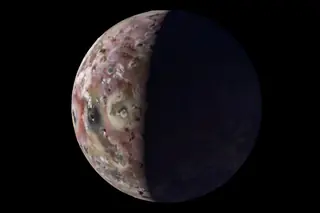 IoThe most volcanic world in the solar system.
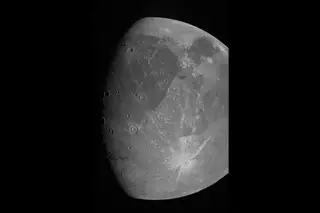 GanymedeThe largest moon, with its own magnetic field.
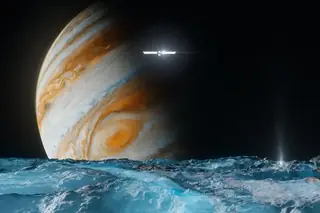 EuropaAn ocean under the ice.All probesEvery spacecraft page on the site.
Reading the auroras
The aurora figure is worth a second look. Juno measured particles with energies up to about 400,000 electron volts, while the particles that make auroras on Earth are typically a few thousand. That gap is a direct sign of how much more power Jupiter's magnetic field puts into its polar lights, and it fits with a field about 30 times stronger than Earth's in places.
The same field is what makes Jupiter's moons interesting to measure. Ganymede is the one moon in the solar system known to have a magnetic field of its own, and Io sits inside Jupiter's field and feeds material into it. Juno's flybys of both, and of Europa, let the same spacecraft that studies the planet look at the moons embedded in its environment.
What changes when Juno stops
NASA's plan is for Juno's orbit to decay until Jupiter's gravity pulls it into the atmosphere, so the mission has a definite end even if the date isn't fixed here. The next chapter is already on the calendar: the European Space Agency's JUICE launched in April 2023 and is due at Jupiter in July 2031, and NASA's Europa Clipper is due in April 2030. Those two will look at the moons in much more detail. Juno's contribution to them is a map of the planet's gravity, magnetic field and radiation that was measured from the inside.