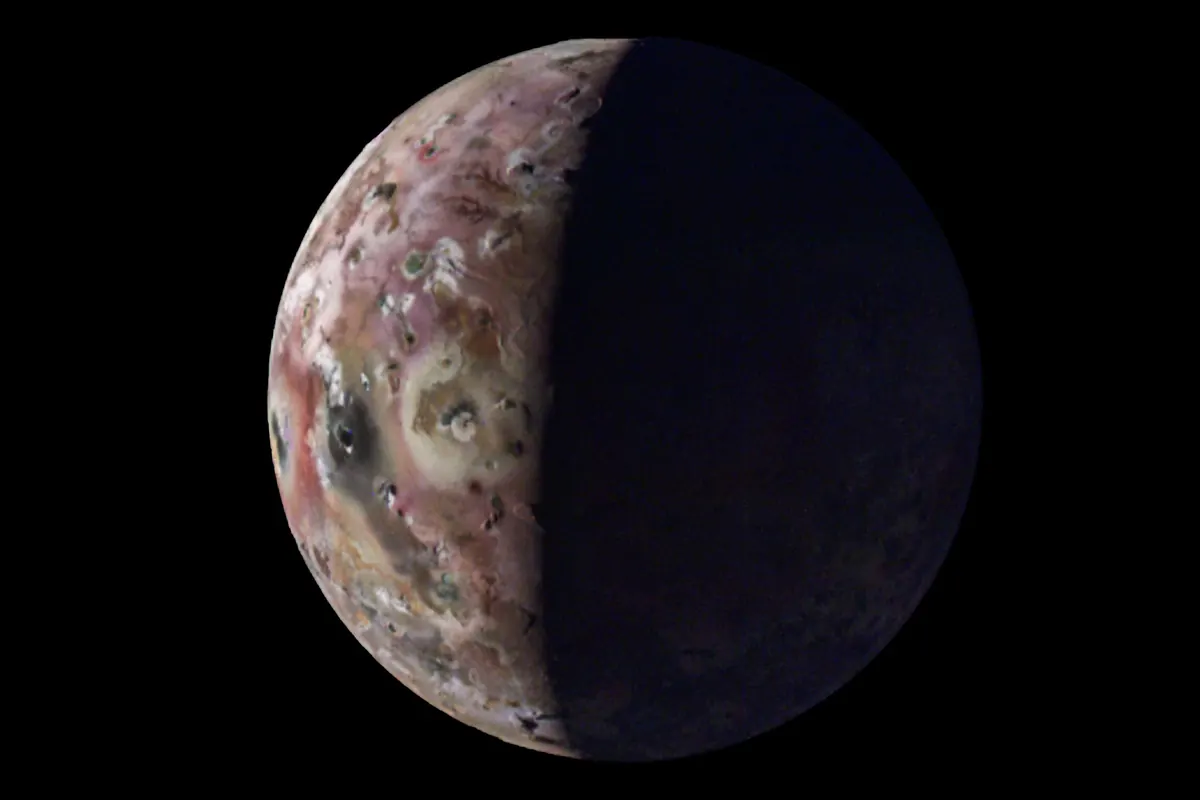
The densest of the big moons
Io's density is 3,530 kilograms per cubic meter, the highest of the four Galilean moons, which means it's mostly rock and metal with little water left. Its radius is 1,821.5 kilometers and it goes around Jupiter in 1.76 days at a distance of 421,800 kilometers, closer than any of the other three.
Surface gravity works out at about 1.8 meters per second squared (my calculation from NASA's mass and radius), around 18 percent of Earth's, and Io has almost no atmosphere. Those two facts help explain why the volcanic fountains rise so high. There's little gravity to pull the material back down and little air to slow it.
Found in a picture
The volcanoes were a surprise when Voyager 1 revealed them in March 1979. A member of the navigation team, Linda Morabito, noticed a bright arc above the edge of Io in an image taken to check the spacecraft's position, and it turned out to be a volcanic plume. Before that, nobody had seen an active volcano on another world.
A tug of war
Io is caught between Jupiter's huge gravity and the smaller but precisely timed pulls of two neighboring moons farther out, Europa and Ganymede. That repeated squeezing heats the interior and drives the volcanoes. Io is only slightly larger than Earth's Moon, about one-quarter the diameter of Earth. Some of its eruptions are powerful enough to be seen with big telescopes on Earth, and it has lakes of molten silicate lava.
How we know
Voyager 1 spotted the first signs of Io's volcanism in 1979. The Galileo spacecraft later studied it in detail. Juno has been watching Io since April 2022, with its closest passes on 30 December 2023 and in February 2024, and its JunoCam returned the first image of the moon's south polar region.
| Moon | Radius (km) | Density (kg per cubic meter) | Distance from Jupiter (thousand km) | Orbit (days) |
|---|---|---|---|---|
| Io | 1,821.5 | 3,530 | 421.8 | 1.769138 |
| Europa | 1,560.8 | 3,010 | 671.1 | 3.551181 |
| Ganymede | 2,631.2 | 1,940 | 1,070.4 | 7.154553 |
| Callisto | 2,410.3 | 1,830 | 1,882.7 | 16.689017 |
Is there a magma ocean?
Io's heat made scientists wonder whether a shallow ocean of molten rock lies under the crust. Gravity measurements from two Juno flybys, combined with earlier Galileo data, gave a tidal response (a number called k2) of 0.125 plus or minus 0.047. The authors of the 2025 Nature paper conclude that this is consistent with a mostly solid mantle and no shallow global magma ocean. They suggest melt may collect in pockets and escape through eruptions, rather than forming a global sea.
Measured: we know this
- Io has hundreds of volcanoes, and some lava fountains reach dozens of miles (or kilometers) high.
- It has lakes of molten silicate lava.
- Io's tidal response, measured from Juno and Galileo data, is 0.125 plus or minus 0.047.
Inferred: we think this
- Io has a mostly solid mantle and no shallow global magma ocean, according to Park et al., Nature 638 (2025). Other teams have argued for a magma ocean, so the picture is still debated.
- Tidal heating from Jupiter and the neighboring moons powers the volcanoes.
Unknown: we don't know
- Where the melt that feeds the volcanoes is stored, and how it gets to the surface.
- Whether any ocean of melt exists deeper down. The 2025 result rules out only a shallow one.
What would settle it
- More Juno flybys of Io, and measurements of its tides over a longer time.
In human terms
- Io is only slightly larger than Earth's Moon, but its lava fountains reach dozens of miles (or kilometers) high.
- It orbits Jupiter in less than two Earth days, closer than any of the other big moons.
Questions people ask
Why is Io so volcanic?
Jupiter's gravity and the timed pulls of Europa and Ganymede keep squeezing Io, which heats its interior and drives hundreds of volcanoes.
Does Io have a magma ocean?
Gravity data from Juno and Galileo suggest it doesn't have a shallow global one. It's more likely to have a mostly solid mantle, with pockets of melt.
Which spacecraft have studied Io?
Voyager 1 first spotted the volcanoes in 1979. Galileo made the most detailed study, and Juno has been watching since April 2022.
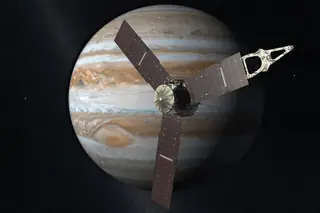 JunoThe orbiter that has been watching Io.
 GanymedeThe largest moon in the solar system.
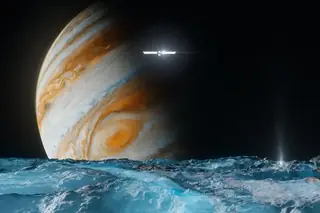 EuropaThe ocean under the ice.All moonsEvery moon page on the site.
What the tidal number means
The measurement in the ledger, a tidal response of 0.125 plus or minus 0.047, describes how much Io's shape changes as Jupiter's pull on it rises and falls. A body with a thick, global layer of melt just under the crust would flex more easily, and would be expected to show a larger number. The reading from Juno and Galileo data is lower, which is why the authors concluded that Io has a mostly solid mantle and no shallow global magma ocean.
That doesn't mean there's no magma. It means a shallow, moon-wide ocean of it's unlikely, while the volcanoes still need a source. Other teams have argued the opposite, and the argument is still going.
A moon that feeds a planet
Io's volcanoes don't just decorate the moon. Gas from the eruptions escapes into space and is caught in Jupiter's magnetic field, where it forms a donut of charged particles around the planet. That's part of Jupiter's rough radiation environment, which is why a spacecraft like Juno protects its electronics in a vault.
The other two moons matter to Io's story. Europa and Ganymede pull on it at regular intervals, which keeps Io's orbit slightly stretched, and that keeps it flexing and hot. The three moons are a linked system, so a question about one of them is often a question about all three.
Two flybys, one lesson
Juno's close passes of 30 December 2023 and February 2024 are the closest anyone has looked since Galileo. For a moon only slightly larger than ours, Io has an extraordinary amount going on, and a body of that size should normally have cooled and gone quiet long ago, as the Moon has. The tides from Jupiter and the neighboring moons are the answer, and measuring how Io responds to them is how scientists test what lies underneath.