The core clears 10 degrees during full darkness on most nights from February to October. In January, November and December it's out of reach, either too close to the Sun or too low in the dark.
Core score by month
| Month | Core score | Best week | Moon-free core hours a night | Average cloud |
|---|---|---|---|---|
| January | 0 | Core not visible | 0 | 38% |
| February | 11 | February 10 to 16 | 0.7 | 37% |
| March | 33 | March 9 to 15 | 1.9 | 32% |
| April | 57 | April 6 to 12 | 3.1 | 26% |
| May | 81 | May 3 to 9 | 4.2 | 19% |
| June | 85 | June 1 to 7 | 5.5 | 15% |
| July | 73 | July 1 to 7 | 5.3 | 27% |
| August | 67 | August 1 to 7 | 3.4 | 22% |
| September | 34 | September 21 to 27 | 1.7 | 20% |
| October | 10 | October 1 to 7 | 0.5 | 24% |
| November | 0 | Core not visible | 0 | 31% |
| December | 0 | Core not visible | 0 | 39% |
Times are for the best seven nights in each month. Moon-free means the moon is below the horizon. The core counts as visible above 10 degrees in full darkness, when the Sun is more than 18 degrees below the horizon.
The best nights in 2027
- May: May 6 is the best night. The core is above 10 degrees and the moon is down from 12:03 am to 4:13 am, with the moon 1% lit that night.
- June: June 3 is the best night. The core is above 10 degrees and the moon is down from 10:13 pm to 3:43 am, with the moon 0% lit that night.
- July: July 1 is the best night. The core is above 10 degrees and the moon is down from 9:43 pm to 3:13 am, with the moon 5% lit that night.
Clock times are Pacific time with daylight saving applied. The best nights fall around the new moon, so the dates shift by about 11 days each year.
About Joshua Tree National Park
Joshua Tree in Southern California is where the Mojave and Colorado deserts meet. Piles of golden boulders, groves of the odd, spiky trees and wide open desert views make it a favorite with climbers and photographers. It's only a couple of hours from Los Angeles, yet the sky at night is dark in many places.
Mormon settlers are said to have named the tree after the biblical Joshua, since its arms look raised in prayer. Minerva Hoyt campaigned to protect the area, and it became a national monument in 1936 and a national park in 1994.
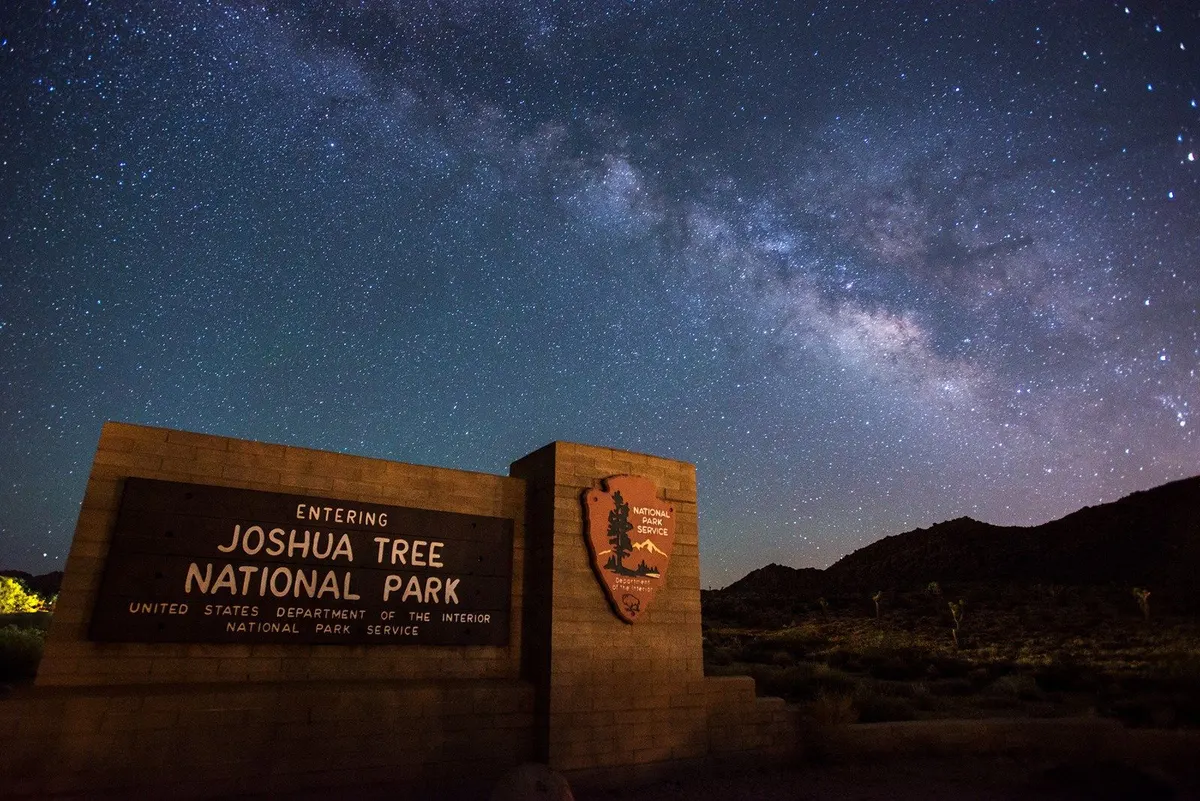
The National Park Service says the Milky Way "is at its best on a moonless summer night" at Joshua Tree. It names the parking lots at Quail Springs, Hidden Valley, Cap Rock and Ryan Mountain as stargazing areas, and recommends Pinto Basin Road between Cholla Cactus Garden and Cottonwood for roadside viewing. National Park Service (opens in a new tab).
How Joshua Tree National Park compares
Its best monthly core score of 85 ranks 2 of 54 national park units that can see the core. The highest is Lassen Volcanic National Park at 86, and the lowest is Voyageurs National Park at 13. Cloud at Joshua Tree National Park runs from 15% in June to 39% in December.
The score ranks months and parks. It isn't a forecast for any night, and it leaves out local weather, smoke and light from nearby towns. How the core score works.
How dark is the sky?
The Park Service models how much artificial light brightens the sky across the lower 48. At the point used for Joshua Tree National Park, it puts the added glow at about 88% of the natural brightness of a moonless sky (a ratio of 0.875). That makes it 32nd darkest of the 47 parks it covers. Lower is darker. This is a model, not a reading taken at the park, and it describes one point, so the edges of a large park can differ.
Questions people ask
When is the best time to see the Milky Way at Joshua Tree National Park?
May, June and July are the best months. The best week of 2027 is June 1 to 7.
Can you see the Milky Way at Joshua Tree National Park all year?
The core clears 10 degrees during full darkness on most nights from February to October. In January, November and December it's out of reach, either too close to the Sun or too low in the dark.
How dark is the sky at Joshua Tree National Park?
The Park Service models how much artificial light brightens the sky across the lower 48. At the point used for Joshua Tree National Park, it puts the added glow at about 88% of the natural brightness of a moonless sky (a ratio of 0.875). That makes it 32nd darkest of the 47 parks it covers. Lower is darker. This is a model, not a reading taken at the park, and it describes one point, so the edges of a large park can differ.
Does the moon matter at Joshua Tree National Park?
Yes. A bright moon hides the Milky Way. The best night in June is June 3, when the moon is 0% lit and the core is above 10 degrees from 10:13 pm to 3:43 am.
Where to park for the night sky
Joshua Tree makes the question of where to stand easy, because it names the places. The Park Service lists four designated stargazing areas, all of them parking lots: Quail Springs, Hidden Valley, Cap Rock and Ryan Mountain. It adds that Cottonwood Campground has the darkest skies, and that Pinto Basin Road between Cholla Cactus Garden and Cottonwood has the least traffic and darkest skies of the roadside pullouts.
The park isn't free of glow. The Park Service says light pollution from surrounding communities does affect the night sky, so some areas are darker than others. That's what you would expect from a park within a few hours' drive of more than 22 million people, a figure the International Dark-Sky Association gave when it designated the park in 2017.
A Silver Tier park with room to improve
The 2017 designation came at the Silver Tier, and the Park Service release said it could rise to Gold with lighting improvements in the Morongo Basin to the north and the Coachella Valley to the west and south. The association's executive director said it had never seen such a complex nomination.
On the programs side, rangers regularly offer night sky talks, and the partner Sky's the Limit Observatory in Twentynine Palms runs its own. The park also hosts an annual Night Sky Festival. Pair this page with Death Valley to compare two desert parks.
If you want to go further out
The Park Service says backcountry camping is an option for visitors who have the necessary skills and knowledge, and it isn't for beginners. For most people the four lots and the campground are the sensible choices.
In our 2027 numbers, Joshua Tree peaks in June with a core score of 85 out of 100. The best week is June 1 to 7, with about 5.5 moon-free hours a night and average cloud near 15 percent. See the Milky Way season hub for how it ranks against the other parks.