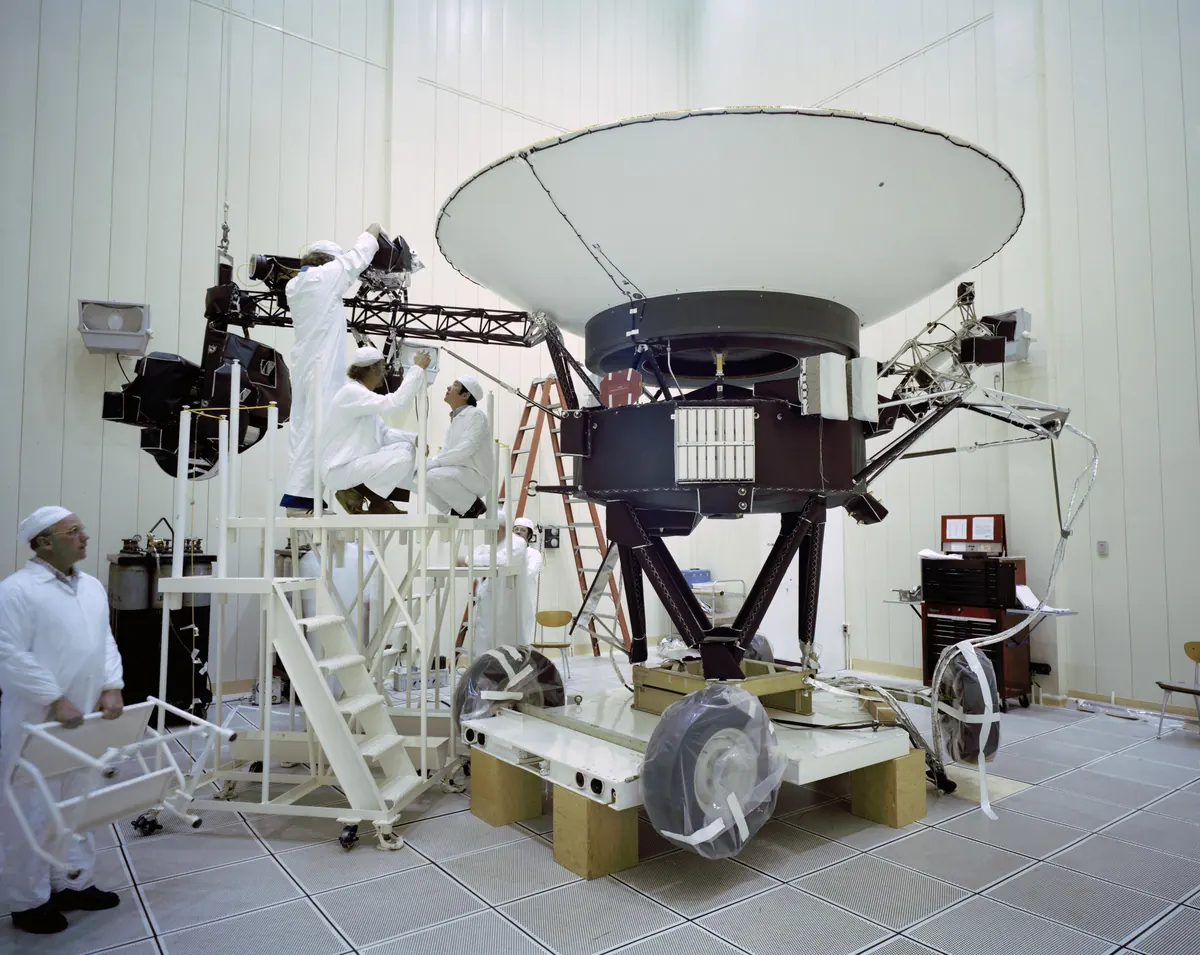
The tour that was cut in half
Voyager 2's route is the result of a cancellation. NASA had planned a Grand Tour: four spacecraft to explore the five outer planets, taking advantage of a planetary lineup. The agency canceled it in January 1972, mainly because of the cost, and replaced it with two spacecraft aimed at Jupiter and Saturn. In 1974 planners proposed that the second one could be redirected on to Uranus and Neptune using gravity assists, if the first mission worked. Jupiter's flyby was partly planned to keep that option open.
The plan worked. Voyager 2 reached Jupiter on 9 July 1979, passing about 645,000 kilometers from the planet, and Saturn on 26 August 1981 at about 101,000 kilometers. Each flyby gave it the push to reach the next planet. That's why NASA's description of it holds today: Voyager 2 is the only spacecraft that has visited Uranus and Neptune, and the only one to study all four giant planets up close. Nothing else has been back.
One pass at Uranus
On 24 January 1986 Voyager 2 passed about 81,500 kilometers from Uranus, and every close-range measurement we have of the planet comes from that single pass. It found 10 new moons and two new rings, and showed that the planet's magnetic field is tilted 55 degrees from its spin axis and doesn't sit at the planet's center. It also flew within 28,260 kilometers of Miranda, a small moon with a jumbled, patchwork surface. A planet with a field that odd, and a spin tipped on its side, remains a puzzle.
Four planets, four flybys
Voyager 2 carried out part of a bigger idea. The original Grand Tour plan, which called for four expensive spacecraft to reach the outer planets, was cancelled in January 1972, largely because of cost (about $1 billion). Two cheaper spacecraft flew instead.
| Planet | Closest approach | Distance | What it found |
|---|---|---|---|
| Jupiter | 9 July 1979 | 645,000 km | Newly found moons and a ring system, 17,000 new pictures, and a Great Red Spot that had drifted and changed shape since the Pioneer flybys. |
| Saturn | August 1981 | 101,000 km | Sharper views of the ring spokes, kinks and the F ring, and data suggesting the A ring is only about 300 meters thick. |
| Uranus | 24 January 1986 | 81,500 km | 10 new moons, two new rings, a magnetic field tilted 55 degrees, and winds up to 724 km/h. |
| Neptune | 25 August 1989 | 4,800 km above the cloud tops | Six new moons, four new rings, winds of 1,100 km/h, a Great Dark Spot, and geysers on Triton. |
Saturn is given as August 1981 because NASA's own Voyager 2 page lists two different days for the closest approach. Distances are from NASA's mission page.
Five and a half hours at Uranus
The Uranus flyby was the tightest part of the schedule. Voyager 2 had only 5.5 hours of close study, in light about 400 times fainter than on Earth, and signals took about two and a half hours to reach the ground. It also flew within 28,260 km of the moon Miranda. The pictures showed a moon whose surface looked like a mixture of unrelated landscapes.
At Neptune, the last planet, the spacecraft capped a trip of about 7 billion km. It flew about 4,800 km over the cloud tops and photographed two thirds of Triton, the largest moon, which NASA calls the coldest known planetary body it had measured, at -235 degrees Celsius.
Leaving the Sun's bubble
Voyager 2 passed the termination shock, where the solar wind slows sharply, on 30 August 2007. On 5 November 2018 its plasma instrument recorded a sudden drop in particles from the Sun and a rise in cosmic rays from outside, which marked the heliopause. It was the second human-made object to get there, after Voyager 1. At 15.4 km/s relative to the Sun, NASA works out that it would take about 19,390 years to cover a single light year.
Measured: we know this
- Voyager 2 flew 4,800 km above Neptune's cloud tops on 25 August 1989, the closest of its four planetary flybys.
- Uranus has a magnetic field tilted 55 degrees off its axis and off its center.
- Neptune's winds reach about 1,100 km/h, and Triton has surface features that look like nitrogen ice geysers.
- It crossed the heliopause on 5 November 2018.
Inferred: we think this
- NASA's account says there's evidence of a boiling ocean of water about 800 km below Uranus's top clouds.
- Data from the Saturn encounter suggested the A ring is only about 300 meters thick.
Unknown: we don't know
- What has changed at Uranus and Neptune since the flybys. No other spacecraft has visited either planet.
- How long the instruments will last. Power falls every year, and engineers have to choose which instruments and thrusters to keep running.
What would settle it
- An orbiter at an ice giant. NASA notes that mission concepts exist that would explore Uranus or Neptune with an approach like Cassini's at Saturn.
In human terms
- At 15.4 km/s, one light year takes about 19,390 years.
- Radio signals from Uranus took about two and a half hours to arrive, so every command sent to Voyager 2 there was a long wait.
Questions people ask
Is Voyager 2 in interstellar space?
Yes. It crossed the heliopause on 5 November 2018, and NASA announced it on 10 December 2018. It's the second spacecraft to do so, after Voyager 1.
Which planets did Voyager 2 visit?
Jupiter, Saturn, Uranus and Neptune. It's the only spacecraft to have studied all four giants at close range, and the only one to have visited Uranus and Neptune.
How is Voyager 2 different from Voyager 1?
Voyager 1 visited Jupiter and Saturn only. Voyager 2 took a longer path on to Uranus and Neptune, using a gravity assist at each planet.
 Voyager 1The most distant object humans have made.
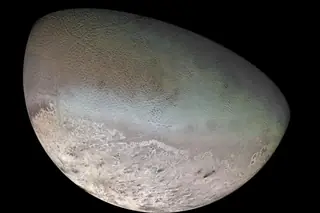 TritonNeptune's backwards moon, seen only by Voyager 2.
 CassiniThirteen years in orbit at Saturn.All probesEvery spacecraft page on the site.
Neptune at the end of the line
The finale came on 25 August 1989, when Voyager 2 passed just 4,800 kilometers above the cloud tops of Neptune, the closest of any of its planetary flybys. It found four new rings and a huge dark storm, the Great Dark Spot. At Triton, Neptune's big moon, it photographed dark plumes rising from a surface of nitrogen ice.
Then the spacecraft's job shrank. In November 1998 NASA permanently turned off nonessential instruments, leaving seven operating, and the mission has been trimming ever since. That's what makes its status in interstellar space, covered above, fragile as well as remarkable.
What the numbers hide
The closest-approach distances in NASA's tables show how different the four encounters were. Voyager 2 passed Jupiter at 645,000 kilometers and Neptune at 4,800, about 134 times closer, and each planet got exactly one pass, in whatever season it happened to be in. For why Uranus is tipped on its side, see the tilt and seasons page.
What to watch next
No spacecraft has returned to Uranus or Neptune since. Until one does, Voyager 2's pictures remain the only close views. Its twin, Voyager 1, took the other route out of the solar system, while New Horizons explored the Kuiper Belt with a very different spacecraft, and Cassini spent thirteen years at the planet that Voyager only passed. If you want to follow the Voyager 2 route in miles and years, the scale of the solar system puts the distances in a size you can walk.