The planet found on paper
Johann Galle, at the Berlin Observatory, received Urbain Le Verrier's letter on the morning of 23 September 1846 and found Neptune on the night of 23 to 24 September 1846. It was only about 1 degree from the position Le Verrier had calculated.
John Couch Adams had made similar calculations in 1845, but British astronomers didn't act in time. Adams later acknowledged that Le Verrier's work led to the discovery. The French astronomer François Arago first called the planet "Le Verrier", but astronomers settled on the neutral name Neptune.
Whether another hidden planet explains oddities farther out is the question on the Planet Nine page.
Neptune was the first planet found by mathematics rather than by looking. Uranus didn't move quite as astronomers expected, so the French mathematician Urbain Le Verrier worked out where an unknown planet should be. He sent his prediction to Johann Galle at the Berlin Observatory, who found Neptune on his first night of searching in 1846. Seventeen days later, its largest moon Triton was discovered. Galileo had already recorded Neptune as a fixed star in 1612 and 1613.
Neptune's year is 165 Earth years long. It finished its first orbit since being discovered in 2011. Because the planet is so far away, noon on Neptune would look like dim twilight to us. The sunlight on Earth is roughly 900 times as bright as on Neptune.
Neptune in numbers
| Measure | Neptune | Compared with Earth |
|---|---|---|
| Diameter | 49,528 km | 3.88 x Earth |
| Mass | 102 x 1024 kg | 17.1 x Earth |
| Density | 1,638 kg/m3 | 0.30 x Earth |
| Surface gravity | 11 m/s2 | 1.12 x Earth |
| Escape velocity | 23.5 km/s | 2.10 x Earth |
| One rotation | 16.1 hours | 0.67 x Earth |
| Sunrise to sunrise | 16.1 hours | 0.67 x Earth |
| Year | 163.7 years (59,800 Earth days) | 163.75 x Earth |
| Average distance from the Sun | 4,515.0 million km (30.18 AU) | 30.18 x Earth |
| Average temperature | -200 C (-328 F) | Earth: 15 C |
| Axial tilt | 28.3 degrees | Earth: 23.4 degrees |
| Moons | 16 | Earth: 1 |
| Rings | Yes | Earth: No |
Numbers from the NASA Planetary Fact Sheet. Temperature and gravity for gas and ice giants are given at the level where the pressure is one bar, since they have no solid surface. Moon count from the JPL list read on October 19, 2026.
What makes Neptune different
Pluto's oval path takes it inside Neptune's orbit for about two decades of every 248, most recently from 1979 to 1999. They can't collide, because Pluto makes two laps for every three Neptune makes, and that repeating pattern keeps them apart.
A day lasts about 16 hours. The axis is tilted 28 degrees, similar to Earth and Mars, so Neptune has seasons, but each lasts more than 40 years. The planet has 16 known moons.
Visiting Neptune
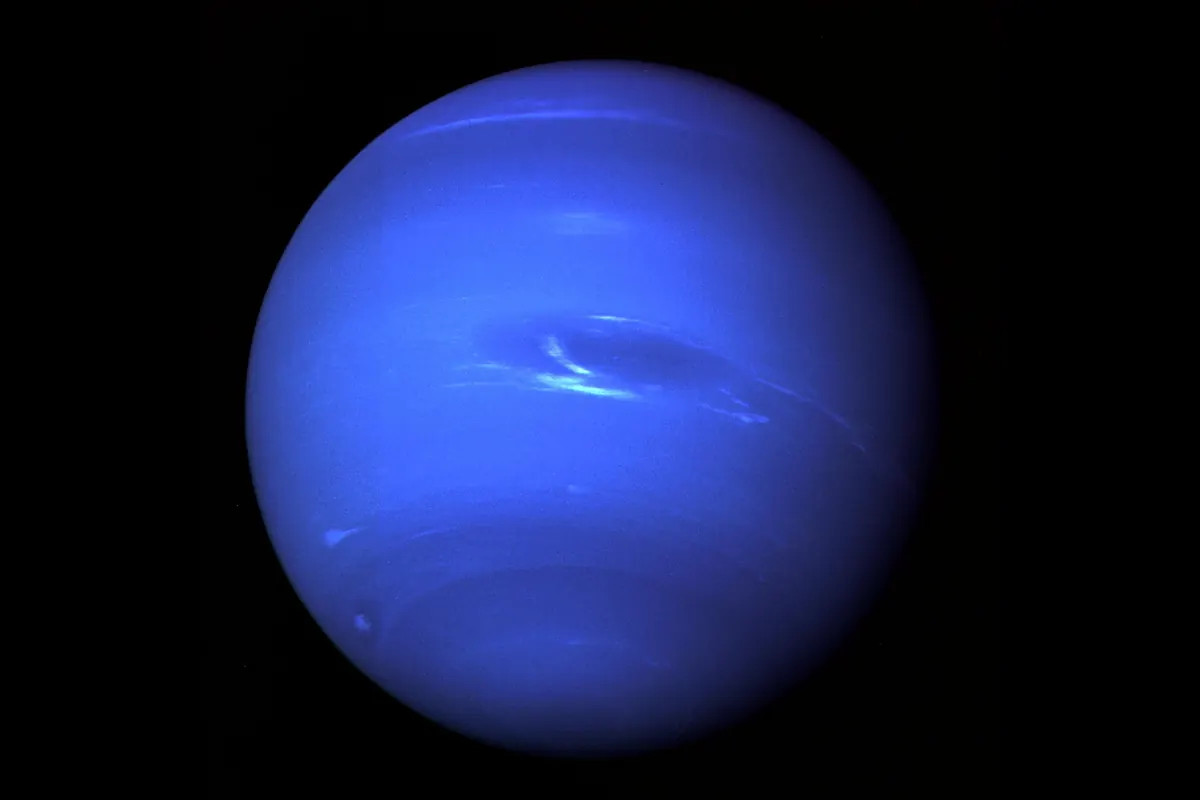
Voyager 2 was the first spacecraft to fly past Neptune, in the summer of 1989, and it's still the only one. The Great Dark Spot on this page was captured by Voyager 2.
Known, inferred, unknown
We keep these apart on every science page.
Measured: we know this
- A year lasts about 165 Earth years and each season lasts more than 40.
- Neptune has 16 known moons and a set of rings.
Questions people ask
How long is a day on Neptune?
One rotation takes 16.1 hours.
How many moons does Neptune have?
It has 16 known moons, by the JPL list read on October 19, 2026.
Who discovered Neptune?
Urbain Le Verrier predicted where it should be from the odd motion of Uranus, and Johann Galle found it in Berlin on his first night of searching in 1846.
Keep exploring
 UranusIce giant, 19.16 AU from the Sun.
 PlutoDwarf planet, 39.48 AU from the Sun.
 How long is a day on each planet?Day length on every planet, and why a day isn't always one spin.
 Planet sizes comparedEvery planet drawn to scale, with diameters next to Earth.
 Weight on other planetsWhat you would weigh on Neptune.
The one flyby
Voyager 2 is the only spacecraft to fly past Neptune. Its closest approach was on 25 August 1989, about 4,950 km above the north pole. It added six moons to the list (Despina, Galatea, Larissa, Proteus, Naiad and Thalassa) and found rings no one had seen.
It also photographed the Great Dark Spot, a storm large enough to hold the whole Earth. The spot has since disappeared. Voyager 2 saw geysers on Triton throwing material more than 8 km high. The Voyager 2 page has the full tour.
Winds three times stronger than Jupiter's
Neptune's winds whip methane clouds at more than 2,000 km/h, which NASA says can be three times as strong as Jupiter's and nine times as strong as Earth's. It's the farthest planet from the Sun, 4,515 million km away, and the distance page shows how that compares.
Methane absorbs the other colors and reflects blue. NASA notes that many Voyager 2 images were enhanced, so Neptune looked a deeper blue than it really is.
Rings, a backward moon and a full year
Neptune has at least five main rings, named Galle, Leverrier, Lassell, Arago and Adams, plus four bright arcs. Triton is the only large moon in the solar system that orbits opposite to its planet's spin. Read more on the Triton page.
The year length page compares the orbits. Neptune was only back where Galle found it in 2011, after a 165-year orbit.