How big is a planet you can't touch?
No one has ever held a ruler to a planet. Sizes come from two measurements. One is how big the disc looks through a telescope, which is a tiny angle. The other is how far away it is. Multiply the two and you get the width, which is why the planet sizes in textbooks only became accurate once the distance scale of the solar system had been pinned down. Spacecraft finished the job. When a probe flies past, its camera and its radio signal give a direct measurement of the width, with far less guesswork.
The planets to scale
Circles are drawn to the same scale, left to right in order from the Sun. Earth is highlighted. Distances between the planets aren't to scale.
Diameters and masses
| World | Diameter (km) | Diameter (miles) | Times Earth wide | Times Earth mass |
|---|---|---|---|---|
| Mercury | 4,879 | 3,032 | 0.38 | 0.0553 |
| Venus | 12,104 | 7,521 | 0.95 | 0.816 |
| Earth | 12,756 | 7,926 | 1.00 | 1 |
| Mars | 6,792 | 4,220 | 0.53 | 0.108 |
| Jupiter | 142,984 | 88,846 | 11.21 | 318 |
| Saturn | 120,536 | 74,898 | 9.45 | 95.1 |
| Uranus | 51,118 | 31,763 | 4.01 | 14.5 |
| Neptune | 49,528 | 30,775 | 3.88 | 17.1 |
| Pluto | 2,376 | 1,476 | 0.19 | 0.00218 |
The ranking
From largest to smallest the eight planets are Jupiter, Saturn, Uranus, Neptune, Earth, Venus, Mars and Mercury. Earth is fifth, which makes it the biggest of the four rocky planets, just a little bigger than Venus.
The table has a twist. Uranus is a little wider than Neptune, 51,118 km against 49,528, yet Neptune holds more mass, 17.1 Earths against 14.5. Neptune is the smaller, denser planet. Width and weight don't always rank the same way, and the density page explains why.
Two classes of planet
The four giants are in a different league. Uranus and Neptune are each about 4.0 times wider than Earth. Jupiter and Saturn are 11 and 9 times wider. Next to them every rocky planet is a small, dense ball. The gap between the two classes is large and abrupt: nothing in our solar system sits between Earth-sized and Uranus-sized. Around other stars, astronomers have found plenty of planets in between. Exoplanet sizes has the numbers.
Mercury versus the Moon
Mercury is only slightly bigger than Earth's Moon, which is 3,475 km across, yet it's a planet with a huge metal core, and the Moon isn't. Pluto, at 2,376 km, is smaller than the Moon, and a dwarf planet.
Pluto got smaller
Pluto is the clearest case of a size that shrank as the tools improved. Early estimates ran large, and Pluto's moon Charon, whose light blurs together with Pluto's in a telescope, helped keep the numbers high. NASA's New Horizons spacecraft settled it with its flyby in 2015, and the fact sheet now gives Pluto's diameter as 2,376 km (NASA's own Pluto page says 2,377). That's well below the early estimates. Why Pluto isn't a planet tells the rest.
The Great Red Spot
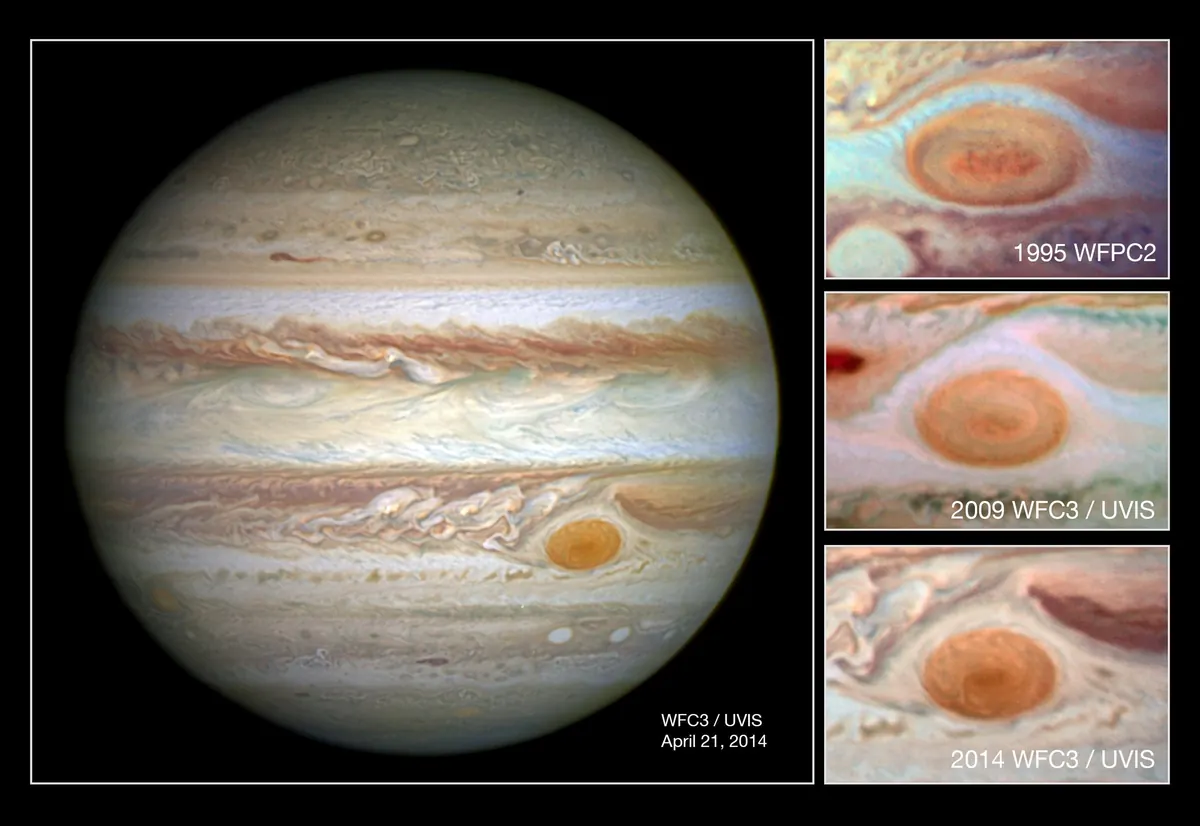
The picture above shows the Great Red Spot on Jupiter, a storm larger than Earth that has shrunk since astronomers first measured it. Hubble images show its diameter falling from just under 21,000 kilometers in 1995 to about 16,000 in 2014, still wider than our planet.
Shrink Earth to a coin
To feel the sizes, shrink Earth to the size of a US quarter, which is 24.26 millimeters across. On that scale Mercury is the size of a small button, 9 millimeters, and Mars is 13 millimeters. Jupiter would be 27.2 centimeters across, a little bigger than a basketball, and Saturn 22.9 centimeters. Pluto would be 4.5 millimeters. The Sun, on the same scale, would stand about 2.6 meters tall.
Planets aren't quite round
Spin makes a planet bulge at the equator. The fact sheet gives each planet's equatorial and polar sizes, and this page uses the mean diameter. Fast spinners like Jupiter and Saturn, with days of about ten hours, bulge the most. Earth's flattening is only 0.00335, against 0.09796 for Saturn.
Width isn't weight
Jupiter is 1.19 times wider than Saturn, a modest margin, but it's 3.3 times heavier. Saturn is so light for its size because it's made mostly of the lightest gas, as the density page shows. Likewise Uranus and Neptune are almost the same width, 51,118 and 49,528 kilometers, while Neptune carries 1.18 times as much mass.
Moons that outsize planets
NASA notes that two moons are bigger than the planet Mercury: Jupiter's Ganymede and Saturn's Titan. They're less massive than Mercury because they're made partly of ice, but they're wider. That makes the point of this page: size is a ranking of widths, and it takes the other columns to say what each world is. Meet them on the pages for Titan and the planets' moons.
All eight in a row
Line the eight planets up edge to edge and they measure 400,697 kilometers, which is 29 percent of the Sun's width of 1,391,400. Jupiter and Saturn make up 66 percent of that row on their own. The picture of the solar system as eight roughly similar balls around a star is wrong in both directions: the planets are far smaller than the Sun, and they're very unequal among themselves.
By volume the gap grows
Width understates the difference, because volume goes with the cube of the width. Jupiter is 11.2 times as wide as Earth, which means about 1,321 times the volume, while Mercury, at 0.38 of Earth's width, holds only 0.056 of its volume. The Earths in Jupiter page works through the full volume table.
How Pluto was measured
Pluto's size was argued over for decades, because it's tiny and far away and has a thin haze that blurs its edge. The answer came from New Horizons. The Pluto page explains how the 2015 flyby settled the figure, and why NASA's value and the fact sheet's differ by a few kilometers.
Questions people ask
What's the biggest planet?
Jupiter, with a diameter of 142,984 km, about 11.2 times Earth's.
What's the smallest planet?
Mercury, at 4,879 km across, about 0.38 times Earth's width.
Where does Earth rank in size?
Fifth largest of the eight planets, after Jupiter, Saturn, Uranus, Neptune. It's the biggest of the four rocky planets.
How big is Pluto compared with Earth?
Pluto's diameter is 2,376 km, about 0.19 of Earth's width, smaller than Earth's Moon.
Keep exploring
 How many Earths fit in Jupiter and the Sun?Volume and mass of every planet and the Sun compared with Earth.
 Density of each planetWhich planet is densest, and why Saturn is lighter than water.
 Distance of each planet from the SunDistance in miles, kilometers, AU and light time, plus the distance from Earth.Solar system, shrunk to a streetOne AU as one meter.