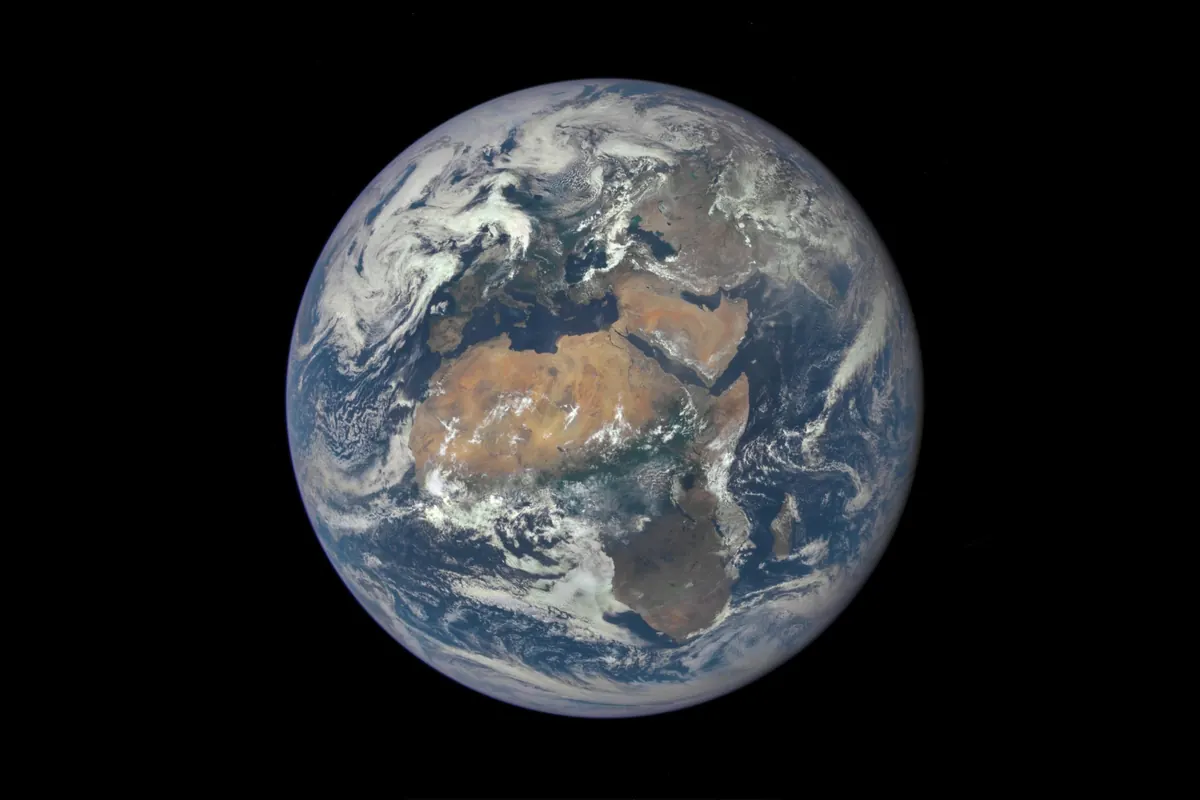
The first look back
On 24 December 1968, during Apollo 8, William Anders photographed the Earth rising over the edge of the Moon. The picture is called Earthrise.
The rest of this page is about the numbers behind that picture: a planet about 4.5 billion years old, with oceans that cover most of the surface.
It's the only planet with liquid water on its surface, and most of the planet is covered by it. The temperature and mix of chemicals are right for liquid water to last for long periods, and life began in the oceans about 3.8 billion years ago.
Earth turns once in 23.9 hours and goes around the Sun in 365.25 days. That extra quarter of a day is the reason for the leap day every four years. The axis is tilted 23.4 degrees, which gives us the seasons: when the northern hemisphere leans toward the Sun it's summer there and winter in the south, and six months later it reverses.
Earth in numbers
| Measure | Earth |
|---|---|
| Diameter | 12,756 km |
| Mass | 5.97 x 1024 kg |
| Density | 5,514 kg/m3 |
| Surface gravity | 9.8 m/s2 |
| Escape velocity | 11.2 km/s |
| One rotation | 23.9 hours |
| Sunrise to sunrise | 24.0 hours |
| Year | 365 Earth days |
| Average distance from the Sun | 149.6 million km (1.00 AU) |
| Average temperature | 15 C (59 F) |
| Axial tilt | 23.4 degrees |
| Moons | 1 |
| Rings | No |
Numbers from the NASA Planetary Fact Sheet. Moon count from the JPL list read on October 19, 2026.
What makes Earth different
Earth is the only planet in the solar system with exactly one moon, and it's the only planet whose English name doesn't come from Greek or Roman mythology. The name is about 1,000 years old, comes from Old English and Germanic words, and simply means the ground.
Inside, Earth has four layers: a solid inner core of iron and nickel, a liquid outer core, a thick mantle with the consistency of caramel, and a thin crust. The crust is about 30 kilometers deep on average on land and thinner under the oceans.
Visiting Earth
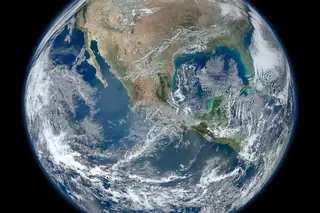
Earth is observed from orbit continuously, and the picture on this page was taken from a satellite a million miles away that watches the sunlit side as the planet turns.
Known, inferred, unknown
We keep these apart on every science page.
Measured: we know this
- Earth is the only planet known to have liquid water on its surface and to host life.
- The Moon is 384,400 kilometers away, and about 30 Earth-sized planets would fit between us and it.
Inferred: we think this
- The Moon is likely the result of a collision billions of years ago, when a large chunk of rock hit the young Earth and the debris clumped together.
- Earth formed about 4.5 billion years ago, when gravity pulled swirling gas and dust into a planet.
Questions people ask
How long is a day on Earth?
One rotation takes 23.9 hours.
How many moons does Earth have?
It has 1 known moon, by the JPL list read on October 19, 2026.
How far away is the Moon?
The Moon is an average of 384,400 kilometers from Earth. About 30 Earth-sized planets would fit in the gap.
Keep exploring
 VenusRocky planet, 0.72 AU from the Sun.
 MarsRocky planet, 1.52 AU from the Sun.
 How long is a day on each planet?Day length on every planet, and why a day isn't always one spin.
 Planet sizes comparedEvery planet drawn to scale, with diameters next to Earth.
 Age on other planetsHow old you would be on each world.
Mostly water
Oceans cover about 71 percent of the surface, hold 97 percent of the planet's water, and average about 3.6 km deep. The crust is a thin skin by comparison, about 5 km thick under the sea.
The air is 78 percent nitrogen and 21 percent oxygen, with about 1 percent of other gases. The tilt of 23.4 degrees produces the seasons explained on the tilt page.
The layers below
The inner core has a radius of 1,221 km and reaches about 5,400 C. Around it sits an outer core about 2,300 km thick, then a mantle about 2,900 km thick. The ground that looks fixed moves: NASA says the North American plate drifts west at roughly the speed your fingernails grow.
The moving, molten nickel-iron core and the planet's fast rotation produce the magnetic field. Its poles have reversed before, about every 300,000 years on average though not on a schedule, and NASA calls a reversal very unlikely for at least another thousand years.
The Moon and the clock
The Moon probably formed after a large piece of rock hit the young Earth. It sits 384,400 km away on average, which is about 30 Earth widths, and its radius of 1,738 km makes it the fifth largest moon in the solar system. People have landed there more than once.
Sunlight takes about 8.35 minutes to arrive, and the light travel calculator turns any distance into light time. Where Earth sits among the other worlds is laid out on the order of the planets page.