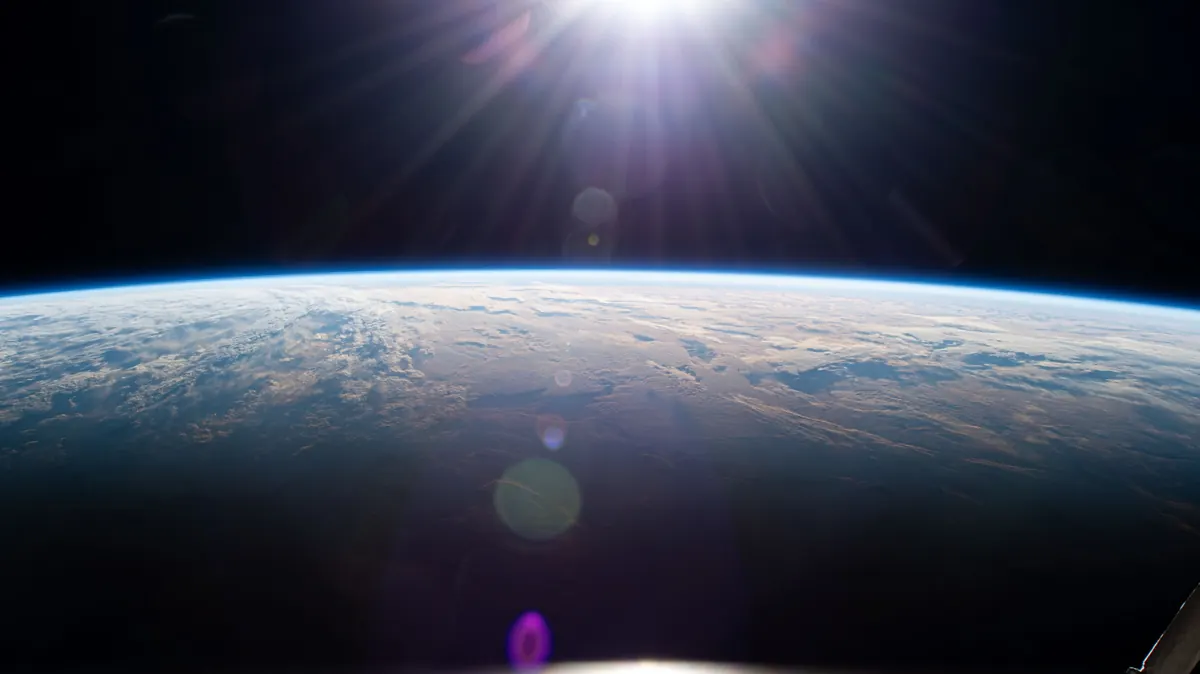
Timing a spin you can't see
On Earth you measure a day by watching the Sun. On other planets it isn't so easy. Clouds hide the surface of Venus, and Jupiter, Saturn, Uranus and Neptune have no surface to watch at all. Astronomers have used radar bounced off the ground, radio signals from magnetic fields, and, for Saturn, even the faint waves in its rings. Each new method has changed an answer we thought we knew, which is why the day lengths on this page have an unusual number of footnotes.
Day length for every planet
| World | One rotation | Spin direction | Sunrise to sunrise | Year (for comparison) |
|---|---|---|---|---|
| Mercury | 58.6 Earth days | Forward | 175.9 Earth days | 88 days |
| Venus | 243.0 Earth days | Backward | 116.8 Earth days | 225 days |
| Earth | 23.9 hours | Forward | 24.0 hours | 365 days |
| Mars | 24.6 hours | Forward | 24.7 hours | 1.9 years |
| Jupiter | 9.9 hours | Forward | 9.9 hours | 11.9 years |
| Saturn | 10.7 hours | Forward | 10.7 hours | 29.4 years |
| Uranus | 17.2 hours | Backward | 17.2 hours | 83.7 years |
| Neptune | 16.1 hours | Forward | 16.1 hours | 163.7 years |
| Pluto | 6.4 Earth days | Backward | 6.4 Earth days | 247.9 years |
Values from the NASA Planetary Fact Sheet. Pluto is a dwarf planet.
Two kinds of day
A rotation is the time a planet takes to spin once against the stars. A solar day is the time from one sunrise to the next, and it differs because the planet also moves along its orbit. On Earth the two differ by only a few minutes. On a slow, close planet they can differ enormously, and on Venus and Mercury the gap changes what a day even means.
Mercury: a day that lasts two years
Mercury spins once every 58.6 Earth days, but it races around the Sun in 88 days, so sunrise to sunrise takes 175.9 Earth days. That's twice the length of its year. Astronomers didn't always know this. In 1889 Giovanni Schiaparelli concluded that Mercury keeps one face to the Sun, the way the Moon keeps one face to Earth, and that view held for decades. Then in 1965 Gordon Pettengill and Rolf Dyce bounced radar off the planet using the Arecibo telescope in Puerto Rico, and the Doppler shift of the echo showed that Mercury turns three times for every two trips around the Sun.
Venus: a day longer than a year
Venus takes 243.0 Earth days to turn once, which is longer than its 225-day year. It also spins backward compared with most planets, so the Sun rises in the west. Radar through the clouds revealed the spin in the early 1960s, and it was confirmed in 1964. Sunrise to sunrise is shorter, 116.8 Earth days, because spinning backward while orbiting forward shortens the wait. NASA gives the sunrise-to-sunset stretch as about 117 Earth days.
Even a figure that precise moves. Radar measurements from 2006 to 2020, led by Jean-Luc Margot, found that Venus's rotation period averages 243.0226 Earth days, but changes: the length of a day varied by about 3 minutes between consecutive days and by up to 21 minutes over the 15 years. The team blamed the thick atmosphere, which trades momentum with the ground below. A planet's day can be a little different every year.
The giants spin fast, and nobody has a surface to check
Jupiter has the shortest day in the solar system at 9.9 hours, and Saturn is second at 10.7 hours. They're enormous, yet they turn faster than anything else. Jupiter's equator moves at about 12.6 km/s, and Earth's equator moves at 0.47 km/s. All that spin flattens Jupiter into a squashed ball. For Saturn, the standard figure came from radio signals, but in 2019 a team led by Christopher Mankovich used waves in Saturn's rings, driven by oscillations inside the planet, and found an interior rotation of 10 hours 33 minutes 38 seconds, several minutes faster than the radio value.
Uranus and Neptune turn in about 17.2 hours and 16.1 hours. Uranus got an upgrade in 2025, when a team led by Laurent Lamy used more than a decade of Hubble images of its aurora and found a rotation of 17 hours 14 minutes 52 seconds, 28 seconds longer than the figure from Voyager 2 in 1986.
Earth and Mars: almost twins
Mars turns once in 24.6 hours, only a little longer than Earth's 23.9 hours. A Martian day, from one sunrise to the next, lasts about 24.7 hours, and it's called a sol. Teams running rovers count their missions in sols, and a Martian year holds about 668 of them. The Mars rovers page lists the machines that have lived by those clocks.
What a long day does to a planet
A slow spin changes the weather. On Earth the day side warms and the night side cools within hours. On Mercury, with a sunrise-to-sunrise day of 175.9 Earth days, the surface cooks for months and then freezes for months. On Venus, the thick air carries heat around so the night side stays as hot as the day side. The fastest spinners reverse the problem: Jupiter's ten-hour day stretches its clouds into bands that circle the whole planet.
Why a day is rarely exactly 24 hours, even here
Earth's own day isn't fixed. The fact sheet's 23.9 hours is the time to spin once against the stars, and a solar day of 24.0 hours is the time from one noon to the next. Tides slow the spin by a small fraction of a second per century. Clocks follow the average. Leap seconds exist to keep them in step with the planet, and the year-length page shows how the other calendar behaves.
Worlds that face each other
Pluto turns once in 6.4 Earth days, and its big moon Charon circles it in the same time, so each always shows the same side to the other. A day on Pluto is also, by that definition, a month for Charon.
Questions people ask
Which planet has the shortest day?
Jupiter, where one rotation takes 9.9 hours.
Which planet has the longest day?
Venus turns once in 243.0 Earth days, the slowest of the eight planets, and the Sun takes 116.8 Earth days to return to the same place in the sky.
How long is a day on Mars?
One rotation takes 24.6 hours. A Martian day is called a sol, and it lasts about 24.7 hours from one sunrise to the next.
How long is a day on Venus?
Venus turns once in 243.0 Earth days, but sunrise to sunrise takes 116.8 Earth days.
Keep exploring
 How long is a year on each planet?Orbit time for every planet, in Earth days and years.
 Planet tilt and seasonsAxial tilt of every planet, and how long a season lasts on each.
 What's the order of the planets?Planets in order from the Sun, with distance and size.
 Age on other planetsHow old you would be on each world.