Six rovers, six careers
Sojourner
Sojourner rode in on Mars Pathfinder on July 4, 1997. NASA says the mission lasted 83 days instead of the planned seven. At its farthest the rover was a little over 12 meters from its lander, and the mission's final data transmission came on September 27, 1997.
Spirit and Opportunity
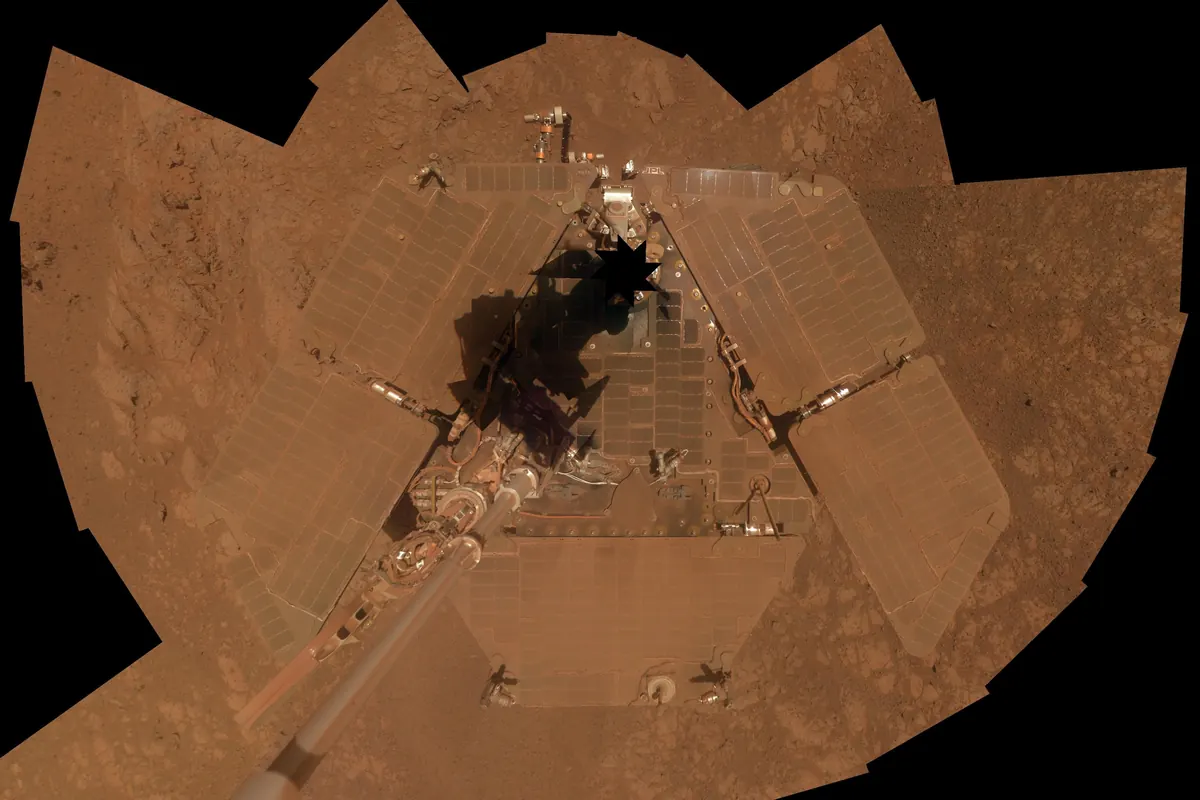
The twin rovers were designed to last 90 Martian days, and Opportunity to travel about 1,000 meters. Spirit drove 7.7 kilometers before it stuck in soft soil on May 1, 2009, and NASA lost contact after March 22, 2010. Opportunity kept going until a planet-wide dust storm in 2018. Its last communication came on June 10, 2018, and NASA declared the mission complete on February 13, 2019, after 45.16 kilometers.
Curiosity and Perseverance
Curiosity landed on August 6, 2012 (UTC). Its prime mission was planned for 23 months, and NASA says it had gained 1 kilometer of elevation up Mount Sharp by August 26, 2026. NASA describes the descent as seven minutes from the top of the atmosphere to the surface. Perseverance landed on February 18, 2021 using Terrain-Relative Navigation. Both were still working at the data date. The success rate page explains why landings carry the most risk.
Zhurong
China's rover landed on May 14, 2021 in Utopia Planitia. By May 2022 it had worked 347 Martian days and driven 1,921 meters. It then went into hibernation and hasn't been confirmed awake.
The list
| Rover | Mission | Program | Landed (UTC) | Landing area | Distance driven | Where it stands |
|---|---|---|---|---|---|---|
| PrOP-M | Mars 2 | Soviet Union | 1971 | - | - | Never operated. The lander crashed. |
| PrOP-M | Mars 3 | Soviet Union | 1971 | - | - | Never operated. The lander fell silent seconds after touchdown. |
| Sojourner | Mars Pathfinder | United States | July 4, 1997 | Ares Vallis | farthest about 12 m from the lander | Mission over. The planned 7 days became 83. |
| Spirit | Spirit (MER-A) | United States | January 4, 2004 | Gusev Crater | 7.7 km | Last heard from 22 March 2010. Mission ended in 2011. |
| Opportunity | Opportunity (MER-B) | United States | January 25, 2004 | Meridiani Planum | 45.16 km | Last contact 10 June 2018. Mission declared over 13 February 2019. |
| Curiosity | Mars Science Laboratory | United States | August 6, 2012 | Gale Crater | not given in the NASA source used | Still working. |
| Zhurong | Tianwen-1 | China | May 14, 2021 | Utopia Planitia | 1,921 m | Went into hibernation in May 2022 and hasn't been confirmed awake. |
| Perseverance | Mars 2020 | United States | February 18, 2021 | Jezero Crater | more than 45 km, as of 11 October 2026 | Still working. |
Each rover rode in on a mission that's also on the full list of Mars missions. Distances are totals at the end of each mission. Perseverance and Curiosity are still driving.
A small start, a long record
Sojourner was planned for 7 days and worked for 83. Spirit and Opportunity, launched in 2003, were planned for 90 Mars days. Spirit's last message came in March 2010. Opportunity went quiet in June 2018 after a dust storm, with 45.16 km on its odometer, the distance record for any rover on another world. NASA reported in October 2026 that Perseverance had passed it.
The two that never moved
The Soviet Union put a small rover called PrOP-M on both Mars 2 and Mars 3 in 1971. Mars 2 crashed. Mars 3 landed and fell silent seconds later, so its rover was never put on the ground. The first rover to drive on Mars was Sojourner, in 1997, and China's Zhurong, in 2021, was the second country's rover to operate.
The helicopter that outlived its plan
One more machine belongs with the rovers, though it isn't one. Ingenuity rode to Mars with Perseverance as a technology demonstration, planned for up to five test flights over 30 days. It made 72 flights, and its final flight was on January 18, 2024. It's listed as its own mission on the full list.
Why distance isn't the whole story
A rover's odometer says little about what it learned. Sojourner's short range was the point: it showed that a rover could work. Opportunity's 45.16 kilometers were a long drive from one outcrop to the next, and the table shows Perseverance now past it. If you want to know what you would weigh on the surface a rover crosses, the weight calculator will tell you.
What the rovers found
Opportunity landed at Meridiani Planum because orbital data suggested hematite there. NASA describes the Eagle Crater outcrop as finely laminated rock rich in sulfate salts, with features that show deposition in flowing liquid water, and the hematite spherules as concretions that also formed with liquid water.
Curiosity launched on November 26, 2011. NASA says it met its major objective, finding evidence of a past environment suited to supporting microbial life, within the first eight months of a 23-month prime mission. At Yellowknife Bay, clay-bearing rocks showed a lakebed with fresh water, the key elements for life and a chemical energy source.
Perseverance is collecting rock for a possible return to Earth. Its drill cored a briefcase-size rock on September 1, 2021, and the core, slightly thicker than a pencil, was sealed in a titanium tube. By early November 2023 it had collected and sealed 23 samples. NASA and ESA have planned later missions to bring such tubes home.
Where they went
The six rovers that worked landed at Ares Vallis (Sojourner), Gusev Crater (Spirit), Meridiani Planum (Opportunity), Gale Crater (Curiosity), Utopia Planitia (Zhurong) and Jezero Crater (Perseverance). Five of the 6 were American. The only other country to operate a rover on Mars is China, whose Tianwen-1 entered orbit on February 10, 2021. The rover Zhurong drove off the lander on May 22, 2021, eight days after landing.
The record that Opportunity broke
The first rover on any other world was the Soviet Lunokhod 1, which landed on November 17, 1970 and roved 10.5 kilometers over 322 days. Its successor, Lunokhod 2, held the longest traverse of any rover on another world for decades. NASA's later remeasurement from orbit puts it at about 39 kilometers, and Opportunity passed it. The page's table shows the 45.16 kilometers Opportunity finished with, and Perseverance has since gone beyond that. The Moon's rovers are on every Moon landing.
The spacing of the landings
The six working rovers landed in 1997, 2004, 2012 and 2021. The longest wait between two of them ran 9 years, from Curiosity in 2012 to Zhurong in 2021. Spirit and Opportunity landed only three weeks apart. The pairing reflects the 26-month launch rhythm described on the mission count page, since two rovers sent in the same window arrive in the same weeks.
What each landing area is
The areas in the table are the plains, craters and valleys the rovers drove across. Gusev Crater, Gale Crater and Jezero Crater are craters. Ares Vallis is a valley, and Meridiani Planum and Utopia Planitia are plains.