How to read the early names
The first launches on the list weren't announced as Mars missions. When the Soviet Union lost a craft before it reached orbit, it said nothing, so the names in the first rows, like Mars 1960A and Sputnik 22, are labels added later by NASA and historians. That's why those rows sit apart from the tidy sequence of Mariner, Viking and Mars numbers that follows.
The firsts
A handful of rows changed what was possible. Mariner 4 made the first successful flyby on July 14, 1965. Mariner 9 became the first spacecraft in orbit around Mars when its main engine fired on November 14, 1971. It went on to send back 7,329 photos, and its last contact came on October 27, 1972.
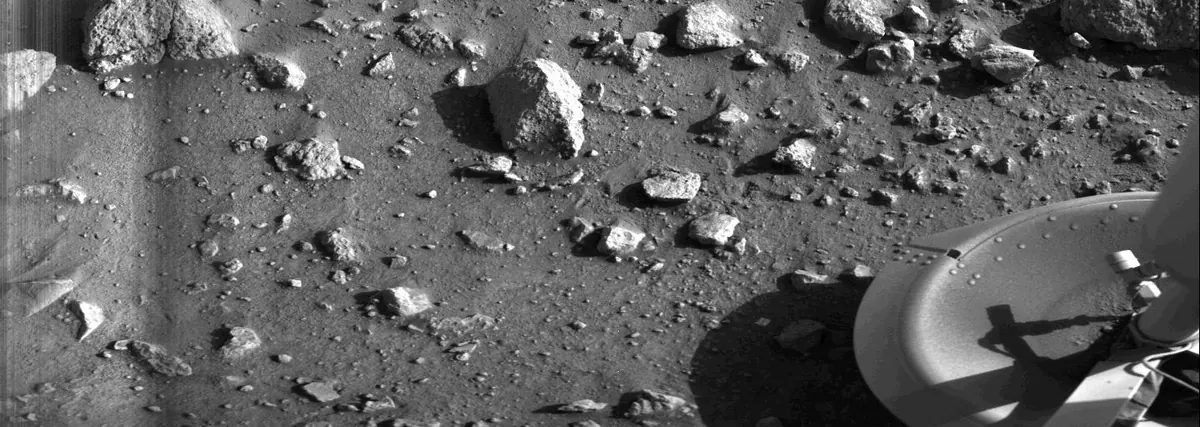
Viking 1's lander touched down on July 20, 1976 and operated until November 11, 1982. Mars Pathfinder landed on July 4, 1997 with the small rover Sojourner, and the final data transmission came on September 27, 1997. Viking 2 followed on September 3, 1976. Phoenix landed on May 25, 2008 and verified water ice under the surface, and its last signal arrived on November 2, 2008. The rovers that followed are on the rover page.
The full list
| Launched | Mission | Country or operator | Type | Result | What happened |
|---|---|---|---|---|---|
| October 10, 1960 | Mars 1960A | Soviet Union | flyby | Failure | Third-stage failure prevented Earth orbit and the intended Mars flyby. |
| October 14, 1960 | Mars 1960B | Soviet Union | flyby | Failure | Third-stage ignition failed; the spacecraft never reached Earth orbit. |
| October 24, 1962 | Sputnik 22 | Soviet Union | flyby | Failure | The escape stage exploded in Earth orbit, preventing the Mars flyby. |
| November 1, 1962 | Mars 1 | Soviet Union | flyby | Failure | Contact was lost in transit; no observations were returned from the Mars encounter. |
| November 4, 1962 | Sputnik 24 | Soviet Union | lander | Failure | The escape stage failed and the intended Mars lander remained in Earth orbit. |
| November 5, 1964 | Mariner 3 | United States / NASA | flyby | Failure | The shroud didn't separate, preventing solar-panel deployment and Mars science. |
| November 28, 1964 | Mariner 4 | United States / NASA | flyby | Success | Returned the first close-up Mars images and atmospheric measurements during its flyby. |
| November 30, 1964 | Zond 2 | Soviet Union | flyby | Failure | Communications failed before arrival; no Mars encounter science was returned. |
| February 25, 1969 | Mariner 6 | United States / NASA | flyby | Success | Completed its close Mars flyby and returned surface images and atmospheric measurements. |
| March 27, 1969 | Mariner 7 | United States / NASA | flyby | Success | Completed its Mars flyby and returned images and measurements, including the south polar region. |
| March 27, 1969 | Mars 1969A | Soviet Union | orbiter | Failure | Third-stage launch failure prevented Earth orbit and the intended Mars orbit mission. |
| April 2, 1969 | Mars 1969B | Soviet Union | orbiter | Failure | First-stage failure destroyed the launch attempt before Earth orbit. |
| May 9, 1971 | Mariner 8 | United States / NASA | orbiter | Failure | Centaur lost control during launch, preventing Earth orbit and Mars orbital science. |
| May 10, 1971 | Kosmos 419 | Soviet Union | orbiter | Failure | The escape-stage timer was mis-set; the spacecraft never left Earth orbit. |
| May 19, 1971 | Mars 2 | Soviet Union | orbiter plus lander | Partial | The orbiter returned Mars science, but the lander crashed and its rover couldn't operate. |
| May 28, 1971 | Mars 3 | Soviet Union | orbiter plus lander | Partial | Orbital science was returned, but the lander fell silent seconds after touchdown and surface work was lost. |
| May 30, 1971 | Mariner 9 | United States / NASA | orbiter | Success | Mapped most of Mars and returned more than 7,000 images, exceeding its mapping objective. |
| July 21, 1973 | Mars 4 | Soviet Union | orbiter | Partial | Failed to enter orbit but returned Mars images and occultation data during the flyby. |
| July 25, 1973 | Mars 5 | Soviet Union | orbiter | Partial | Returned orbital images and measurements before depressurization ended observations and prevented planned lander relay. |
| August 5, 1973 | Mars 6 | Soviet Union | lander | Partial | Returned atmospheric descent measurements, but contact ended before a functioning surface mission began. |
| August 9, 1973 | Mars 7 | Soviet Union | lander | Failure | The lander missed Mars; cruise measurements didn't fulfill its primary Mars landing investigation. |
| August 20, 1975 | Viking 1 | United States / NASA | orbiter plus lander | Success | Orbiter mapping and sustained surface imaging, atmospheric, chemistry and life-search experiments were accomplished. |
| September 9, 1975 | Viking 2 | United States / NASA | orbiter plus lander | Success | Completed orbital mapping and a long-lived lander investigation of the surface and atmosphere. |
| July 7, 1988 | Phobos 1 | Soviet Union | orbiter plus lander | Failure | A command error disabled attitude control and the craft was lost before reaching Mars or Phobos. |
| July 12, 1988 | Phobos 2 | Soviet Union | orbiter plus lander | Partial | Returned Mars and Phobos observations, but failed before the close Phobos encounter and release of its landers. |
| September 25, 1992 | Mars Observer | United States / NASA | orbiter | Failure | Communications were lost before Mars orbit insertion, preventing the primary mapping mission. |
| November 7, 1996 | Mars Global Surveyor | United States / NASA | orbiter | Success | Completed global mapping and extended investigations of Mars' surface, atmosphere and interior. |
| November 16, 1996 | Mars 96 | Russia / Russian Space Agency | orbiter plus lander | Failure | Failed to escape Earth orbit, losing the orbiter, two landers and two penetrators. |
| December 4, 1996 | Mars Pathfinder | United States / NASA | lander | Success | Demonstrated low-cost landing and rover operations, returning science beyond the design lifetimes. |
| July 3, 1998 | Nozomi | Japan / ISAS (later JAXA) | orbiter | Failure | Propulsion, power and communications problems prevented Mars orbit insertion and the primary atmospheric investigation. |
| December 11, 1998 | Mars Climate Orbiter | United States / NASA | orbiter | Failure | Lost at Mars orbit insertion before the intended atmospheric mapping and relay mission. |
| January 3, 1999 | Deep Space 2 | United States / NASA | impactor | Failure | Neither penetrator returned a signal after arrival, so impact-survival and subsurface technology objectives weren't demonstrated. |
| January 3, 1999 | Mars Polar Lander | United States / NASA | lander | Failure | Contact was lost during landing; no surface science was received. |
| April 7, 2001 | 2001 Mars Odyssey | United States / NASA | orbiter | Success | Completed its primary mapping mission, including global elemental and mineral investigations. |
| June 2, 2003 | Beagle 2 | United Kingdom / Beagle 2 project | lander | Failure | Landed but didn't fully deploy or communicate; none of its planned surface science was returned. |
| June 2, 2003 | Mars Express | Europe / ESA | orbiter | Success | Completed its prime orbital science mission and continued surface, subsurface and atmospheric investigations. |
| June 10, 2003 | Spirit | United States / NASA | rover | Success | Completed its 90-sol primary investigation and found evidence of past water during extended exploration. |
| July 8, 2003 | Opportunity | United States / NASA | rover | Success | Completed its 90-sol primary investigation, identifying water-altered rocks, and operated for nearly 15 years. |
| August 12, 2005 | Mars Reconnaissance Orbiter | United States / NASA | orbiter | Success | Completed its primary science phase, returning extensive high-resolution imaging and evidence of past watery environments. |
| August 4, 2007 | Phoenix | United States / NASA | lander | Success | Completed its prime surface mission, confirming water ice and investigating polar soil and weather. |
| November 8, 2011 | Phobos-Grunt | Russia / Roscosmos | sample return | Failure | Its propulsion module never fired for departure from Earth orbit, preventing Phobos landing and sample return. |
| November 8, 2011 | Yinghuo-1 | China / CNSA | orbiter | Failure | The host Phobos-Grunt spacecraft remained in Earth orbit, preventing release into Mars orbit. |
| November 26, 2011 | Mars Science Laboratory | United States / NASA | rover | Success | Established that ancient Gale Crater had conditions suitable for microbial life and completed its prime investigation. |
| November 5, 2013 | Mars Orbiter Mission | India / ISRO | orbiter | Success | Demonstrated interplanetary cruise, Mars orbit insertion and autonomous orbital operation, far exceeding its six-month design life. |
| November 18, 2013 | MAVEN | United States / NASA | orbiter | Success | Completed its primary upper-atmosphere and atmospheric-escape investigation before years of extended operations. |
| March 14, 2016 | ExoMars 2016 | Europe / ESA and Russia / Roscosmos | orbiter plus lander | Partial | Trace Gas Orbiter achieved orbital science, but Schiaparelli crashed before completing the landing demonstration. |
| May 5, 2018 | InSight | United States / NASA | lander | Partial | Seismology and interior-structure objectives were met, but the required deep heat-flow measurement wasn't obtained. |
| May 5, 2018 | Mars Cube One | United States / NASA | technology demonstrator | Success | The two CubeSats demonstrated independent deep-space flight and successfully relayed InSight landing telemetry. |
| July 19, 2020 | Emirates Mars Mission | United Arab Emirates / UAE Space Agency and MBRSC | orbiter | Success | Completed the planned global atmospheric observing campaign and continued into extended science operations. |
| July 23, 2020 | Tianwen-1 | China / CNSA | orbiter plus lander | Success | Both the orbiter and Zhurong rover accomplished their planned scientific exploration tasks. |
| July 30, 2020 | Ingenuity | United States / NASA | technology demonstrator | Success | Demonstrated powered, controlled flight on Mars and exceeded its original five-flight technology demonstration. |
| July 30, 2020 | Mars 2020 | United States / NASA | rover | Success | Explored ancient habitable environments, searched for biosignatures and collected and cached samples for possible return. |
| November 13, 2025 | ESCAPADE | United States / NASA and University of California, Berkeley | orbiter | Pending | Pending: launched successfully, but primary Mars plasma-science objectives await arrival and science operations. |
Dates are launch dates in UTC. Where two missions share a launch date they rode the same rocket, or two rockets flew on the same day. Beagle 2 and Yinghuo-1 are listed apart from the spacecraft that carried them because they were separate projects. Zond 3 (1965) isn't listed: it was a flyby of the Moon that also tested hardware for Mars.
The rhythm of the windows
The rows arrive in clusters because Earth and Mars line up for the most energy-efficient trip about once every 26 months. Group the launches that fall within about six months of each other and the list resolves into 21 windows. The busiest, around 1971, held 5 launches. The window of 2020 had 3, from the United Arab Emirates, China and the United States, all within 11 days of each other in July.
A missed window means a wait of more than two years, so teams press hard to launch inside one. Several of the early Soviet pairs show the same logic. Mars 1960A and 1960B flew four days apart, and Mars 1969A and 1969B six days apart, because each team built two spacecraft to put two chances into the same window.
Rides, add-ons and what counts as a mission
Some rows belong to a craft that rode with another. Beagle 2 went with Mars Express, Yinghuo-1 with Phobos-Grunt, and Ingenuity with Perseverance. Each had its own team and goals, so each is its own mission, which is why the page lists more missions than launches. The arithmetic is spelled out on how many missions have gone to Mars.
How they came out
The result column carries the ledger's grade for each mission, and the grades differ in meaning. A partial result such as Mars 5's means a stated goal was met even though others were lost. The reasons are written in the last column. The success rates by decade, and what they do and don't show, are on the success rate page, and the failures are told one by one on Mars missions that failed.
What's next
ESCAPADE launched on November 13, 2025 and has no grade yet, because its main objectives await arrival and science operations. Japan's JAXA has scheduled the launch of its Martian Moons eXploration mission, MMX, for October 20, 2026 (Japan time), on an H3 rocket from Tanegashima. A scheduled launch isn't counted until it has happened, so MMX will join the table only after it lifts off. Its target, Phobos, has its own page.
What kind of missions the list holds
19 of the 53 missions were orbiters, 9 were flybys, and 21 carried a lander or rover. The rest were impactors, sample returns and technology demonstrations. The mix changed with time. The first missions were flybys, because passing the planet was within reach before stopping at it was. Orbiters came next, then landers.
The longest quiet spell
The longest gap between Mars launches ran 13 years, from Viking 2 in 1975 to Phobos 1 in 1988. The decade with the fewest missions was the 1980s.
The long-lived orbiter
Some rows stand out for how long they worked. Mars Global Surveyor launched on November 7, 1996 and began orbiting Mars on September 11, 1997. NASA says its camera returned more than 240,000 images and that it operated longer at Mars than any spacecraft before it. Contact was lost on November 2, 2006, and a review board linked the loss to a computer error. The row in the table reads simply as a success, which understates the length of the career.
The partial results, in the ledger's words
Eight missions carry the middle grade. Each is a case where a stated goal was met and another was lost:
- Mars 2: The orbiter returned Mars science, but the lander crashed and its rover couldn't operate.
- Mars 3: Orbital science was returned, but the lander fell silent seconds after touchdown and surface work was lost.
- Mars 4: Failed to enter orbit but returned Mars images and occultation data during the flyby.
- Mars 5: Returned orbital images and measurements before depressurization ended observations and prevented planned lander relay.
- Mars 6: Returned atmospheric descent measurements, but contact ended before a functioning surface mission began.
- Phobos 2: Returned Mars and Phobos observations, but failed before the close Phobos encounter and release of its landers.
- ExoMars 2016: Trace Gas Orbiter achieved orbital science, but Schiaparelli crashed before completing the landing demonstration.
- InSight: Seismology and interior-structure objectives were met, but the required deep heat-flow measurement wasn't obtained.