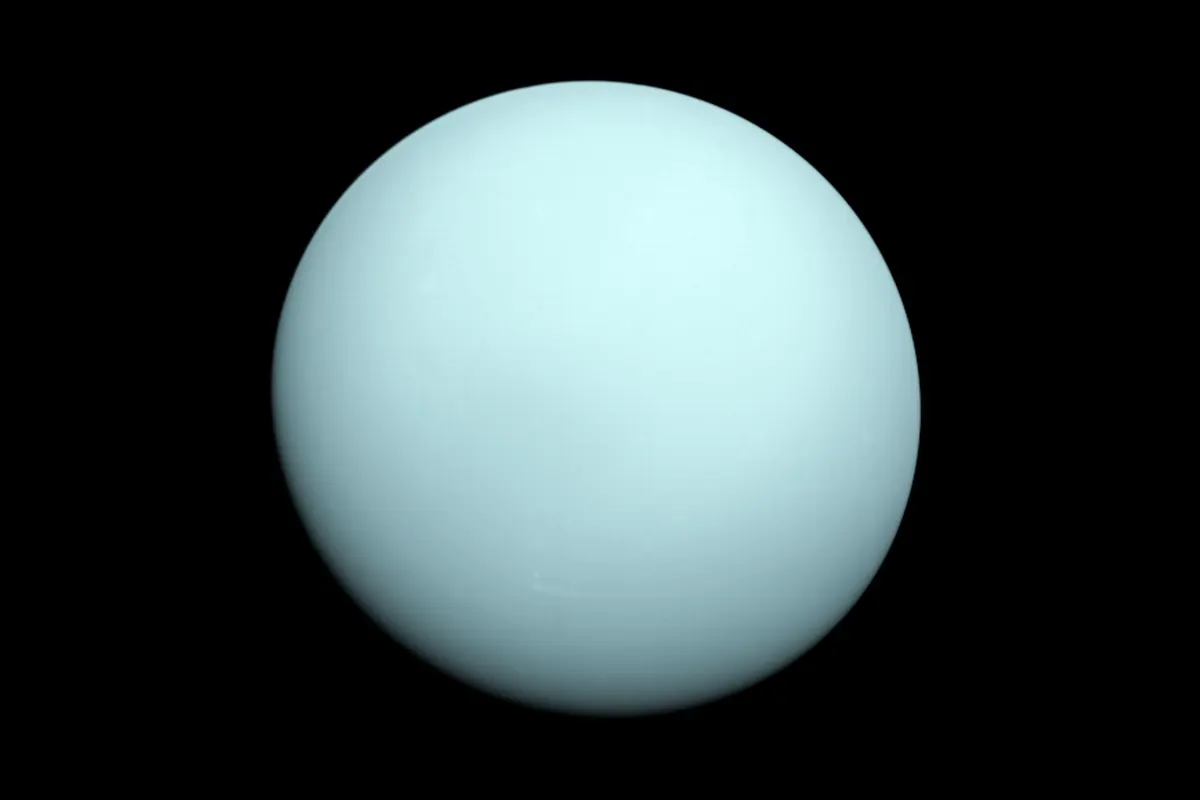
Found by accident, visited once
William Herschel found Uranus on 13 March 1781 from his back garden in Bath. He took it for a comet at first.
The rings turned up by accident. On 10 March 1977, astronomers on the Kuiper Airborne Observatory and at the Perth Observatory watched Uranus pass in front of the star SAO 158687, hoping to learn about the atmosphere. The star dimmed before and after the planet covered it. Something narrow and dark was in the way, and Uranus turned out to have rings like Saturn.
Voyager 2 is the only spacecraft to visit. It passed on 24 January 1986, about 81,500 km above the cloud tops, found 10 new moons and 2 new rings, and then left for Neptune.
It was the first planet found with the aid of a telescope. William Herschel spotted it in 1781 but thought it was a comet or a star, and the object was only accepted as a planet two years later, partly because of observations by Johann Elert Bode. Herschel wanted to call it Georgium Sidus, after King George III. The name Uranus, for the Greek god of the sky, was Bode's suggestion.
The tilt is extreme: the equator is about 97.77 degrees from the orbit, so Uranus looks like it spins sideways and rolls around the Sun like a ball. That gives it the most extreme seasons in the solar system. For nearly a quarter of each Uranian year, the Sun shines straight down on one pole, and the other half of the planet sits in a winter that lasts 21 years.
Uranus in numbers
| Measure | Uranus | Compared with Earth |
|---|---|---|
| Diameter | 51,118 km | 4.01 x Earth |
| Mass | 86.8 x 1024 kg | 14.5 x Earth |
| Density | 1,270 kg/m3 | 0.23 x Earth |
| Surface gravity | 8.7 m/s2 | 0.89 x Earth |
| Escape velocity | 21.3 km/s | 1.90 x Earth |
| One rotation | 17.2 hours (backward) | 0.72 x Earth |
| Sunrise to sunrise | 17.2 hours | 0.72 x Earth |
| Year | 83.7 years (30,589 Earth days) | 83.76 x Earth |
| Average distance from the Sun | 2,867.0 million km (19.16 AU) | 19.16 x Earth |
| Average temperature | -195 C (-319 F) | Earth: 15 C |
| Axial tilt | 97.8 degrees | Earth: 23.4 degrees |
| Moons | 29 | Earth: 1 |
| Rings | Yes | Earth: No |
Numbers from the NASA Planetary Fact Sheet. Temperature and gravity for gas and ice giants are given at the level where the pressure is one bar, since they have no solid surface. Moon count from the JPL list read on October 19, 2026.
What makes Uranus different
A day lasts about 17 hours and a year about 84 Earth years. Uranus is one of only two planets that turn the opposite way to most of the others. Venus is the other.
The moons are named for characters from Shakespeare and Alexander Pope, rather than from Greek or Roman myth. The inner moons seem to be about half water ice and half rock, and the outer moons are probably captured asteroids.
Visiting Uranus
Voyager 2 is the only spacecraft that has flown past Uranus, in 1986. Both pictures on this site's Uranus pages are from its images.
Known, inferred, unknown
We keep these apart on every science page.
Measured: we know this
- The equator is tilted about 97.77 degrees to the orbit.
- Uranus has two sets of rings and moons named for Shakespeare and Pope characters.
Inferred: we think this
- The tilt may be the result of a collision with an Earth-sized object long ago.
- The outer moons are likely captured asteroids.
Unknown: we don't know
- What the outer moons are made of.
Questions people ask
How long is a day on Uranus?
One rotation takes 17.2 hours, but the Sun takes 17.2 hours to return to the same place in the sky.
How many moons does Uranus have?
It has 29 known moons, by the JPL list read on October 19, 2026.
Why does Uranus spin on its side?
Nobody knows for certain. NASA says the extreme tilt may be the result of a collision with an Earth-sized object long ago.
Keep exploring
 SaturnGas giant, 9.57 AU from the Sun.
 NeptuneIce giant, 30.18 AU from the Sun.
 How long is a day on each planet?Day length on every planet, and why a day isn't always one spin.
 Planet sizes comparedEvery planet drawn to scale, with diameters next to Earth.
 Weight on other planetsWhat you would weigh on Uranus.
Cold, windy and blue-green
The lowest atmospheric temperature measured is 49 K (-224.2 C), colder in places than Neptune despite being closer to the Sun. Winds can reach 900 km/h. Methane in the atmosphere absorbs red light, which gives the blue-green color.
NASA says the extreme tilt of 97.77 degrees may be the result of a collision with an Earth-sized object long ago.
A giant planet has no ground, so temperatures are quoted at a chosen pressure level. The temperature page explains the choice.
Moons named from plays and poems
NASA lists 28 known moons, named after characters in the works of William Shakespeare and Alexander Pope. The moon counts differ between lists, and the moons page shows which date each count is from.
There are 13 faint rings. The epsilon ring is the brightest and densest. A Uranus orbiter and probe was the top priority in the 2023 to 2032 planetary science decadal survey. Until something goes back, the Voyager 2 page is the best record of what we have.