Taking a planet's temperature from a distance
Most planetary temperatures were first measured without touching anything. Instruments on a spacecraft read the heat a planet gives off, as microwaves or infrared, and turn that into a temperature. Venus was the surprise. NASA's Mariner 2 flew past it on December 14, 1962, the first successful planetary flyby, and its radiometers confirmed that the surface was extremely hot. Eight years later, on December 15, 1970, the Soviet Venera 7 became the first spacecraft to return data from the surface of another planet, and sent a signal for about 23 minutes before the heat took it.
Average temperature of every planet
| World | Celsius | Fahrenheit | Kelvin | Distance from Sun (million km) |
|---|---|---|---|---|
| Mercury | 167 | 333 | 440 | 57.9 |
| Venus | 464 | 867 | 737 | 108.2 |
| Earth | 15 | 59 | 288 | 149.6 |
| Mars | -65 | -85 | 208 | 228.0 |
| Jupiter | -110 | -166 | 163 | 778.5 |
| Saturn | -140 | -220 | 133 | 1,432.0 |
| Uranus | -195 | -319 | 78 | 2,867.0 |
| Neptune | -200 | -328 | 73 | 4,515.0 |
| Pluto | -225 | -373 | 48 | 5,906.4 |
The fact sheet gives the average over the whole surface, or for the giant planets at the level where the pressure is one bar. Real temperatures vary from equator to poles, day to night and with the seasons.
The pattern, and where it breaks
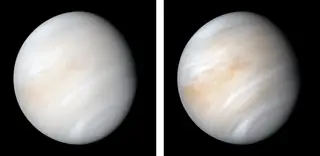
Going outward from Venus, each planet is colder than the one before. The break is at the start of the list: Venus averages 464 C while Mercury, closer to the Sun, averages 167 C. The reason is the atmosphere. Venus has a thick blanket of carbon dioxide, and Mercury has almost none. NASA puts the surface of Venus at 467 C, a few degrees off the fact sheet, and the two sources are measuring slightly different things. Which planet is the hottest? goes through the numbers.
Averages hide extremes
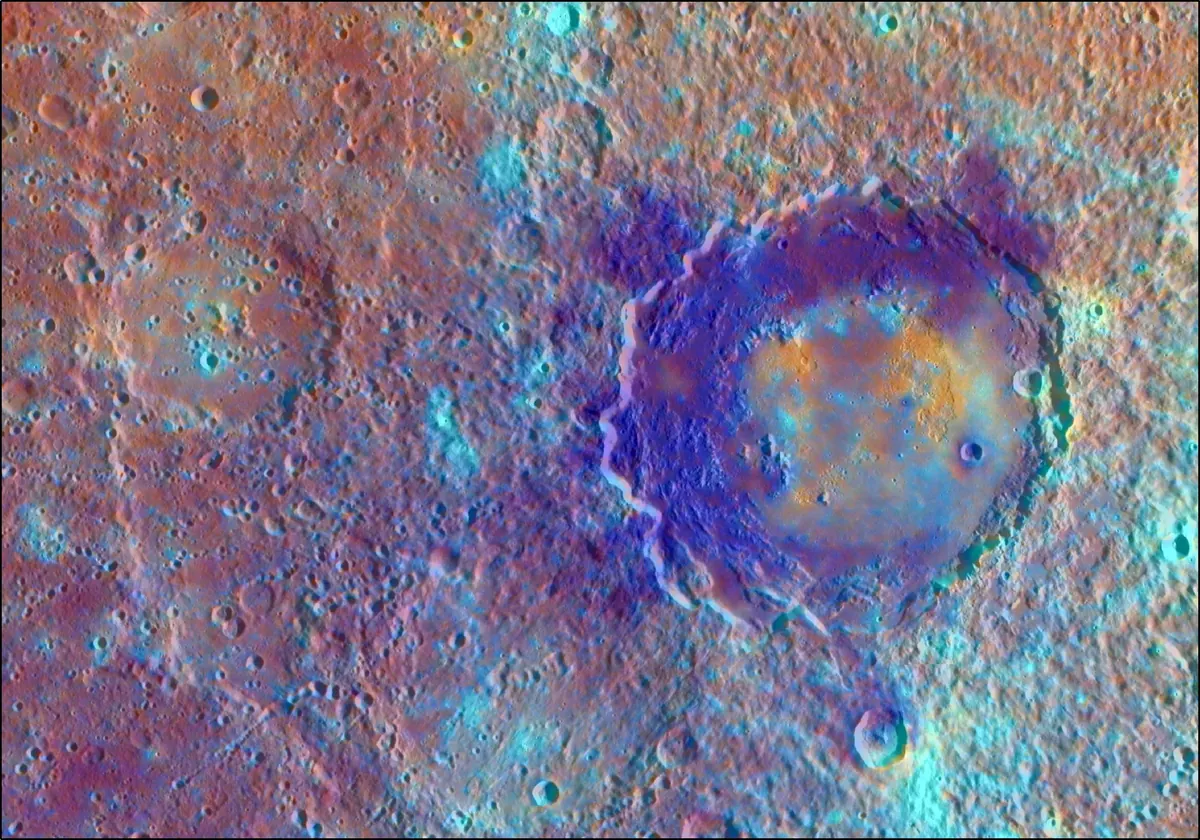
Mercury swings the most. NASA says its day side can reach about 430 degrees Celsius, and without an atmosphere to hold the heat, the night side can drop to about minus 180. A single average of 167 C hides a range of about 610 degrees. Oddly for the hottest-looking world, NASA says Mercury may hold water ice in deep craters at its poles, in places that never see the Sun.
Earth sits in a narrow band
At 15 C, Earth is the only planet with liquid water on its surface, according to NASA. Mars at -65 C is cold enough to keep its surface frozen and dry, though NASA missions have found evidence it was warmer and wetter long ago. The average is for the whole planet and the whole year: a summer afternoon at the Martian equator can feel mild, and the same place on a winter night is far colder.
The coldest planet isn't the farthest
Jupiter at -110 C, Saturn at -140, Uranus at -195 and Neptune at -200 are all measured high in the atmosphere, where the pressure is about the same as at sea level on Earth, since there's no surface to read. Neptune is farthest from the Sun, so it should be coldest, but the coldest atmosphere belongs to Uranus. NASA gives a minimum of 49 kelvin, or -224.2 C, for Uranus, even colder than Neptune in some places. The likely reason is heat from within: Neptune gives off noticeably more heat than it receives from the Sun, and Uranus gives off very little.
Far out
Pluto averages -225 C, and NASA gives about -235 C for the surface of Neptune's big moon Triton. At those temperatures nitrogen freezes, which is why Pluto has frozen plains of it.
What the greenhouse adds
A planet's temperature has a baseline set by sunlight, and the fact sheet's detail pages give a black-body temperature for each world: the temperature it would have if it had no atmosphere and absorbed the sunlight it receives. For Earth that figure is 254 kelvin, about -19 C, against an actual average of 15 C. The difference is the greenhouse effect, which keeps Earth about 34 degrees warmer. For Venus the black-body figure is 227 kelvin, or -47 C, and the average in the table is 511 degrees hotter than that.
Why temperature isn't one number
Temperature depends on where you stand and when. Mars is the example every rover team knows: a typical day reading and a typical night reading differ by tens of degrees. The planet's thin air can't hold heat. The average in the table can hide a swing like that, and so can the figure for a gas giant, which is read at one level in the atmosphere. Deeper down, the giants are far hotter.
Heat from within
Some planets make their own heat. Jupiter, Saturn and Neptune radiate more energy than they receive from the Sun, left over from their formation and from slow contraction. That's the reason Neptune, at 4,515 million kilometers, is warmer than its distance alone would suggest. The hottest planet page covers the opposite case, where a thick atmosphere does the work.
Sunlight for each world
The detail pages of the fact sheet give the sunlight reaching the inner planets in watts per square meter: Mercury 9,083, Venus 2,601, Earth 1,361, Mars 586. Those numbers fall off fast with distance. Without an atmosphere, the sunlight Earth receives, 1,361 W/m2, would hold the planet at about -19 C, which is how much work the atmosphere does for us.
Why scientists use kelvin
You'll see temperatures in kelvin in research papers, the same size of degree as Celsius but starting at absolute zero, minus 273.15 C. It avoids negative numbers on the cold worlds: Neptune averages 73 K, where in Celsius it is -200. The table above lists both, along with Fahrenheit. Pluto averages 48 K.
Questions people ask
Which planet is the hottest?
Venus, with an average of 464 C. It's hotter than Mercury, which is closer to the Sun, because of its thick atmosphere.
Which planet is the coldest?
Neptune has the lowest average of the eight planets, -200 C at the one-bar level. NASA gives a minimum of 49 K (-224.2 C) for the Uranus atmosphere.
What's the average temperature on Mars?
About -65 C (-85 F).
What's the temperature on Earth?
The average over the whole surface is 15 C (59 F).
Keep exploring
 Which planet is the hottest?Why Venus is hotter than Mercury, and the numbers behind it.
 Distance of each planet from the SunDistance in miles, kilometers, AU and light time, plus the distance from Earth.
 Planet tilt and seasonsAxial tilt of every planet, and how long a season lasts on each.
 VenusRocky planet, 0.72 AU from the Sun.