Axial tilt of every planet
| World | Tilt (degrees) | Spin | Year | A quarter of a year |
|---|---|---|---|---|
| Mercury | 0.034 | Forward spin | 88 days | 22 days |
| Venus | 177.4 | Backward spin | 225 days | 56 days |
| Earth | 23.4 | Forward spin | 365 days | 91 days |
| Mars | 25.2 | Forward spin | 1.9 years | 172 days |
| Jupiter | 3.1 | Forward spin | 11.9 years | 3.0 years |
| Saturn | 26.7 | Forward spin | 29.4 years | 7.4 years |
| Uranus | 97.8 | Backward spin | 83.7 years | 20.9 years |
| Neptune | 28.3 | Forward spin | 163.7 years | 40.9 years |
| Pluto | 119.5 | Backward spin | 247.9 years | 62.0 years |
Tilt is the angle between a planet's equator and its orbit. Values above 90 degrees mean the planet spins backward. From the NASA Planetary Fact Sheet. A quarter of a year is the rough length of a season on a planet with four of them.
How tilt makes seasons
When a planet leans its northern half toward the Sun, that half gets more direct sunlight and has summer, while the southern half has winter. Six months later it reverses. Earth's tilt of 23.4 degrees gives us our seasons, and Mars, at 25.2, and Neptune, at 28.3, are similar.
The myth about distance
A common belief is that summer comes when Earth is closer to the Sun. It doesn't. Earth is nearest the Sun, at perihelion, around January 2 to 5 in the north's winter, and farthest, at aphelion, around July 4 to 7, in summer. In January Earth receives about 7 percent more sunlight than in July, and the northern hemisphere is cold anyway. Tilt wins. The tilt also shapes the year in the sky, and the sky calendar shows what to look for overhead as the seasons turn.
Uranus: the extreme case
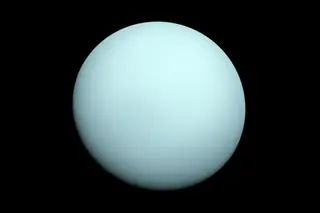
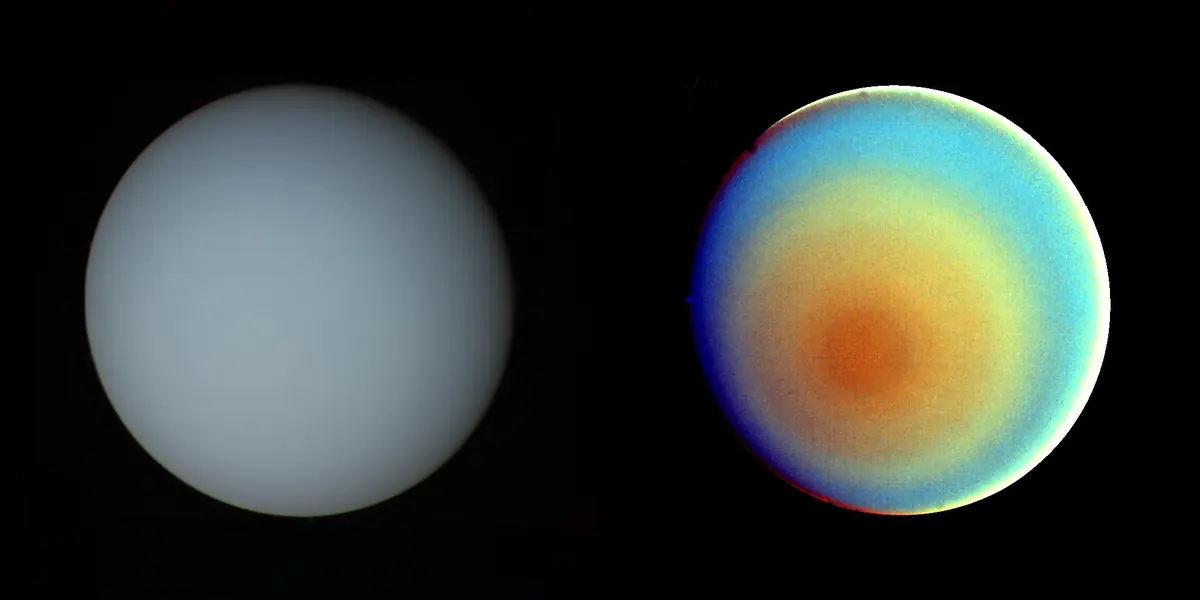
Uranus is tilted 97.8 degrees, so it looks as if it spins sideways and rolls around the Sun like a ball. For nearly a quarter of each Uranian year the Sun shines straight down on one pole, while the other half of the planet sits in a winter that lasts 21 years. NASA says the tilt may be the result of a collision with an Earth-sized object long ago.
In 2018 a team led by Jacob Kegerreis ran more than 50 computer simulations of such a collision, and found that an impact with a young protoplanet about twice the size of Earth could tip Uranus over. It's a model, not a proof, and no spacecraft has visited since Voyager 2 in 1986.
Venus: upside down
Venus's tilt of 177.4 degrees means that it's almost upside down compared with Earth, which is why it turns the opposite way from most planets. The Sun rises in the west there. See how long a day lasts on Venus, where the slow backward spin makes the calendar odd.
Mercury and Jupiter: no seasons to speak of
Mercury leans only 0.034 degrees and Jupiter leans 3.1, so both spin nearly upright and neither has strong seasons. Jupiter's year is 11.9 years long, but there's no summer or winter to count.
Why Earth's tilt is steady
A planet's tilt can wander over millions of years. In 1993 Jacques Laskar showed that Mars swings chaotically between about 0 and 60 degrees. Earth's tilt, he found, varies only about 1.3 degrees either side of its mean, and he argued that our large Moon is the reason: without it, the tilt could roam as far as roughly 85 degrees. Without the Moon, Earth's seasons might swing wildly over geological time. The moons hub has more about ours.
Seasons that outlast a life
Saturn leans 26.7 degrees, similar to Earth, so it has seasons, but each lasts about 7.4 years. On Neptune a season lasts more than 40 years. Pluto, tilted 119.5 degrees, goes through very long seasons over its 248-year orbit.
What the tilt does to the sky
A planet's tilt decides where the Sun stands at midday through the year. On Earth the Sun at noon swings 47 degrees up and down between the winter and summer solstices, and that swing is the seasons. On Uranus, tilted 97.8 degrees, the Sun can stand almost straight overhead at a pole. Mars has a tilt of 25.2 degrees, close to ours, which is why its polar caps grow and shrink on a schedule telescope users have followed for centuries.
Why the long seasons matter
Where a season lasts decades, the weather runs in slow motion. Uranus and Neptune show changes in brightness and cloud patterns across the span of a human life. The year-length page gives the full set of durations.
When the orbit matters more than the tilt
Earth's orbit is nearly a circle, so tilt does all the work. Other planets have oval orbits, and the distance to the Sun changes enough to add its own seasons. Mars is at 207 million kilometers at its closest and 249 at its farthest, so it receives about 1.45 times more sunlight at perihelion than at aphelion. Mercury has almost no tilt but swings between 46 and 70 million kilometers, a sunlight ratio of 2.30, and what it has instead of seasons is a long beat between closer and farther.
Where the polar circle sits
Tilt also sets the geography of the sky. The polar circle, the latitude beyond which the Sun stays up or down for at least a full day, lies at 90 degrees minus the tilt. On Earth that's 66.6 degrees, and on Mars 64.8. On Uranus, tilted 97.8 degrees, the polar circles lie only 7.8 degrees from the equator, so almost the entire planet goes through long spells of unbroken sunlight and unbroken night each Uranian year.
A quarter of an orbit
Because a Uranian year is 83.7 years, a quarter of it, the rough length of one season, is 20.9 years. On Pluto, with an orbit of 247.9 years and a tilt of 119.5 degrees, a season lasts 62.0 years, and the years since its discovery in 1930 cover only about 1.5 of them. Seasons that long are why planetary scientists talk in terms of decades of data.
Questions people ask
Which planet has the most tilt?
Pluto, a dwarf planet, is tilted 119.5 degrees. Of the eight planets, Venus is tilted 177.4 degrees, which means it's nearly upside down, and Uranus is tilted 97.8. Uranus spins on its side.
Why does Uranus spin on its side?
NASA says the tilt may be the result of a collision with an Earth-sized object long ago.
Does Mercury have seasons?
Almost none. Its axis is tilted only 0.034 degrees.
How long is a season on Neptune?
More than 40 years, since its year is 163.7 years.