What the first visitors found
Mariner 4 launched on 28 November 1964 and passed Mars on 15 July 1965, 9,846 km above the surface. Its 21 pictures covered about 1 percent of the planet and showed craters like the Moon's. That surprised people. Together with a very thin atmosphere, estimated at 4.1 to 7.0 millibars, it dampened the hope of finding anything advanced.
Viking 1 landed on 20 July 1976 and kept working until 11 November 1982, about about 6 years, 3 months and 3 weeks. Viking 2 landed on 3 September 1976 and shut down on 12 April 1980 after a battery failure. Their three life-detection experiments gave one result that looked like metabolism, but most scientists concluded that ordinary chemistry in the oxidizing soil explained it. Later finds of perchlorate salts strengthened that view, and the question is still formally unresolved.
Mars Pathfinder landed on 4 July 1997 using airbags and carried the rover Sojourner. The plan was a week to a month. It lasted 83 sols, until 27 September 1997. The rover list picks up the story from there.
The planet has seasons, polar ice caps, extinct volcanoes, canyons and weather. Its red color comes from iron minerals in the dust that rust, which is why it was named for the Roman god of war and why the Egyptians called it the red one.
A Mars day is a little longer than ours, 24.6 hours, and Martian days are called sols. A year lasts 687 Earth days, or 669.6 sols. The tilt, 25 degrees, is close to Earth's, so Mars has seasons, but they last longer, and because the orbit is egg-shaped the seasons are different lengths.
Mars in numbers
| Measure | Mars | Compared with Earth |
|---|---|---|
| Diameter | 6,792 km | 0.53 x Earth |
| Mass | 0.642 x 1024 kg | 0.108 x Earth |
| Density | 3,934 kg/m3 | 0.71 x Earth |
| Surface gravity | 3.7 m/s2 | 0.38 x Earth |
| Escape velocity | 5 km/s | 0.45 x Earth |
| One rotation | 24.6 hours | 1.03 x Earth |
| Sunrise to sunrise | 24.7 hours | 1.03 x Earth |
| Year | 1.9 years (687 Earth days) | 1.88 x Earth |
| Average distance from the Sun | 228.0 million km (1.52 AU) | 1.52 x Earth |
| Average temperature | -65 C (-85 F) | Earth: 15 C |
| Axial tilt | 25.2 degrees | Earth: 23.4 degrees |
| Moons | 2 | Earth: 1 |
| Rings | No | Earth: No |
Numbers from the NASA Planetary Fact Sheet. Moon count from the JPL list read on October 19, 2026.
What makes Mars different
Mars has two small, potato-shaped moons, Phobos and Deimos, that may be captured asteroids. They're named for the horses that pulled the chariot of the Greek god of war. Phobos is slowly moving toward Mars and will crash into the planet or break apart in about 50 million years. Deimos is about half as big as Phobos and orbits two and a half times farther out.
NASA missions have found lots of evidence that Mars was much wetter and warmer, with a thicker atmosphere, billions of years ago. Scientists don't expect living things to be thriving there now. They're looking for signs of life that existed long ago.
Visiting Mars
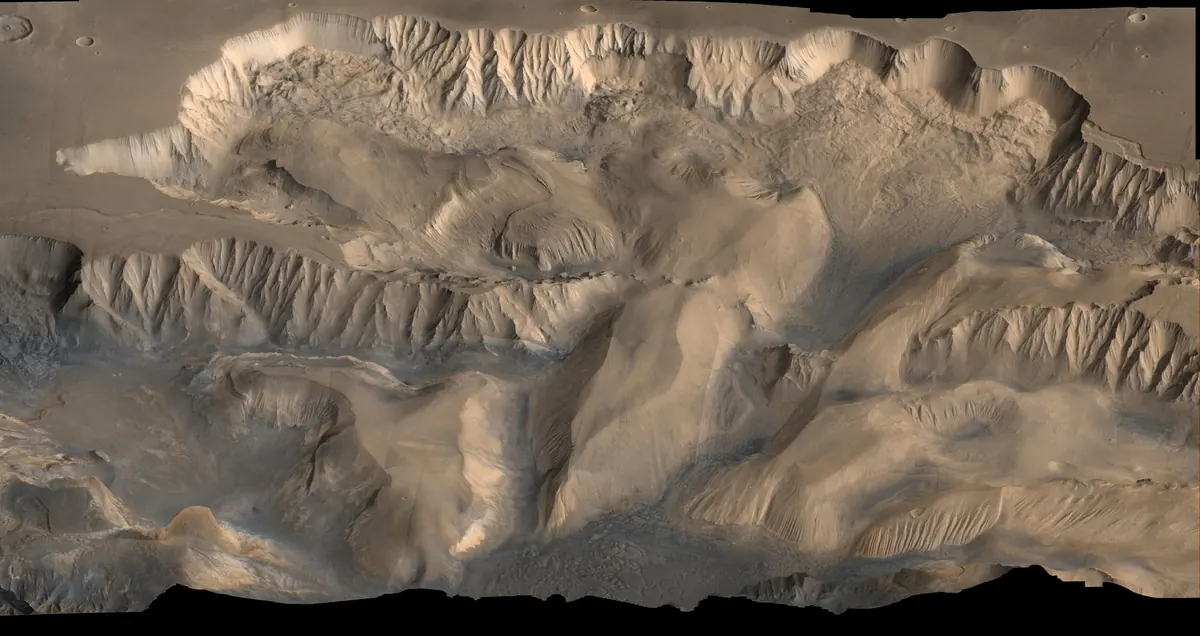
Mars is one of the most explored bodies in the solar system. The image on this page shows Valles Marineris, a canyon system assembled from pictures taken by the Viking orbiters.
Known, inferred, unknown
We keep these apart on every science page.
Measured: we know this
- The surface is cold and dry, with an average temperature of about minus 65 degrees Celsius and a very thin atmosphere.
- Mars has two moons, Phobos and Deimos.
Inferred: we think this
- The planet was once much wetter and warmer, with a thicker atmosphere, billions of years ago.
- Phobos and Deimos may be captured asteroids.
Unknown: we don't know
- Whether life ever existed on Mars. Researchers are looking for signs of life from the time when the planet was warmer and wetter.
Questions people ask
How long is a day on Mars?
One rotation takes 24.6 hours.
How many moons does Mars have?
It has 2 known moons, by the JPL list read on October 19, 2026.
How long is a year on Mars?
A Martian year is 687 Earth days, which is 669.6 Martian days (sols).
Keep exploring
 EarthRocky planet, 1.00 AU from the Sun.
 JupiterGas giant, 5.20 AU from the Sun.
 How long is a day on each planet?Day length on every planet, and why a day isn't always one spin.
 Planet sizes comparedEvery planet drawn to scale, with diameters next to Earth.
 Weight on other planetsWhat you would weigh on Mars.
Biggest on the map
Olympus Mons stands more than 25 miles (about 40 km) from base to summit, and its base covers an area about the size of Arizona. Valles Marineris runs about 3,870 km, spans up to 600 km across and drops 9.3 km from rim to floor.
NASA gives the temperature range as -153 to 20 C. Winds sometimes whip up storms that cover much of the planet, and it can take months for the dust to settle.
Where the water went
Ancient river valleys, deltas and lakebeds point to a wetter past. NASA says some features suggest huge floods about 3.5 billion years ago. Water ice lies just under the surface near the poles, and briny water seasonally flows down some slopes and crater walls today.
The surface gravity is 3.7 m/s squared, about 0.38 of Earth's, which is the number the weight calculator uses.
Perseverance, Ingenuity and the sample question
Perseverance launched on 30 July 2020 and landed in Jezero Crater on 18 February 2021. Its helicopter, Ingenuity, made its first flight on 19 April 2021 and went on to 72 flights before NASA retired it after the last one on 18 January 2024. An experiment called MOXIE made 122 grams of oxygen from the carbon dioxide in the air.
The rover carries 43 sample tubes, and 33 were filled as of July 2025. Bringing them home was the aim of Mars Sample Return, which NASA paused on 13 November 2023. In April 2024 NASA said the roughly $11 billion cost wasn't feasible and turned to cheaper options. The record of what has worked is on the success rate page, and the best windows to see the planet are on the opposition page.