The next eight oppositions
| Date | Time | Distance from Earth | In kilometers |
|---|---|---|---|
| February 19, 2027 | 15:44 UTC | 0.678 AU | 101 million km |
| March 25, 2029 | 07:21 UTC | 0.649 AU | 97 million km |
| May 4, 2031 | 11:30 UTC | 0.559 AU | 84 million km |
| June 28, 2033 | 01:10 UTC | 0.427 AU | 64 million km |
| September 15, 2035 | 20:12 UTC | 0.382 AU | 57 million km |
| November 19, 2037 | 09:16 UTC | 0.499 AU | 75 million km |
| January 2, 2040 | 15:06 UTC | 0.614 AU | 92 million km |
| February 6, 2042 | 11:44 UTC | 0.672 AU | 101 million km |
Opposition is when the planet is on the opposite side of Earth from the Sun, so it rises at sunset, is highest at midnight and stays up all night. Dates are calculated in UTC and checked against NASA's JPL Horizons: dates agree to about an hour and distances to within 1 percent.
Why some Mars oppositions are better than others
Mars comes round every 780 days, but the distance at opposition varies a lot because its orbit is quite oval. In the next eight oppositions Mars is as close as 0.38 AU and as far as 0.68 AU, so it looks about 1.8 times wider at the best of them than at the worst. A close, or favorable, opposition is the one to wait for if you want surface detail through a telescope.
Gaps between oppositions run from 764 to 809 days in this list. The gap isn't constant for the same reason: Mars moves faster near the Sun and slower far from it.
What opposition does and doesn't mean
Opposition is a good time to look because the planet is up all night and close. But the closest approach to Earth falls a few days either side of opposition, not exactly on it, because the planets orbit in ellipses and Earth is moving too. In this list Mars is nearest, at 0.38 AU, at the opposition on September 15, 2035, and farthest, at 0.68 AU, on February 19, 2027.
The oppositions worth waiting for
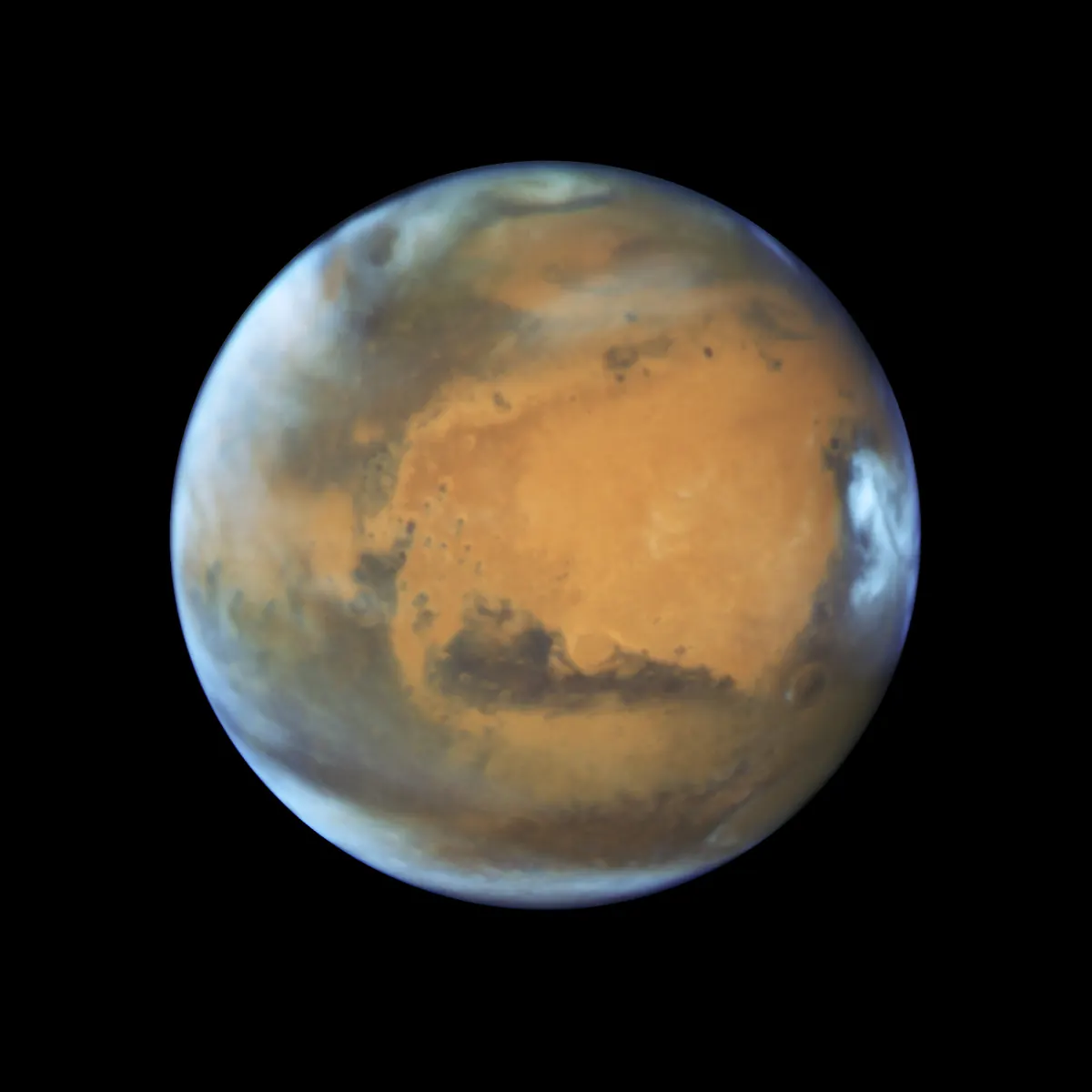
Mars is a small planet, and for most of its two-year cycle it's a tiny, plain dot in a telescope. Opposition changes that, but not equally every time. Of the next eight oppositions in the table above, the best is on September 15, 2035, when Mars is 57 million kilometers away and its disk is 24.5 arcseconds wide. The poorest is on February 19, 2027, at 101 million kilometers and 13.8 arcseconds.
Planetary scientists call the good ones favorable oppositions. They happen when Mars is near its closest point to the Sun, a point called perihelion, as Earth passes it. NASA's JPL said the opposition of August 27, 2003 brought Mars to 55.76 million kilometers, the closest in nearly 60,000 years. The best of the next eight is 2 percent farther away than that record.
How Mars fixed the shape of the planets' orbits
Oppositions are how we learned that planetary orbits aren't circles. Johannes Kepler spent years working with Tycho Brahe's careful measurements of Mars. No circle fitted them, and in 1609 he published Astronomia nova, which argued that the planet moves in an ellipse with the Sun at one focus. Kepler's first two laws of planetary motion appear in that book.
Mars gave the answer because its orbit is noticeably oval. Its eccentricity is 0.094 on NASA's fact sheet, against 0.049 for Jupiter, so the departure from a circle was big enough for Tycho's instruments to reveal.
Two moons and a network of channels
Mars has two moons, and they were found at an opposition. In August 1877, the astronomer Asaph Hall searched the sky near the planet with the 26-inch refractor at the U.S. Naval Observatory, Washington. He found Deimos on August 11, 1877 and Phobos on August 17, 1877, and the discovery was announced on August 18, 1877. The moons are small, and in the light of a bright planet they're hard to see, which is why a close opposition was the right time to look.
The same opposition produced an enduring mistake. Giovanni Schiaparelli reported a network of canali, or channels, on Mars in 1877. The word was translated into English as canals, and the idea that someone had built them kept going for decades, even though later spacecraft found no such thing. It's a good reminder of how much a planet at the edge of what telescopes can resolve can mislead.
When dust covers everything
A close opposition doesn't guarantee a good view. Dust storms on Mars can grow into global ones and hide the surface for weeks. The storm that began on May 30, 2018 was declared global by June 20, 2018, and it was still going when Mars reached opposition on July 27, 2018, at 58 million kilometers. NASA's Opportunity rover, which relied on sunlight, went silent in the storm and was declared lost in February 2019.
That's why observers watch Mars for weeks before opposition. A bright, pale cloud or a sudden loss of dark markings is the warning that the surface is hidden, and it can spoil a planned night.
What you can see
Through a small telescope at a good opposition, Mars shows a white polar cap and the dark region called Syrtis Major. Steady air matters more than the size of the telescope. The planet rotates once in 24.6 hours, so if you see a marking on one night, you'll find it about 40 minutes later the next night, and over a few weeks the whole surface rotates into view.
Binoculars show only a red-orange star-like point, and the brightness is the easy thing to enjoy. The next one is on February 19, 2027, at 101 million kilometers. For the other outer planets, see the list of planet oppositions, or compare Jupiter, whose distance barely changes, and Saturn, whose rings do. For what it would be like to stand on Mars, try the space calculators on this site.
 Planet oppositionsWhen each planet next reaches opposition.
 Jupiter oppositionThe next dates and distances.
 Space calculatorsYour weight and age on Mars.
Questions people ask
When is Mars at opposition next?
February 19, 2027, at 0.68 AU from Earth.
How often is Mars at opposition?
About every 780 days, which is the time Earth takes to catch up with the planet again.
When is Mars closest to Earth?
Closest approach is within a few days of opposition. The nearest opposition in the next eight is September 15, 2035, at 0.38 AU.
What does opposition mean?
The planet is on the opposite side of Earth from the Sun, so it rises at sunset and stays up all night.