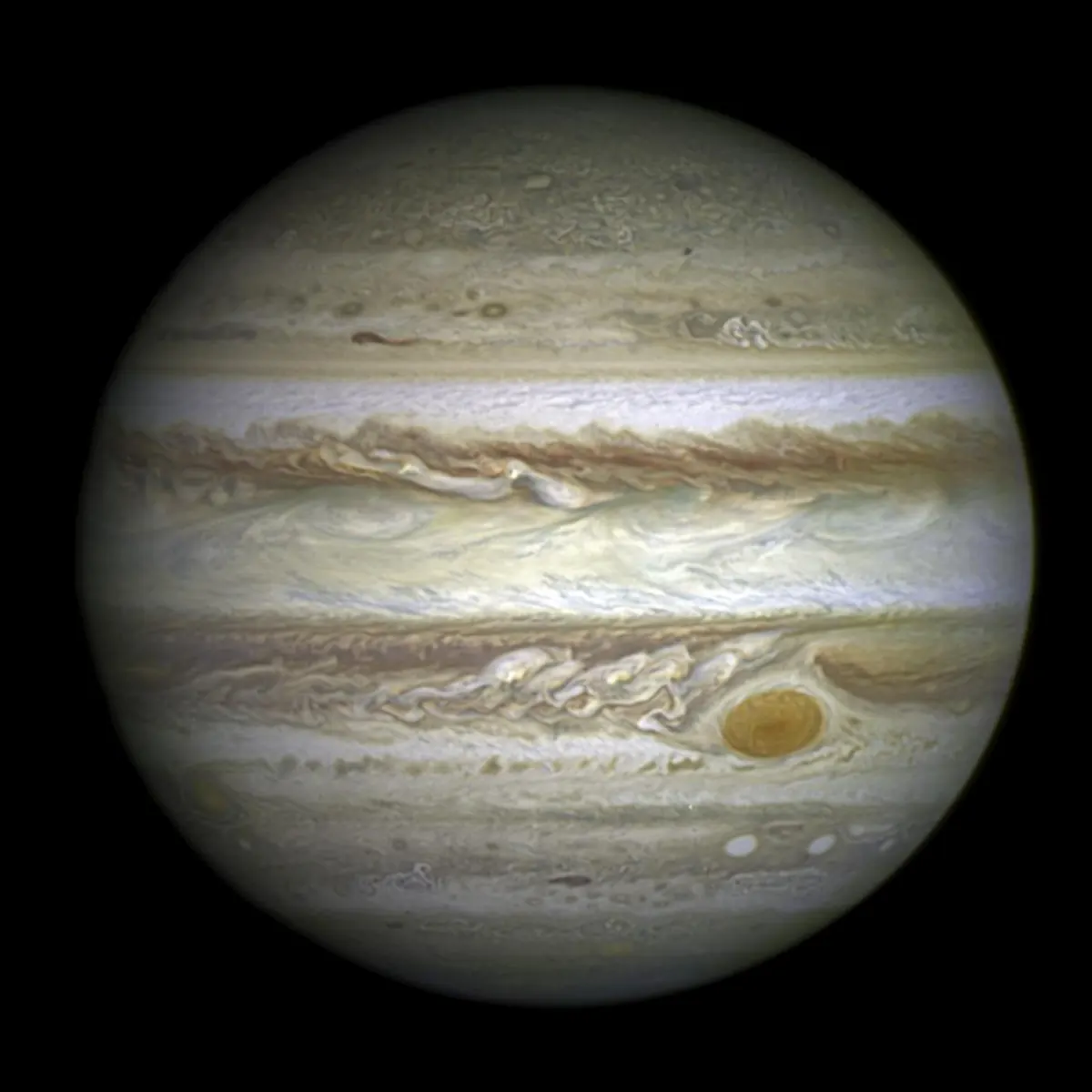
The next eight oppositions
| Date | Time | Distance from Earth | In kilometers |
|---|---|---|---|
| February 11, 2027 | 00:11 UTC | 4.361 AU | 652 million km |
| March 12, 2028 | 15:09 UTC | 4.441 AU | 664 million km |
| April 12, 2029 | 03:38 UTC | 4.451 AU | 666 million km |
| May 13, 2030 | 11:25 UTC | 4.387 AU | 656 million km |
| June 15, 2031 | 09:14 UTC | 4.266 AU | 638 million km |
| July 19, 2032 | 08:22 UTC | 4.121 AU | 616 million km |
| August 25, 2033 | 05:20 UTC | 4.000 AU | 598 million km |
| October 2, 2034 | 00:28 UTC | 3.950 AU | 591 million km |
Opposition is when the planet is on the opposite side of Earth from the Sun, so it rises at sunset, is highest at midnight and stays up all night. Dates are calculated in UTC and checked against NASA's JPL Horizons: dates agree to about an hour and distances to within 1 percent.
Why the Jupiter opposition date creeps later
Jupiter takes almost 12 years to go round the Sun, so Earth catches up with it a little over a year after each opposition. Oppositions come roughly every 399 days and the date moves about a month later each time. The distance changes only a little, from 3.95 AU to 4.45 AU in the next eight, so Jupiter looks much the same size each year.
What opposition does and doesn't mean
Opposition is a good time to look because the planet is up all night and close. But the closest approach to Earth falls a few days either side of opposition, not exactly on it, because the planets orbit in ellipses and Earth is moving too. In this list Jupiter is nearest, at 3.95 AU, at the opposition on October 2, 2034, and farthest, at 4.45 AU, on April 12, 2029.
A slow planet on a regular schedule
Jupiter is the easiest of the outer planets to plan around. It takes 11.9 years to circle the Sun, so Earth catches it up after 399 days, or 34 days more than a year. Each opposition is therefore about a month later in the calendar than the one before. The next is on February 11, 2027.
The distance hardly changes. In the next eight oppositions Jupiter is between 591 and 666 million kilometers away, and its disk runs from 44.3 to 49.9 arcseconds, because its orbit is almost circular. Jupiter is by far the biggest planet, with a diameter of 142,984 kilometers, and it's bright enough that you don't need an opposition to find it.
Galileo's four points of light
Jupiter is where the telescope first changed our picture of the sky. On January 7, 1610, Galileo Galilei saw three small stars near Jupiter, and a few nights later a fourth. He saw that they changed place from night to night and always stayed in a line with the planet. He concluded that they were moons going round Jupiter, which showed that not everything in the sky circled Earth. He published his observations in Sidereus Nuncius on March 13, 1610.
Today NASA's fact sheet lists 95 moons for the planet. Four are still called the Galilean moons, and you can see them in binoculars held steady on a wall. They look like a short line of small stars, and they change places within hours, so a quick look an hour apart is worth doing.
A spot that has outlasted the telescope
The Great Red Spot is a storm larger than Earth. Records of a spot are old: Robert Hooke described a spot on Jupiter in 1664, and Giovanni Cassini wrote about one in 1665. Researchers aren't certain whether those were the same storm as the spot first confirmed in 1831. NASA says a continuous record of at least one observation a year goes back to 1878, and the spot has slowly shrunk.
Jupiter turns once in 9.9 hours, faster than any other planet. This fast spin stretches the clouds into the bands you can see in a small telescope, and a feature crosses the visible disk in about five hours, so you can follow the Red Spot on any night when it is facing Earth.
When a comet hit
In July 1994, astronomers watched pieces of Comet Shoemaker-Levy 9 hit Jupiter, from July 16 to July 22. It was the first time that people had seen two bodies of the solar system collide, and the impact scars were visible in small telescopes for weeks.
Jupiter's strong gravity keeps drawing in comets and asteroids, and a later hit was found by an amateur. On July 19, 2009, an Australian amateur astronomer, Anthony Wesley, noticed a dark mark near Jupiter's south pole that turned out to be the scar of an impact. Observers who photograph Jupiter often are still the ones most likely to spot the next one.
How to watch it
Opposition is the time when Jupiter is brightest and visible from dusk to dawn, but because its distance changes so little, the weeks before and after are almost as good. Look for the four moons with binoculars, the two main cloud belts with a 60 mm telescope and the Red Spot with a larger one. The planet also twinkles far less than a star does, which helps you pick it out.
If you want to compare it with the other giants, the Saturn opposition page has the ring tilt, the Mars opposition page shows a planet whose distance swings widely, and the planet oppositions page puts the dates side by side.
Eight years of Jupiter
Across the table, the opposition moves from February 2027 to October 2034, about 34 days later each year. At that rate the date takes about 11 years to work all the way round the calendar, one lap of Jupiter's orbit less a year's catching up.
The time of year matters because Jupiter lies close to the ecliptic, the path of the Sun. At a summer opposition in the Northern Hemisphere it's low all night, and at a winter one it rides high.
 Planet oppositionsWhen each planet next reaches opposition.
 Saturn oppositionThe next dates and ring tilt.
 Mars oppositionThe next dates and distances.
Questions people ask
When is Jupiter at opposition next?
February 11, 2027, at 4.36 AU from Earth.
How often is Jupiter at opposition?
About every 399 days, which is the time Earth takes to catch up with the planet again.
When is Jupiter closest to Earth?
Closest approach is within a few days of opposition. The nearest opposition in the next eight is October 2, 2034, at 3.95 AU.
What does opposition mean?
The planet is on the opposite side of Earth from the Sun, so it rises at sunset and stays up all night.