Why the question has two answers
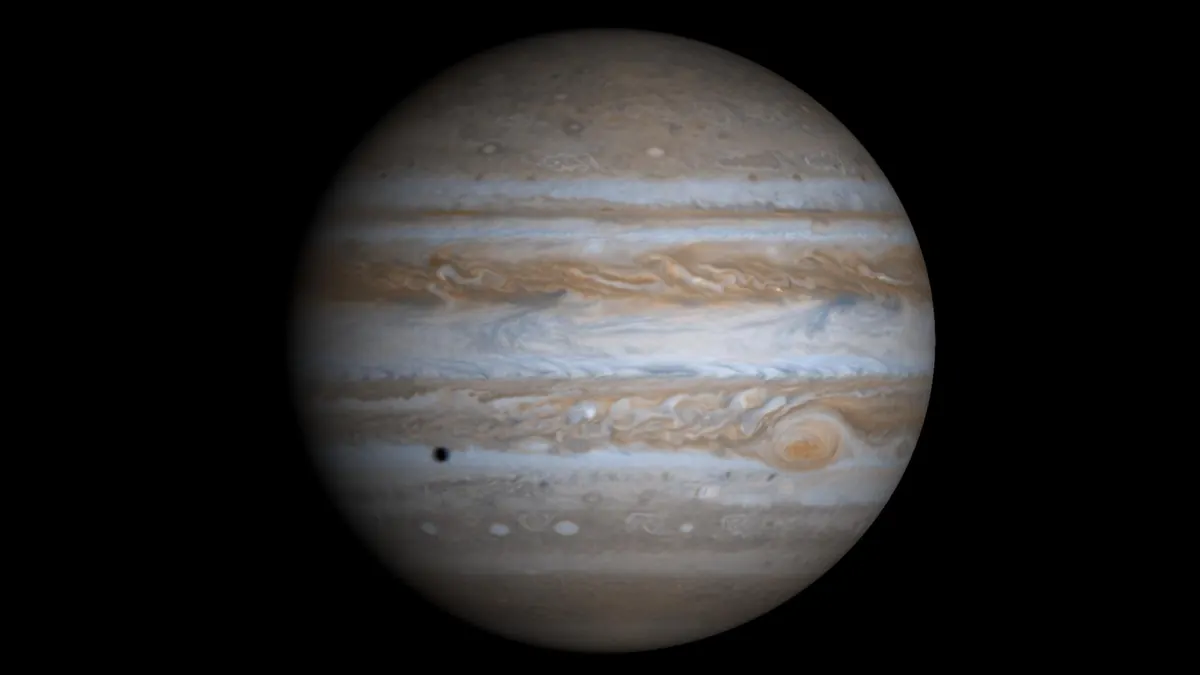
There are two ways to ask how many Earths fit inside something, and they give wildly different numbers. One is about space: how many Earth-sized balls would it take to fill Jupiter if you could pour them in. The other is about stuff: how many Earths' worth of material does Jupiter hold. For Jupiter the first answer is about 1,321 and the second is about 318. The gap between them is the most interesting thing on this page.
Volume compared with Earth
| World | Volume (Earths) | Mass (Earths) |
|---|---|---|
| Mercury | 0.056 | 0.055 |
| Venus | 0.857 | 0.816 |
| Earth | 1 | 1 |
| Mars | 0.151 | 0.108 |
| Jupiter | 1,321 | 318 |
| Saturn | 764 | 95.1 |
| Uranus | 63.1 | 14.5 |
| Neptune | 57.7 | 17.1 |
| Pluto | 0.006 | 0.002 |
Volume ratios come from each planet's fact sheet page and allow for the planet's slightly flattened shape. The Sun's volume is 1,304,000 Earths. NASA's Jupiter page gives a rounder figure of about 1,000 Earths for a hollow Jupiter. This page uses the fact sheet number.
Why a bigger planet is so much bigger
Jupiter is 11.2 times wider than Earth, but volume grows with the cube of width. Eleven times wider means more than a thousand times the volume, and the arithmetic gets bigger quickly after that. The Sun has 109 times Earth's radius, so its volume is 1,304,000 times Earth's, and 987 Jupiters would fit in it.
That cube rule is also why size comparisons feel wrong. A planet twice as wide holds eight times as much, and a star 109 times as wide holds about 1,304,000 times as much. Picture the Sun as tall as a front door, and Earth beside it would be a marble. The planet sizes page draws all of them to the same scale.
An old guess that was far too small
The ancient Greek astronomer Aristarchus of Samos tried the Sun's size by geometry, using the angles between the Sun, Moon and Earth at a half Moon. He concluded that the Sun is 18 to 20 times farther away than the Moon, when the true ratio is about 390. His method was sound and his angles were too hard to measure by eye. Even so, his figures implied that the Sun is larger than Earth.
Volume isn't the same as weight
Jupiter holds 1,321 Earths by volume but only about 318 Earths of mass. The difference is density. Jupiter is mostly hydrogen and helium, so it's a lot lighter for its size than rock and iron. Earth's average density is 5,514 kg per cubic meter and Jupiter's is 1,326. Even so, Jupiter outweighs all the other planets put together by a factor of about 2.5 in the fact sheet numbers, and it holds more than all the rest of the planetary system combined.
The Sun dwarfs everything
The Sun has about 332,900 times the mass of Earth. NASA's Solar Dynamics Observatory team says it holds 99.8 percent of the mass of the solar system, so all the planets together, Jupiter included, make up the other fraction of a percent. It's about 109 times wider than Earth.
The size difference marks a boundary. Jupiter, big as it is, would need to be many times more massive to squeeze its core hard enough to ignite as a star. The planets aren't small stars that failed. They're a different kind of object, and the Sun holds nearly all the material in the system.
Packing isn't perfect
These are volume ratios. They show how much space there is, not how many round Earths you could stack inside, because spheres leave gaps when they pack. Even a perfect packing of equal spheres fills only about three quarters of the space, so the real count would be lower still.
Every other planet inside Jupiter
Add up the volumes of the other seven planets and you get about 886 Earths' worth, from the table above. Jupiter alone is about 1,321 Earths by the fact sheet, so all the rest of the planets together would fill roughly 67 percent of it. Saturn, the second giant, accounts for most of that. This is the sense in which Jupiter is the solar system's other heavyweight: not only the biggest planet, but bigger than everything else orbiting the Sun put together, apart from the Sun itself.
Why the Sun's size is hard to imagine
The Sun's mean radius is 695,700 kilometers, about 109 times Earth's. That's 1.8 times the distance from Earth to the Moon, so the Moon's whole orbit would fit inside the Sun with room to spare. On the scale model page this is the first thing that stops people.
How planets get weighed
The mass column comes from watching things fall. A moon's orbit depends on the mass of the planet it circles, so planets with moons were weighed by timing the moons, which Venus and Mercury don't have. Both were measured from the way passing spacecraft were pulled off course. Once you know a planet's mass and its volume you get its density, and the gap between Jupiter, with 318 Earth masses spread through 1,321 Earth volumes, and a rocky planet is a quick way to see what a world is made of. The density page follows that thread.
The mass story is even more lopsided
By mass the planets are odder still. The Sun weighs 333,065 Earths. The sum of all eight planets comes to 447 Earth masses, a bit over a thousandth of the Sun's mass. We live on one of the small bits left over from the making of a star. Saturn shows the volume and mass gap clearly: it holds about 764 Earths by volume and only 95 by mass. Counted in a smaller unit, it would take about 8,751 planets the size of Mars to fill Jupiter.
Questions people ask
How many Earths fit inside Jupiter?
About 1,321 Earths by volume. Jupiter is 11.2 times wider than Earth.
How many Earths fit inside the Sun?
About 1,304,000 Earths by volume.
How many Jupiters fit inside the Sun?
About 987 Jupiters by volume.
How much heavier is Jupiter than Earth?
Jupiter has about 318 times the mass of Earth, much less than its volume ratio, because it's made mostly of light gas.
Keep exploring
 Planet sizes comparedEvery planet drawn to scale, with diameters next to Earth.
 Density of each planetWhich planet is densest, and why Saturn is lighter than water.
 Gravity on each planetSurface gravity on every world, and what you would weigh.
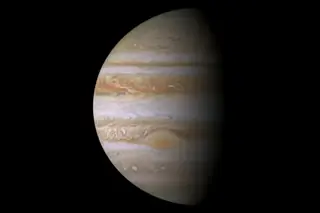 JupiterGas giant, 5.20 AU from the Sun.
The only spacecraft to fly through the Sun's outer atmosphere is the Parker Solar Probe.