How do you weigh a planet?
The gravity figures on this page rest on masses that nobody can put on a scale. The first step was taken in a London laboratory. Between 1797 and 1798, Henry Cavendish measured the tiny pull between lead balls, which was the first time the strength of gravity itself was measured in a lab. His result was expressed as the density of the Earth: 5.448 times that of water. From that, the mass of the planet followed. Once you know how strongly gravity pulls, the orbit of any moon, or of a passing spacecraft, tells you the mass of the planet it circles, and surface gravity is just that mass divided by the square of the planet's radius.
Surface gravity compared
| World | Gravity (m/s2) | Times Earth | 80 kg person weighs | Escape velocity |
|---|---|---|---|---|
| Mercury | 3.7 | 0.38 | 30 kg | 4.3 km/s |
| Venus | 8.9 | 0.91 | 73 kg | 10.4 km/s |
| Earth | 9.8 | 1.00 | 80 kg | 11.2 km/s |
| Mars | 3.7 | 0.38 | 30 kg | 5 km/s |
| Jupiter | 23.1 | 2.36 | 189 kg | 59.5 km/s |
| Saturn | 9 | 0.92 | 73 kg | 35.5 km/s |
| Uranus | 8.7 | 0.89 | 71 kg | 21.3 km/s |
| Neptune | 11 | 1.12 | 90 kg | 23.5 km/s |
| Pluto | 0.7 | 0.07 | 6 kg | 1.3 km/s |
Bars show gravity in tenths of m/s2. For Jupiter, Saturn, Uranus and Neptune, gravity is given at the one-bar level in the atmosphere, because these planets have no solid surface to stand on. The 80 kg person is only a round example.
Why weight changes but mass doesn't
Your mass is how much matter you're made of, and it stays the same everywhere. Weight is the pull of the planet on that mass, so it changes from world to world. A scale on Mars would read about 38 percent of what it reads at home, even though you're the same person. On Jupiter it would read 236 percent, a bit more than double.
What a jump looks like
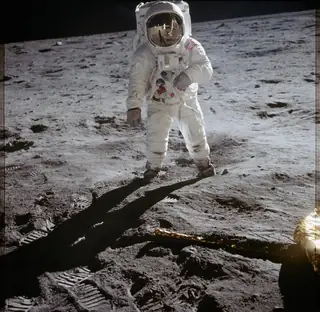
Gravity decides how high you go. Take a jump that lifts you half a meter on Earth. With the same push, you would rise about 1.3 meters on Mars and about 3.0 meters on the Moon, because height scales with the inverse of gravity. That's a back-of-envelope estimate, but it matches the look of the Apollo footage.
The Moon and the hammer
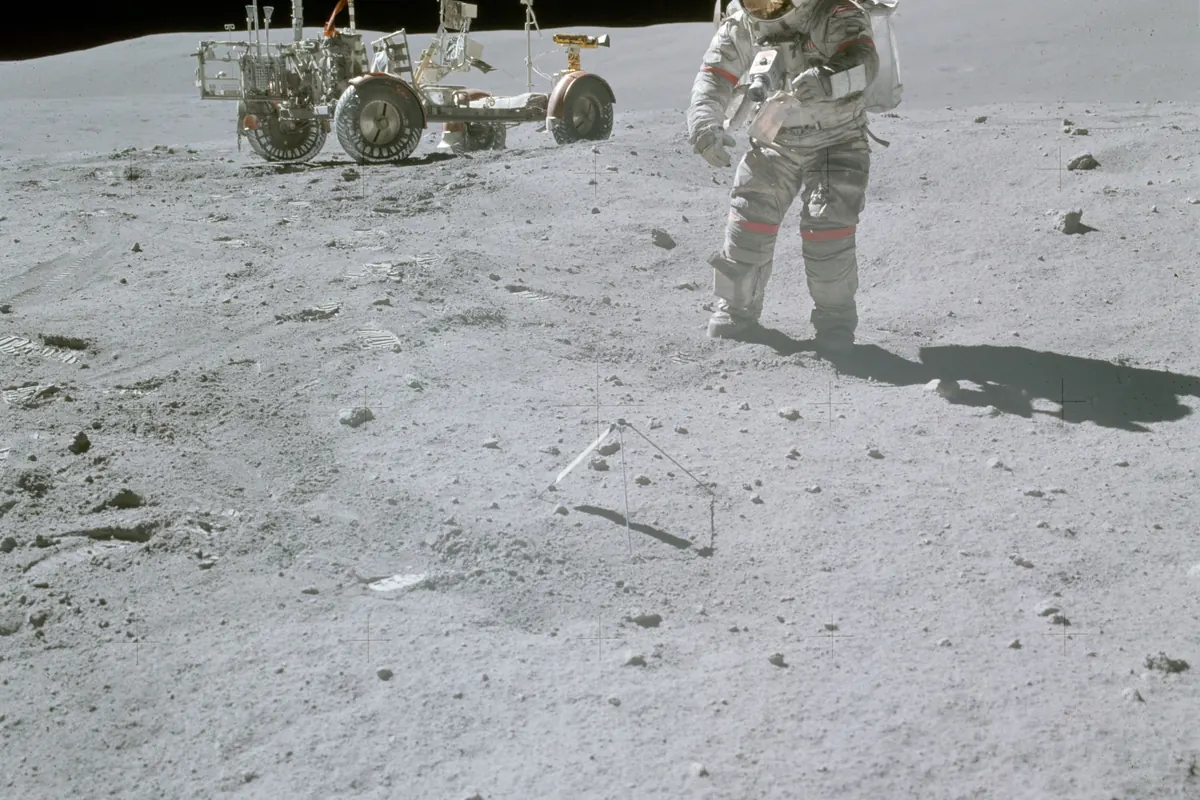
The Moon's gravity is about one sixth of Earth's, which is why the Apollo astronauts bounced and loped across the surface in their bulky suits. In August 1971, Apollo 15 commander David Scott held a 1.32 kilogram geologic hammer in one hand and a 0.03 kilogram falcon feather in the other, in front of a camera, and let go. With no air to slow the feather, both hit the dust together, and Scott said that Galileo had been right. Try the weight calculator to see your own number on every world.
The planets with no ground
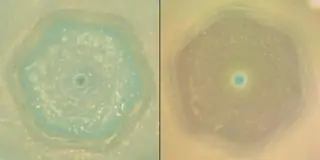
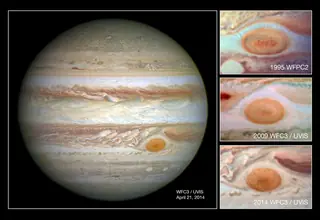
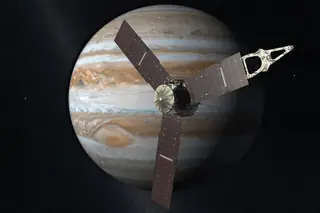
For the four giants, the gravity in the table is measured at the one-bar level, which is roughly where the pressure matches sea level on Earth, and there's nothing solid to stand on. Saturn is 9.4 times wider than Earth, yet its gravity at that level is 0.92 times Earth's, because the planet is so light for its size. Jupiter pulls at 2.36 times Earth's. NASA says measurements by the Juno spacecraft show a core much larger than expected and not solid, a result that came from watching how the planet's gravity pulls on the spacecraft.
Gravity doesn't vanish in orbit
Astronauts on the International Space Station float, but gravity there's still about 90 percent of its strength at the surface. They float because they're in constant free fall around Earth, along with the station. The same effect makes the escape velocity column worth reading: it's the speed a rocket needs to leave the surface for good. From Earth it's 11.2 km/s, from Mars 5 km/s, and from Jupiter 59.5 km/s, more than five times as much.
Low gravity isn't weightlessness
Low gravity feels like floating, but it doesn't make work easy. A pressurized suit is stiff, and the effort of pushing, stopping and turning depends on mass, which doesn't change. A person who weighs 80 kg on Earth would read 30 kg on Mars, while carrying the same mass. Weight is what changes, and inertia stays the same.
Gravity and atmosphere
A planet's gravity decides what it can keep. Escape velocity is 11.2 km/s for Earth and 5 for Mars, and a lower figure lets gas leak away over billions of years. Pluto's is only 1.3 km/s. Jupiter, at 59.5, holds on to even hydrogen and helium, the lightest gases there are.
Gravity inside you
Bodies that spend months in low gravity change. Astronauts on the International Space Station lose bone and muscle unless they exercise for hours each day. Gravity on Mars is 0.38 times Earth's, and no one yet knows if that's enough to keep a human body healthy for years. The missions hub follows the work to find out.
Gravity differs across one planet
A planet's gravity isn't the same everywhere. Fast rotation and a squashed shape change it between equator and pole. On Jupiter the fact sheet gives 23.12 m/s2 at the equator and 27.01 at the pole, a spread of about 17 percent. Earth's own spread is far smaller, 9.78 at the equator against 9.83 at the poles. The table on this page uses a mean value, which is the figure most people want. On Jupiter the equator is the lighter place because the spin throws the surface outward, and the planet bulges there as well, which puts the equator farther from the center.
Questions people ask
What's the gravity on Mars?
Surface gravity on Mars is 3.7 m/s2, or 0.38 times Earth's. A person who weighs 80 kg on Earth would read 30 kg on a scale on Mars.
Which planet has the strongest gravity?
Jupiter, at 23.1 m/s2 at the one-bar level, 2.36 times Earth's.
Which planet has the weakest gravity?
Of the eight planets, Mercury and Mars are lowest at 3.7 m/s2, 0.38 times Earth's. Pluto, a dwarf planet, is weaker still at 0.7 m/s2.
What's the gravity on the Moon?
The Moon's surface gravity is 1.6 m/s2, 0.166 times Earth's, about one sixth.