Neptune's ghost
Astronomers have found a planet from its pull before. In 1846, Uranus wasn't moving quite as expected, the mathematician Urbain Le Verrier worked out where an unseen planet had to be, and Johann Galle found Neptune on his first night of looking. The same logic led Percival Lowell to hunt for a 'Planet X' beyond Neptune, and 1930 brought Pluto, which turned out to be far too small to be the culprit.
The story took its modern turn on 5 January 2005, when Mike Brown, Chad Trujillo and David Rabinowitz found Eris, a world about the size of Pluto (opens in a new tab), roughly 2,400 kilometers across. Eris helped force the debate that ended on 26 August 2006 with Pluto reclassified as a dwarf planet (the story is on why Pluto isn't a planet). Brown later turned to a different question: whether something larger was still out there.
Odd orbits in the dark
The clues were a handful of far-flung objects. Sedna, found in 2003, never comes closer to the Sun than about 76 times Earth's distance, and a second, 2012 VP113, announced in March 2014, stays out beyond about 80. In 2014, Chad Trujillo and Scott Sheppard noticed that these and other extreme objects have similar orbits, and suggested an unseen planet 200 to 300 times Earth's distance from the Sun.
In January 2016, Konstantin Batygin and Brown of Caltech put numbers on it. Six distant objects had orbits that clustered in the same direction, and they calculated only a 0.007 percent chance that this was coincidence. The six came from six different surveys on six different telescopes, which they argued made a pointing bias unlikely. A planet of several Earth masses on a distant, stretched orbit would herd them, and it would also explain a handful of other oddities in the outer solar system.
The clue
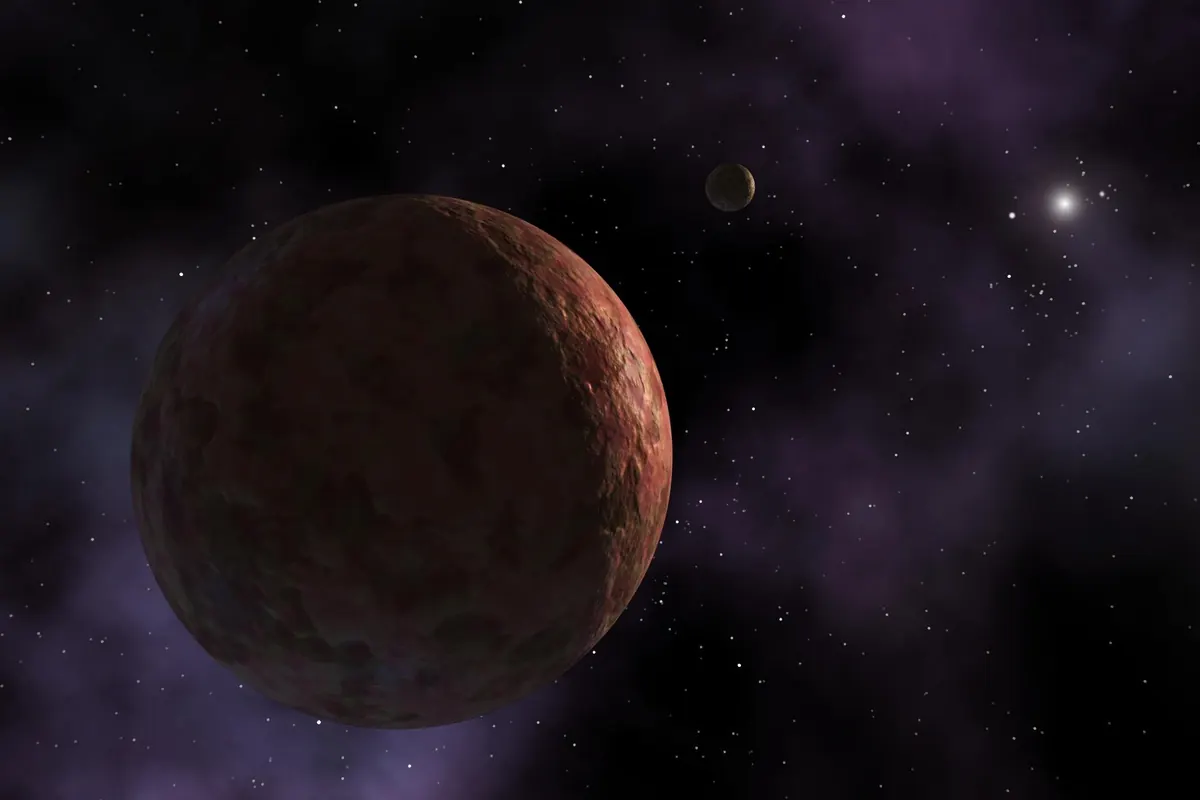
Some objects far out in the Kuiper Belt follow stretched orbits that point the same way and tilt the same way, which would be unlikely by chance. Batygin and Brown found that the clustering had only a 0.007 percent probability of being chance and could be explained by a distant, eccentric planet of more than about 10 Earth masses, whose closest approach to the Sun lies 180 degrees away from theirs. The same planet would account for the Sedna-like objects (the picture shows Sedna) and a group of bodies on steeply tilted orbits.
NASA lists five puzzles the planet would explain, including why distant Kuiper Belt orbits tilt by about 20 degrees to the planets' plane, why the plane of the planets is tilted about 6 degrees to the Sun's equator, and why some objects orbit backwards. If it exists, NASA says it might have a mass of 5 to 10 times that of Earth, orbit 20 to 30 times farther from the Sun on average than Neptune, and take between 10,000 and 20,000 Earth years to go round the Sun.
| Question | Where things stand |
|---|---|
| Has Planet Nine been seen? | No. NASA says it hasn't been discovered and that the scientific community is divided about whether it exists. |
| What's the evidence? | The gravitational pattern in the orbits of distant bodies, not a direct sighting. |
| Is it the same as Planet X? | The name Planet X goes back to a 1915 idea of Percival Lowell about Uranus's orbit, which turned out to be a measurement error but led to the discovery of Pluto in 1930. Planet Nine refers to the 2016 proposal. |
| Could the clustering be chance? | Possibly. A survey that found more than 800 new distant bodies produced an analysis consistent with a random spread, though it couldn't rule Planet Nine out. |
The search
Astronomers are looking with the Keck and Subaru telescopes in Hawaii, and Backyard Worlds: Planet 9, a NASA-funded citizen science project using images from NASA's WISE mission. The WISE mission ended on 31 July 2024. The Vera C. Rubin Observatory in Chile is designed to carry out a 10-year survey of the southern sky, and it'll find more distant objects. If their orbits line up with each other, that would be more evidence for Planet Nine, or at least show where to look. If they don't, the explanation may be that the planet doesn't exist.
Measured: we know this
- A set of distant Kuiper Belt objects have orbits that cluster. The 2016 paper put the chance of coincidence at 0.007 percent.
Inferred: we think this
- A planet of several Earth masses on a distant elongated orbit could explain the clustering, and NASA lists five puzzles it would explain. This is a hypothesis, not a finding.
- Random observational bias in the sky coverage could explain the pattern. Some researchers argue for that.
Unknown: we don't know
- Whether Planet Nine exists at all.
- If it does, where it is and what it is, such as how massive it is and how it formed.
What would settle it
- A direct detection by a deep survey telescope.
- Or an independent set of distant objects whose orbits don't cluster, which would weaken the case.
In human terms
- Neptune orbits at about 30 times Earth's distance from the Sun. If NASA's range is right, Planet Nine would average 600 to 900 times Earth's distance, by simple multiplication.
Questions people ask
Does Planet Nine exist?
Nobody knows. NASA says it hasn't been discovered and that scientists disagree about whether it exists.
Is Pluto Planet Nine?
No. Pluto was found in 1930 and is now classed as a dwarf planet. Planet Nine is a different, hypothetical world proposed in 2016.
How would astronomers find it?
By detecting it directly with a very sensitive survey, or by finding more distant objects whose orbits fit its pull. The Rubin Observatory's ten-year survey is built for that kind of search.
 New HorizonsThe Kuiper Belt visitor.
 OumuamuaA visitor from another star.
 All mysteriesEvery open question on the site.
The estimate keeps moving
NASA's range for the hypothetical planet is 5 to 10 times Earth's mass, on an orbit 20 to 30 times farther out than Neptune. The newest published fit, a 2024 analysis by Amir Siraj, Christopher Chyba and Scott Tremaine (arXiv:2410.18170 (opens in a new tab)), puts it closer and lighter: a semi-major axis of 290 plus or minus 30 times Earth's distance and a mass of 4.4 plus or minus 1.1 Earth masses. That sort of shift is what a hypothesis does when the data are thin. A planet that moves every time somebody refits it hasn't been found, and the numbers shown on this page should be read as one analysis among several, not as a measurement.
The case against
Not everyone is convinced the clustering is real. The Outer Solar System Origins Survey found eight distant objects with orbits larger than 150 times Earth's distance, and after correcting for the way surveys favor certain parts of the sky, it saw no clustering. A 2020 analysis of more than 800 trans-Neptunian objects from that survey and the Dark Energy Survey likewise found none. Those results don't rule a planet out, but they weaken the evidence that sent astronomers looking for one.
There are rival explanations for the same orbits. A primordial black hole, proposed in 2019, could pull on them. A planet captured from another star, as argued in 2020, is a version of the same idea. A massive disk of small distant bodies could do it without any single planet at all.
What to watch next
The test is simple to state and hard to do. A planet that big, that far away, reflects very little light, so finding it means taking deep pictures of a lot of sky and watching for something that moves slowly. The Vera C. Rubin Observatory began its ten-year survey of the southern sky in July 2026, and its images will either turn up the planet or add to the list of objects whose orbits can test the clustering. Until something is found, this mystery sits in the same corner as dark matter: a gravitational pull that we infer without seeing the source. For the Kuiper Belt that sits closer in, see what New Horizons found, and for a feel for how far hundreds of times Earth's distance really is, see the scale of the solar system.