The cluster that wouldn't hold together
In 1933 the Swiss-born astronomer Fritz Zwicky studied the Coma Cluster, a crowd of galaxies, and found them moving too fast for the gravity of the matter anyone could see. At those speeds the cluster should have flown apart. Zwicky concluded that something unseen was supplying the missing pull and called it "dunkle Materie", dark matter. He thought of it as ordinary matter that happened to be dim, nothing like the exotic stuff physicists mean today, and as NASA tells the story (opens in a new tab), the idea didn't change until the 1970s.
The curve that didn't fall
What changed it was Vera Rubin and a better spectrograph. In 1965 Rubin applied to observe at Palomar Observatory as the first woman allowed to, and was reluctantly given access with her time limited, she was told, because "we don't have a women's bathroom." With the instrument builder Kent Ford she then measured how fast gas and stars circle at different distances from the center of the Andromeda galaxy, in a 1970 paper in The Astrophysical Journal (opens in a new tab).
Inside the bright part of a galaxy, orbital speeds climb. Outside it, where there is little light, they should fall, the way the outer planets orbit the Sun more slowly than the inner ones (see how a planets year grows with distance). They didn't fall. In 1980, Rubin, Ford and Norbert Thonnard reported the same flat curves across 21 spiral galaxies, reaching out to 122 kiloparsecs, about 400,000 light years, in the largest. The outermost material was moving as fast as the inner. A flat curve means mass keeps adding up where the light stops: every galaxy sits inside a halo of something that gives off no light.
Three more ways to see the invisible
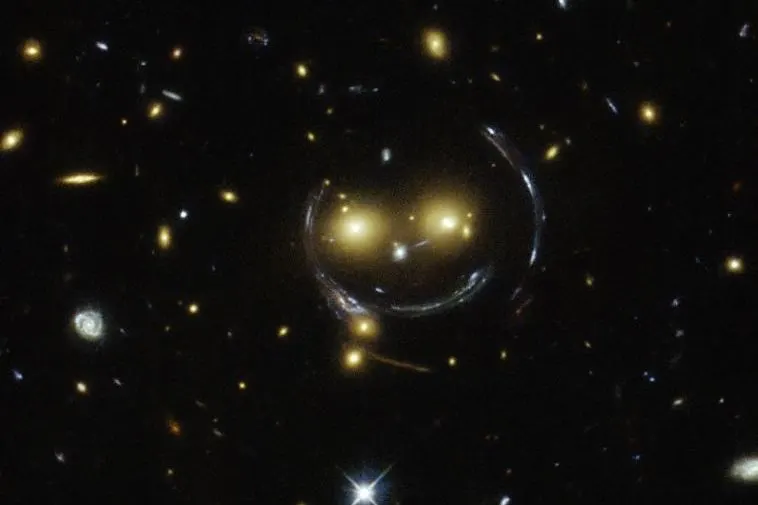
Gravity bends light, so a clump of mass works like a lens, and astronomers can map the mass in a galaxy cluster from how it distorts the galaxies behind it. The cleanest test is the Bullet Cluster, 1E 0657-56, about 3.8 billion light years away, where two clusters have collided. Chandra's X-rays show the hot gas, which slowed in the crash and stayed in the middle. The lensing map shows most of the mass sitting well outside the gas. That's what you'd expect if the missing mass passes through collisions untouched.
The third line of evidence is the afterglow of the Big Bang. The pattern in the cosmic microwave background fits a universe where dark matter outweighs ordinary matter about five to one, which is where the figures at the top of this page come from.
In human terms
- Of all the energy and matter in the universe, ordinary stuff (stars, planets, you) is about 5%. Dark matter is about 27%. The remaining 68% is dark energy.
- Dark matter is thought to outweigh the ordinary matter in a galaxy by about 5 to 1.
Measured: we know this
- Stars at the edge of galaxies orbit too fast for the visible matter alone to hold them in.
- Gravitational lensing maps show mass where there is no visible matter.
- The pattern of the cosmic microwave background fits a universe with about five times more dark matter than ordinary matter.
Inferred: we think this
- Dark matter is a kind of particle that barely interacts with light or normal matter.
- It's "cold", meaning slow moving, which helps galaxies form.
Unknown: we don't know
- What the particle is, or whether it's a particle at all.
- Underground detectors have run for decades and haven't yet confirmed a detection.
- Whether modified gravity theories can replace it. Most evidence disfavours that, but the question isn't closed.
What would settle it
- A confirmed signal in a direct-detection experiment.
- Making the particle in a collider and matching it to the sky.
- An observation that dark matter alone can't explain and modified gravity can.
Questions people ask
What's dark matter?
Matter that gives off no light. We know it's there from what it does: stars at the edges of galaxies orbit too fast for visible matter alone, and gravitational lensing maps show mass where nothing is visible.
How much of the universe is dark matter?
About 27%. Ordinary matter is about 5% and dark energy about 68%.
Has dark matter been detected?
Not directly. Underground detectors have run for decades without a confirmed detection.
Could modified gravity replace dark matter?
Most evidence disfavors that, but the question isn't closed.
The hunt for the particle
If dark matter is a particle, it barely touches anything. The leading candidates are weakly interacting massive particles, WIMPs, and axions, which were first theorized in 1977 to solve a puzzle in the physics of the strong force. Primordial black holes, proposed in 1966 by Yakov Zeldovich and Igor Novikov and in 1971 by Stephen Hawking, are a third.
The best-funded WIMP search is LUX-ZEPLIN, a tank holding 7 tonnes of liquid xenon about 1.5 kilometers underground at the Sanford Underground Research Facility in South Dakota, shielded from cosmic rays by the rock above it. Its first results came in 2022 and 2023, and after 280 days of running by August 2024 it had found no dark matter. It has company: the XENON and PandaX experiments, and the earlier LUX detector, all reported null results across the standard WIMP mass range. A null result isn't a failure. Each one rules out a range of particle masses and strengths, which is why axions have become more popular.
The rival idea
A minority of physicists argue that no unseen matter is needed and that gravity itself behaves differently at the scales of galaxies. Modified Newtonian dynamics and its relatives do reproduce flat rotation curves. The trouble is everything else. No modified-gravity theory yet explains all the evidence at once, and the Bullet Cluster is a particular problem: its lensing is centered away from the visible matter, which modified gravity, tied to visible matter, doesn't predict.
What to watch next
Two telescopes are now mapping where the mass is. Euclid, an ESA mission with NASA contributions, launched on 1 July 2023 to make a 3D map of the universe. The Vera C. Rubin Observatory on Cerro Pachon in Chile, renamed in 20 December 2019 in the astronomer's honor, began its ten-year survey of the southern sky in July 2026. Both will measure how matter clumps, which tests dark matter models and the dark energy that works against them. Space telescopes help from another side: Webb uses lensing to find the faintest early galaxies. And the Hubble tension shows how much still depends on getting the contents of the universe right.
Sources
Planck 2018 cosmological parameters (ESA). NASA Science: Dark Matter and Dark Energy. Rubin and Ford, Astrophysical Journal 159, 379 (1970). Rubin, Ford and Thonnard, Astrophysical Journal 238, 471 (1980). NASA Science: Euclid. Vera C. Rubin Observatory.