A telescope with a long lead time
Webb is named for James Webb, who ran NASA during the early Apollo years, and it's a partnership of NASA, the European Space Agency and the Canadian Space Agency. It left Kourou, French Guiana, on an Ariane 5 rocket on 25 December 2021, Christmas Day, and took a month to reach its orbit, arriving on 24 January 2022. Along the way it unfolded itself: the sunshield first, then the mirror, whose segments were folded to fit inside the rocket.
What makes that unusual is that nobody could fix it afterward. Hubble was visited by astronauts several times. Webb sits about 1.5 million kilometers away, far beyond any crewed mission, so the unfolding had to work the first time. It did, and the first full-color images came out on 12 July 2022.
Why it is so far away and so cold
Webb looks at infrared light, which is heat radiation, so the telescope itself has to be very cold or it would drown out the faint signals it's chasing. It does that by hiding behind a five-layer sunshield at the second Sun-Earth Lagrange point, 1.5 million km from Earth (1 million miles), where the Sun, Earth and Moon are all on the same side. Hubble, by comparison, orbits only 560 km above Earth. The telescope stays below 50 Kelvin (-223 degrees Celsius), the near-infrared instruments run at about 39 K, and the mid-infrared instrument is chilled to 7 K by a helium cryocooler.
A mirror too big for a rocket
| Aspect | Webb | Hubble |
|---|---|---|
| Primary mirror | 6.5 m, 18 hexagonal segments of 1.32 m | 2.4 m |
| Where it is | 1.5 million km from Earth, at L2 | 560 km above Earth |
| Light it sees | 0.6 to 28 micrometers, orange light through the mid-infrared | Visible light, with some infrared |
NASA's engineers found that a Hubble-style mirror scaled up to 6.5 m would have been too heavy to launch. So they built the mirror from 18 segments, using only one-tenth of Hubble's mass per unit of area, and folded it up to fit in the rocket. The segments are coated in gold, which reflects red and infrared light very well. Four instruments sit behind the mirror.
What it is finding
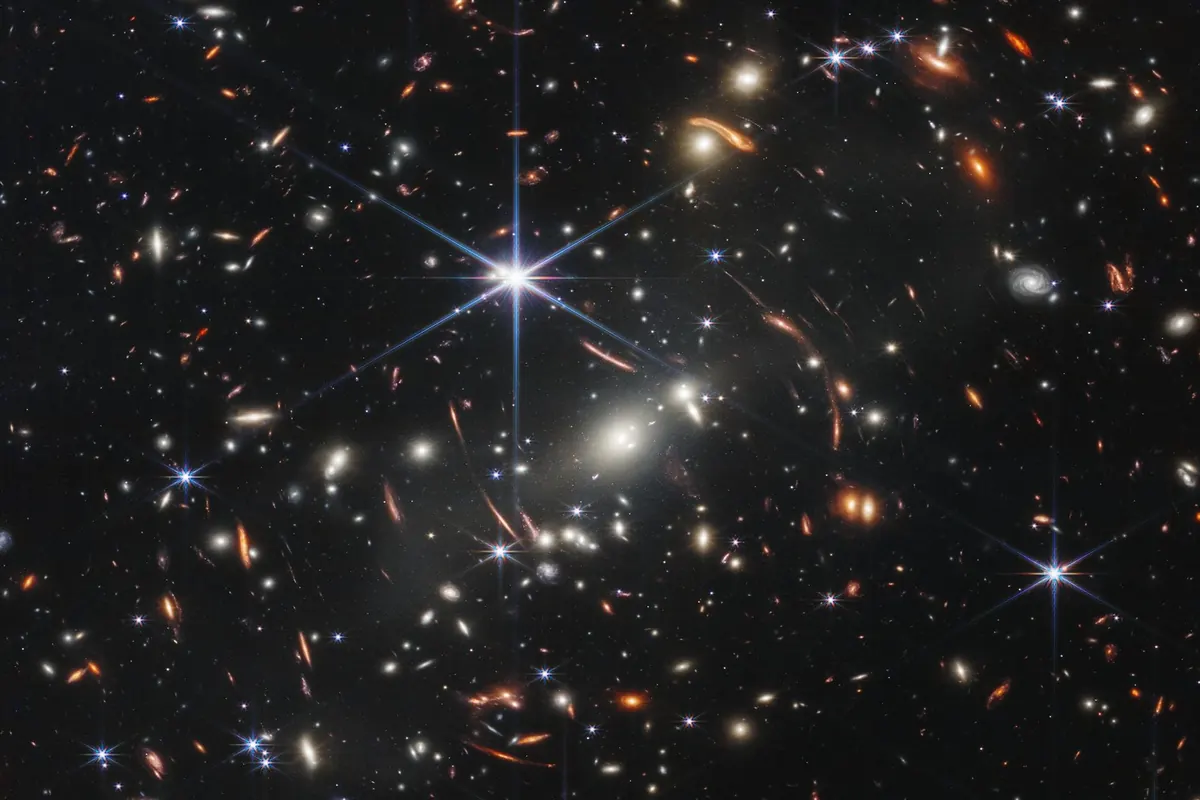
Webb's first full-color images were released on 12 July 2022, led by the deep field of galaxy cluster SMACS 0723 shown above, in which gravitational lensing by the cluster stretches the light of galaxies far behind it. NASA now says the observatory has enough propellant for more than two decades of science. In October 2026 it measured the distance to the farthest fast radio burst yet seen, FRB 20240304B, whose host galaxy sits at a redshift of 2.148, about 3 billion years after the big bang. See fast radio bursts for the story.
Measured: we know this
- Webb's host-galaxy measurement of FRB 20240304B: redshift 2.148, about 3 billion years after the big bang, announced by NASA on 8 October 2026.
- The telescope has been at L2 since 24 January 2022 and works across 0.6 to 28 micrometers.
Inferred: we think this
- NASA says astronomers theorize that the compact "little red dots" seen mostly in the early universe are active supermassive black holes.
- The observatory should be able to support science for more than two decades, because it has enough propellant. Other factors, such as hardware degrading in space, could shorten that.
Unknown: we don't know
- How the first galaxies formed. Webb was built to look at galaxies at redshifts of 15 or more.
- How long the hardware will last in the harsh environment of space.
What would settle it
- More Webb data on distance-ladder stars, which the Hubble constant teams say is needed to tighten the measurement of the universe's expansion rate. See the Hubble tension.
In human terms
- Details sharp enough to pick out a US penny at about 24 miles, or a soccer ball at about 340 miles, NASA says, for its sharpest near-infrared vision.
- The sunshield is about the size of a tennis court. The telescope has to stay below 50 K.
Questions people ask
Where's the James Webb Space Telescope?
About 1.5 million km from Earth at the second Sun-Earth Lagrange point, L2. It orbits the Sun there, not the Earth.
Why is Webb so cold?
It observes infrared light, which is heat, so it has to stay below 50 Kelvin (-223 degrees Celsius). A five-layer sunshield blocks the heat from the Sun, Earth and Moon.
How big is the Webb mirror?
The primary mirror is 6.5 m across and made of 18 hexagonal segments, each 1.32 m wide, compared with Hubble's 2.4 m mirror.
 The Hubble tensionWhy the universe's expansion rate depends on how you measure it.
 Fast radio burstsWebb found the farthest one's home galaxy.
 Dark energyWhat's speeding up the expansion?All probesEvery spacecraft page on the site.
Why redshift decides the wavelength
Expansion of the universe stretches light on its way to us. A redshift z means wavelengths are lengthened by a factor of 1 plus z. For the fast radio burst host at z = 2.148, that's a stretch of about 3.1. For the galaxies Webb was built to hunt, at redshifts of 15 or more, the factor is 16 or more, so light that left as visible, at about half a micrometer, arrives near 8 micrometers, deep in the infrared.
That's why Webb's instruments cover 0.6 to 28 micrometers, and why it needs to be cold. At 8 micrometers, even a warm telescope would glow brighter than the faint galaxies it's trying to see.
Measuring as well as looking
The headline images get the attention, but a lot of Webb's work is numbers. Its instruments split light into spectra, which show what elements are present in a galaxy or in an exoplanet's atmosphere, how fast things are moving, and how far away they are. The fast radio burst result is a good case: the host's redshift is a distance measurement, and it's what tells astronomers when in cosmic history the burst happened.
The same approach feeds other open questions on this site. In the exoplanets hub, spectra are how scientists read the gases in a planet's atmosphere. In the case of the Hubble tension, Webb's observations of the stars used to measure distances help test whether the disagreement is real. And for how fast the universe's expansion is changing, see dark energy.