An idea Einstein regretted
Dark energy is a very old idea in new clothes. In 1917 Einstein added a term to his equations of gravity, the cosmological constant, because without it the equations said a universe full of matter couldn't sit still, and everyone assumed the universe did. Then the data changed. Alexander Friedmann showed in 1922 that the equations worked fine for a universe that changes size, Georges Lemaitre argued in 1927 that ours is expanding, and Edwin Hubble's observations in 1929 backed it up. By 1931 Einstein accepted an expanding universe without the extra term.
The famous line, that the constant was his biggest blunder, traces back to the physicist George Gamow, and historians have found no record of Einstein writing the phrase himself.
1998: two teams, one shock
The constant came back because of supernovae. The Supernova Cosmology Project's first reports, in July 1997, seemed to show the expansion slowing down, which is what gravity should do. Then the picture flipped. In 1998 that team and a rival group, the High-Z Supernova Search Team, both announced that distant supernovae were fainter than they should be, which meant the expansion was speeding up. Saul Perlmutter, Brian Schmidt and Adam Riess shared the 2011 Nobel Prize in Physics (opens in a new tab). The cosmological constant went back into the equations, and the name dark energy was attached to whatever it is.
The worst prediction in physics
The trouble starts when physicists try to compute how much energy empty space should have. Quantum theory says space is never truly empty, so it should carry some energy, and that energy would act like a cosmological constant. The number that comes out of the simple calculation is bigger than the measured value by a factor of around 10 to the 120th power, a 1 followed by 120 zeros. That figure is an estimate and depends on assumptions, but even cautious versions are huge, and physicists often call it the worst theoretical prediction in the history of their field. Whatever dark energy is, nobody has calculated it from first principles.
How it was found
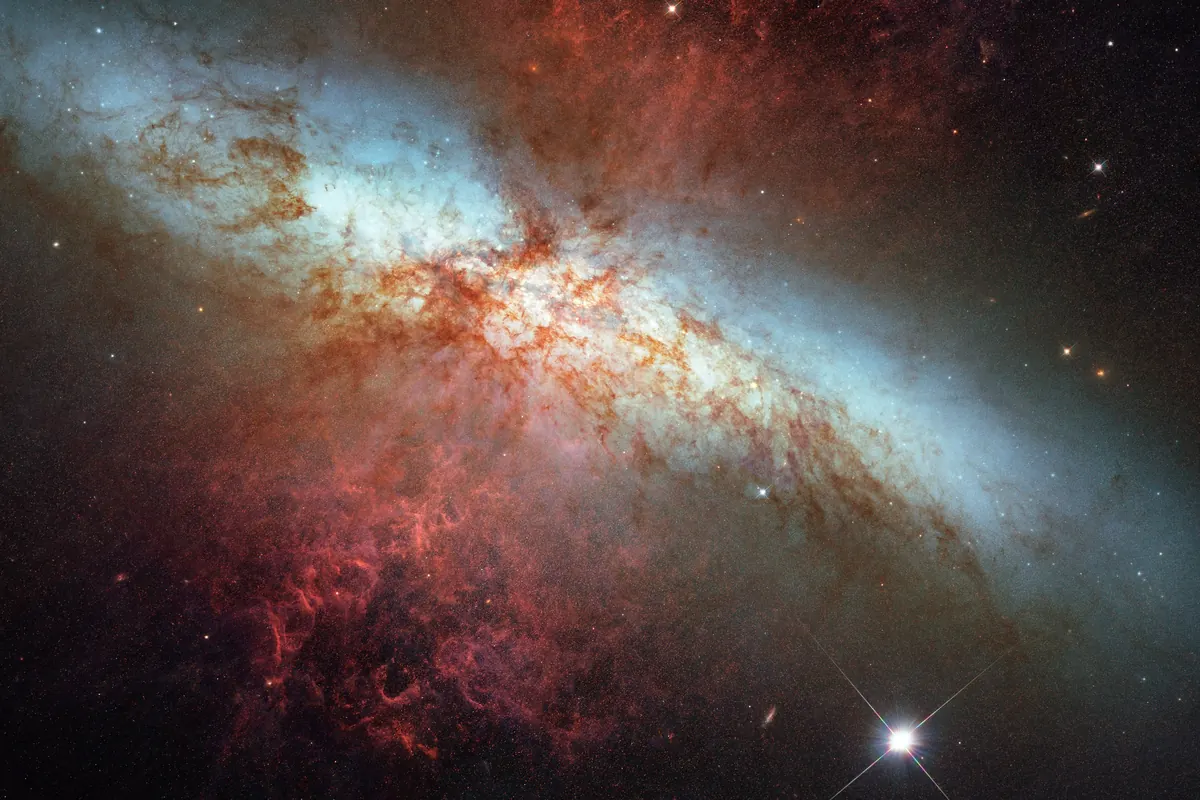
The universe began about 13.8 billion years ago with a rapid expansion, and gravity was expected to slow it. But nine billion years after the universe began, NASA says, the expansion began to speed up. In 1998, two teams of astronomers, whose leaders Saul Perlmutter, Brian Schmidt and Adam Riess later shared the Nobel Prize, noticed that distant Type Ia supernovae were dimmer than expected. These explosions have a known intrinsic brightness, so dimness meant they were farther away than the redshift said, which meant the universe had expanded faster over time. They shared the 2011 Nobel Prize. The picture shows SN 2014J in the galaxy M82, a Type Ia supernova, the kind used as distance markers.
| Year | What happened |
|---|---|
| 1998 | Two supernova teams find distant Type Ia supernovae dimmer than expected, showing that the expansion is speeding up |
| 2011 | Perlmutter, Schmidt and Riess are awarded the Nobel Prize in Physics for the discovery |
| April 2024 | DESI publishes first-year results that hint dark energy may weaken over time (arXiv:2404.03002) |
| March 2025 | DESI publishes second-year results that strengthen the hint (arXiv:2503.14738) |
What the universe is made of
| Component | Share | How it is worked out |
|---|---|---|
| Ordinary matter | 4.9% | Baryon density 0.0224 divided by h squared, with h = 0.674 |
| Dark matter | 26.6% | Total matter minus ordinary matter |
| Dark energy | 68.5% | One minus total matter (a flat universe) |
Total matter is Omega m = 0.315 plus or minus 0.007 in Planck 2018. NASA quotes approximately 68.3 to 70 percent for dark energy, depending on the dataset.
Four ideas
| Idea | What it says |
|---|---|
| Vacuum energy (cosmological constant) | A constant energy of empty space, the same everywhere and always. The size physicists calculate doesn't match what's observed, which is called the cosmological constant problem. |
| Quintessence | An energy field that fills space but can change in strength over time and place. |
| Space wrinkles | Defects in space itself, such as hypothetical cosmic strings left over from the early universe. |
| A flaw in general relativity | No dark energy at all, but gravity behaving differently on the largest scales. |
A hint that it's changing
The simplest idea, a constant, has been the standard model. But the Dark Energy Spectroscopic Instrument (DESI) found something else. Its first-year results preferred a dark energy that weakens over time at the 2.5 to 3.9 sigma level, depending on which supernova sample was added. The second-year results, published in 2025, put the preference at 2.8 to 4.2 sigma, and at 3.1 sigma using DESI with the cosmic microwave background alone. The authors say that unless there's an unknown error in one or more datasets, the standard model is being challenged. It's a hint, not a discovery.
Measured: we know this
- The expansion is accelerating. Supernova teams found it in 1998.
- Planck puts dark energy at about 68.5 percent of the universe in a flat model.
Inferred: we think this
- DESI data prefer a dark energy that changes over time by 2.8 to 4.2 sigma. That's a hint, and it depends on which datasets are combined.
- If dark energy is the vacuum energy of space, the amount physicists calculate doesn't match what's seen. NASA calls this the cosmological constant problem.
Unknown: we don't know
- What dark energy is: vacuum energy, an evolving field, defects in space or a flaw in gravity. NASA says we don't know.
- Whether it's constant. DESI hints that it isn't.
What would settle it
- Larger maps of the universe, such as ESA's Euclid, launched in 2023, and the Nancy Grace Roman Space Telescope, which NASA says is designed to investigate dark energy.
In human terms
- Of every 100 units of the universe, about 5 are the stars, planets and gas we know, about 27 are dark matter and about 68 are dark energy.
Questions people ask
What's dark energy?
The name for the unknown cause of the accelerating expansion of the universe. NASA says we don't know what it is, but we know it exists.
Is dark energy the same as dark matter?
No. Dark matter holds galaxies together and dark energy pushes the universe apart. Their main similarity is that we don't know what either is.
Is dark energy changing?
There's a hint. DESI data prefer a dark energy that changes over time at the 2.8 to 4.2 sigma level, which isn't yet enough to count as a discovery.
 The Hubble tensionTwo measurements of the expansion that disagree.
 Dark matterMost of the matter, and invisible.
 James Webb Space TelescopeStudying distant supernovae and galaxies.
 All mysteriesEvery open question on the site.
Mapping the expansion
The best new evidence comes from mapping galaxies rather than exploding stars. The Dark Energy Spectroscopic Instrument, DESI, sits on the Mayall 4-meter telescope at Kitt Peak and records the spectra of tens of millions of galaxies and quasars to build a 3D map of the universe out to 11 billion light years. By 15 April 2026 it had finished its original five-year plan, with more than 47 million galaxies and quasars observed against a target of 34 million, and the survey is continuing. The map measures a ruler of sorts, the characteristic spacing left in the distribution of galaxies by sound waves in the early universe. Comparing that ruler at different distances shows how fast space has stretched over time.
That's how DESI's results, announced on 19 March 2025, strengthened the hint described above: a dark energy that weakens over time. Physicists usually ask for 5 sigma before they call something a discovery, about one chance in 3.5 million of a fluke. The hint isn't there yet, and it depends on which datasets are combined.
The next maps
Euclid, launched on 1 July 2023, is building its own 3D map from space, and NASA's Nancy Grace Roman Space Telescope, which has a field of view at least 100 times larger than Hubble's, is listed on NASA's mission page (opens in a new tab) with a launch date of 30 August 2026 and early commissioning checks in September and October. Each will measure how galaxies cluster, which is where dark matter and dark energy pull in opposite directions.
What to watch
If the weakening hint grows past 5 sigma in several independent datasets, the cosmological constant, Einstein's regretted term, would lose its standing as the simplest answer. If it fades, the constant wins by default, and physics still owes an explanation for why it is so small. Either way, dark energy is tied to the other big disagreement in cosmology: the Hubble tension, a mismatch over the expansion rate that new mappers like Webb are helping to test.