A constant that started out wrong
The Hubble constant has been disputed since it was named. Edwin Hubble's 1929 value, from 46 galaxies, was 500 kilometers per second per megaparsec, around seven times today's figure. He had the right idea and bad distances. Walter Baade found in the early 1950s that there are two types of Cepheid stars, the yardsticks Hubble used, and the recalibration he announced in Rome in 1952 roughly halved the number.
Then came the long argument. For most of the second half of the twentieth century, estimates ranged from 50 to 90, and two camps stood at the ends. Allan Sandage argued for a value near 50, Gerard de Vaucouleurs for one near 100. In 1975, Sandage and Gustav Tammann acknowledged that their method had systematic errors, and de Vaucouleurs complained that the warning had been forgotten. By the late 1990s the range had narrowed to roughly 50 to 70.
The argument changes shape
What's different now is precision. Today's disagreement isn't between 50 and 100. It's between about 67 and 73, with each side claiming an uncertainty of around one percent, which means the two numbers can't both be right. The measurements come from two very different directions, as the page above explains: an inverse ladder that starts with the afterglow of the Big Bang and a conventional ladder that starts with stars close to home. No obvious mistake has turned up on either side, and the Webb check of the Cepheids described above removed the leading suspect.
What's being measured
The Hubble constant, written H0, says how fast galaxies recede at each distance. Its units are kilometers per second per megaparsec: for every megaparsec (about 3.26 million light years) farther away a galaxy sits, it moves away about H0 kilometers per second faster. Edwin Hubble first showed in 1929 that galaxies recede faster the farther they are. A better value of H0 sets the age and size of the universe.
Two roads to the number
| Aspect | Early universe | Local distance ladder |
|---|---|---|
| What's measured | The pattern in the afterglow of the big bang and the sound waves frozen into galaxy maps | Distances to nearby galaxies, using Cepheid stars, red giants and exploding stars |
| What it assumes | The standard model of cosmology holds all the way from then to now | That each rung of the ladder is calibrated correctly |
| Typical result | 67.4 | 73.04 |
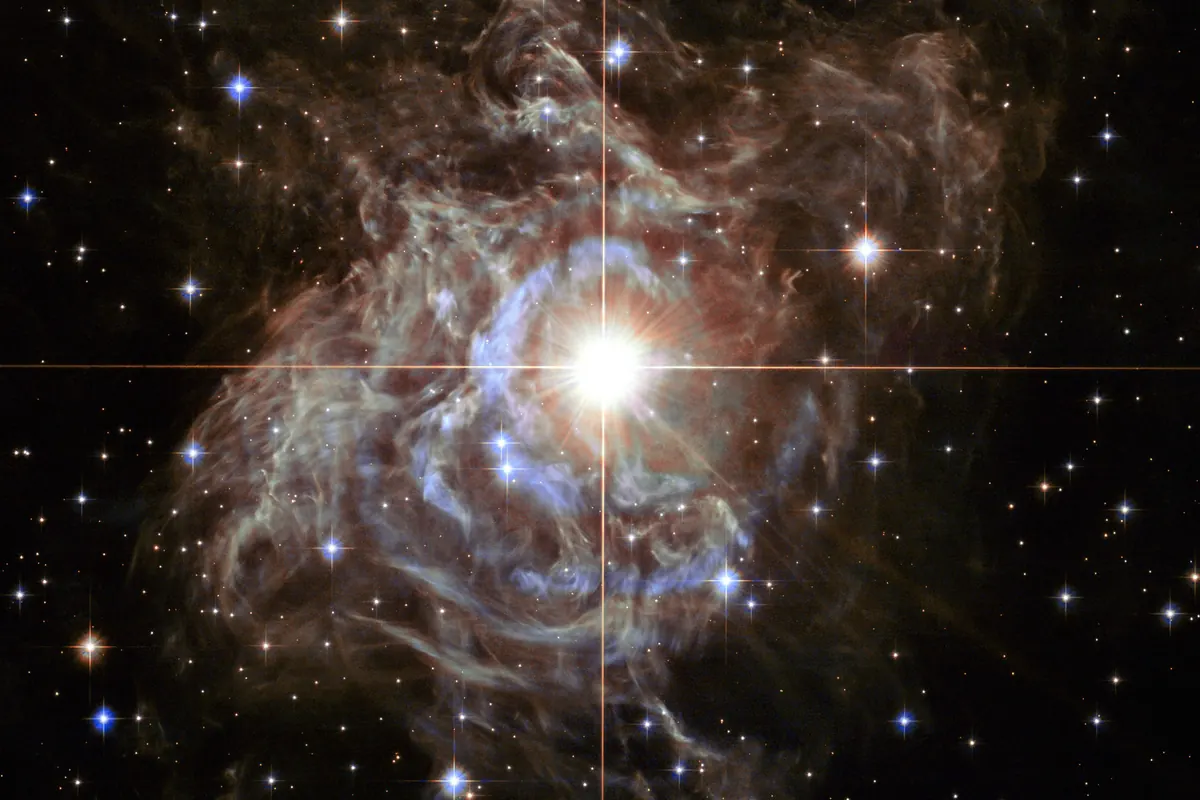
The ladder starts with Cepheids, stars that brighten and dim on a regular cycle. In 1912 Henrietta Swan Leavitt showed that the cycle length gives a star's true brightness, so comparing it with how bright it looks gives a distance. The star in the photograph, RS Puppis, is one of the most luminous Cepheids, with a six-week cycle and 15,000 times the Sun's luminosity, and Hubble photographed light flashes rippling across its surrounding dust cloud.
The measurements side by side
| Estimate | Value (km/s/Mpc) | Source |
|---|---|---|
| Planck 2018 (early universe, standard model) | 67.4 plus or minus 0.5 | arXiv:1807.06209 |
| DESI first-year galaxy maps with a nucleosynthesis prior | 68.52 plus or minus 0.62 | arXiv:2404.03002 |
| Atacama Cosmology Telescope with Planck, lensing and DESI | 68.22 plus or minus 0.36 | arXiv:2503.14452 |
| The same, adding DESI second-year data | 68.43 plus or minus 0.27 | arXiv:2503.14452 |
| SH0ES: Hubble Cepheids and supernovae (Riess et al. 2022) | 73.04 plus or minus 1.04 | arXiv:2112.04510 |
| Chicago-Carnegie Hubble Program, red giants, 24 calibrators (Freedman et al.) | 70.39 plus or minus 1.9 | arXiv:2408.06153 |
| Local Distance Network (Casertano et al. 2026) | 73.5 plus or minus 0.81 | DOI 10.1051/0004-6361/202557993 |
The Chicago-Carnegie error bar combines the authors' statistical (1.22), systematic (1.33) and supernova (0.7) terms in quadrature; the other bars are as quoted by their authors.
Has anyone found the mistake?
The obvious suspect was crowded star fields blurring the Cepheid measurements. In 2024 the SH0ES team used Webb on more than 1,000 Cepheids and found no significant difference from Hubble's distances (a formal difference of -0.01 plus or minus 0.03 magnitudes), rejecting unrecognized crowding as the cause at 8.2 sigma. A separate team, the Chicago-Carnegie Hubble Program, uses red giant stars and gets 70.39, in between, and says that's consistent with the standard model. In April 2026 a community collaboration published a network that combines many distance methods and got 73.5 with a precision of just over 1 percent, and concluded that a single overlooked error in the local measurements is unlikely.
Measured: we know this
- The local ladder gives 73.04 plus or minus 1.04, from Cepheids in the hosts of 42 supernovae. Its authors report a 5 sigma difference from the Planck prediction.
- Planck, assuming the standard model, gives 67.4 plus or minus 0.5.
- Webb saw no sign of the Cepheid crowding error that was the leading suspect.
Inferred: we think this
- A single overlooked error in the local distance measurements is unlikely, say the authors of the Local Distance Network.
- If the tension is real, it may point to new physics beyond the standard model, such as a different behavior of dark energy, new particles or changes to gravity. The Network authors say it could, though they don't claim it does.
Unknown: we don't know
- Whether the gap is new physics or a hidden systematic error. The Chicago-Carnegie group reads its own data as consistent with the standard model.
- Which, if any, change to the standard model would fix it.
What would settle it
- More Webb observations of distance-ladder stars, which the Chicago-Carnegie group says are needed to improve precision.
- Independent early-universe and late-universe probes of dark energy. See dark energy.
In human terms
- At a distance of 326 million light years (100 megaparsecs), the early-universe value predicts a recession of about 6,740 km/s and the local value about 7,304 km/s. The two differ by about 564 km/s.
Questions people ask
What's the Hubble tension?
It's the disagreement between two ways of measuring how fast the universe expands: about 67.4 kilometers per second per megaparsec from the early universe, and about 73.04 from nearby stars and supernovae.
Is the Hubble tension real?
Several teams have tried to find a mistake. The Webb check of the Cepheids found none, and a 2026 community network concluded a single error is unlikely. But another team, using red giants, gets a value in between and says it's consistent with the standard model.
What's the Hubble constant?
The rate at which the universe is expanding, in kilometers per second per megaparsec. A galaxy one megaparsec farther away recedes about that much faster.
 Dark energyWhat's speeding up the expansion?
 James Webb Space TelescopeThe telescope that rechecked the Cepheids.
 Dark matterThe other big unknown.
 All mysteriesEvery open question on the site.
Other rulers
There are other ways to measure the expansion, and they don't all agree with one side. Time-delay cosmography, which uses the different travel times of light from a gravitationally lensed object, was first proposed by Sjur Refsdal in 1964. Merging neutron stars give distances without any ladder, and a 2023 method using the expanding fireball of a kilonova gave 67.0 plus or minus 3.6. A tip-of-the-red-giant-branch measurement in 2019 found 69.8, and the Megamaser Cosmology Project agreed in 2020 with the local ladder at 95 percent confidence.
They land on both sides of the gap, and several are too imprecise to settle it. The newer methods are worth watching because they have different weak points: if several independent ones all fall near the same side, the argument changes.
If it's real
A real disagreement would mean that the standard model of the universe, with its dark matter and dark energy, is missing something. The early universe might have contained a short-lived extra ingredient. Dark energy might behave differently than a constant, a possibility the DESI results hint at. Or gravity might need adjusting. None of these fixes has won general agreement, which is why the idea of a hidden measurement error still has defenders.
What to watch next
The near-term test is the same star-by-star work, with better tools. Webb can see Cepheids and red giants more sharply than Hubble could, and the teams using it disagree about what it shows. Surveys such as Euclid and the Vera C. Rubin Observatory will add supernovae and map how the universe grew, giving cross-checks that don't depend on a ladder. For the other big open questions about what the universe contains, see the full list of mysteries.