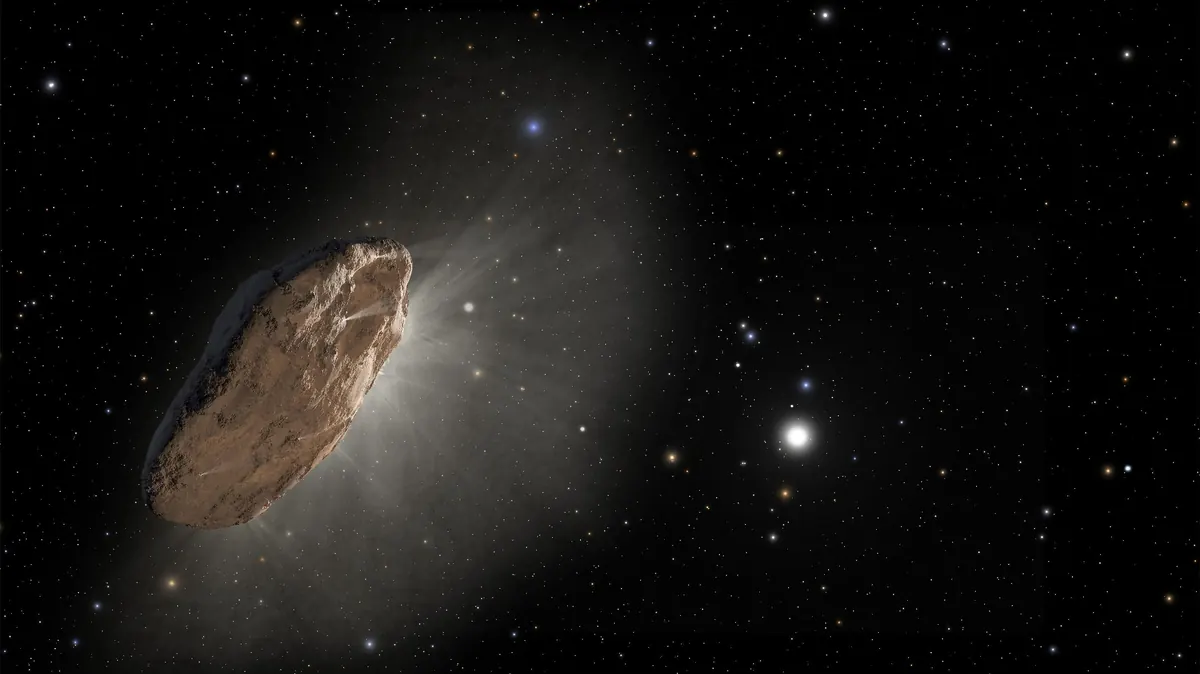
A visitor found on its way out
'Oumuamua was a surprise in time as well as space. Robert Weryk spotted it on 19 October 2017 in images from the Pan-STARRS 1 telescope in Hawaii, which scans the sky for moving objects. By then it had already passed the Sun, on 9 September 2017, and passed Earth on 14 October 2017 at a distance of about 0.16 times the Earth-Sun distance, roughly 24 million kilometers. Astronomers saw it for the first time only after it was heading out again, and they had a few months at best to study it.
What made it special was its path. Every object bound to the Sun follows an orbit with an eccentricity below 1. 'Oumuamua's was about 1.2, which means the Sun couldn't hold it, and no planet's tug, even an undiscovered one, could explain a path that extreme. It had come from another star system.
A name that changed three times
The object's label shows how fast the story moved. It was announced first as a comet, C/2017 U1, because of its path. Very deep images then showed no coma, the cloud of gas and dust a comet usually grows, and it was reclassified as an asteroid, A/2017 U1, the first comet ever redesignated that way. Once its interstellar origin was clear it became 1I/2017 U1, the first object to get the 'I' for interstellar. Its Hawaiian name, 'Oumuamua, means a messenger from afar arriving first.
What we saw
'Oumuamua is Hawaiian for a messenger from afar arriving first. It was up to 400 meters long and about 10 times as long as it is wide, a more extreme shape than any asteroid or comet known in our solar system, where the most elongated objects are no more than three times longer than wide. It rotates every 7.3 hours and its brightness changes by a factor of 10 as it spins. It was reddish and, NASA says, completely inert, with no dust around it. The shape in the picture is an artist's concept, because nobody has seen the real shape.
It came from the direction of the bright star Vega, but it took so long to travel that Vega wasn't near that spot about 300,000 years ago. The object seems to have wandered the Milky Way for hundreds of millions of years before meeting ours, and NASA notes that an object like it passes through the inner solar system about once per year but is usually too faint to see.
The acceleration puzzle
After passing the Sun on 9 September 2017, 'Oumuamua began to move in a way gravity alone couldn't explain. NASA says it was classified as a comet, then an asteroid, until measurements found it was accelerating slightly. Yet telescopes saw no dust and none of the usual signs of a comet's activity. In 2023 Bergner and Seligman proposed an answer: that the object was a water-ice planetesimal whose ice had been broken apart by cosmic rays during its trip, trapping hydrogen, which then escaped as it warmed. The proposal is contested, because other researchers have argued that the ice couldn't have produced enough hydrogen.
| Object | First reported | Notes |
|---|---|---|
| 'Oumuamua (1I) | 19 October 2017 | Up to 400 m long, no coma, unexplained acceleration |
| 3I/ATLAS | 1 July 2025 | Reported by the ATLAS survey telescope in Chile; the third known interstellar object. Upper limit on its diameter 5.6 km, though it could be as small as 440 m. Closest to Earth: 1.8 AU (270 million km) |
3I/ATLAS: a second chance
When 3I/ATLAS was reported, NASA used almost every telescope and spacecraft it could. Here are some of the observations on its timeline.
| When | What |
|---|---|
| 1 July 2025 | ATLAS reports the first sighting |
| 21 July 2025 | Hubble images help estimate the size |
| 6 August 2025 | Webb observes it with its near-infrared spectrograph |
| 28 September 2025 | MAVEN images hydrogen around the comet |
| 4 October 2025 | Perseverance photographs it from Mars |
| 6 November 2025 | Europa Clipper sees it |
| 15 January 2026 | TESS observes it again, the latest observation on NASA's timeline |
Measured: we know this
- It was discovered on 19 October 2017 and is the first confirmed interstellar object.
- Its brightness varies by a factor of 10 every 7.3 hours, so it's highly elongated.
- It showed no dust or gas around it, but it accelerated slightly.
Inferred: we think this
- It spent hundreds of millions of years drifting between the stars before it arrived. NASA says the observations suggest it.
- Hydrogen released from its ice could explain the acceleration, according to Bergner and Seligman (2023), Nature 615, 610. Other researchers dispute whether enough hydrogen could form.
Unknown: we don't know
- What it is made of and what shape it really is. It was observed for only a few months, and never from close up.
- What caused the acceleration. No explanation has convinced everyone.
What would settle it
- More interstellar visitors, studied with the lessons from 3I/ATLAS. NASA estimates that objects like 'Oumuamua pass through the inner solar system about once per year, so surveys such as Pan-STARRS and ATLAS may find more.
In human terms
- At the 38.3 km/s listed above it would cover about 1.2 billion kilometers a year. It's leaving the solar system for good and won't come back.
Questions people ask
What is 'Oumuamua?
The first confirmed interstellar object, discovered on 19 October 2017. It was elongated, reddish and inert, and it passed through the solar system and left.
Was 'Oumuamua an alien spacecraft?
There's no evidence for that. Natural explanations, such as hydrogen released from water ice, have been proposed for its acceleration, and NASA treats it as a natural object, though what exactly it's remains unsettled.
What was 3I/ATLAS?
The third known interstellar object, first reported on 1 July 2025. NASA and its partners tracked it with many telescopes and spacecraft.
 Planet NineA hidden world in the distant solar system?The scale of the solar systemHow far away is far?
 New HorizonsThe spacecraft in the Kuiper Belt.
 All mysteriesEvery open question on the site.
The sail and the other explanations
The acceleration puzzle you read about above produced one of the most-discussed ideas in recent astronomy. On 26 October 2018, Shmuel Bialy and Avi Loeb submitted a paper (opens in a new tab) suggesting that 'Oumuamua might be a thin artificial sail pushed by sunlight. Other scientists said the evidence wasn't there: they argued that a tumbling sail couldn't accelerate that way, and that simpler natural explanations exist, which is the view many researchers hold.
Natural ideas have kept coming. In 2020 one proposal called it a fragment of a planet torn apart by its star's gravity. In 2020 another linked it to small bodies made of hydrogen ice that form in cold molecular clouds, though a later calculation found that such bodies couldn't survive the trip. In 2021 a third said it might be a chunk of nitrogen ice from the surface of an exo-Pluto, and others countered that it wasn't. The 2023 proposal in the box above, hydrogen trapped in water ice, is the one that fits the acceleration and the lack of a tail best, and some researchers still question it.
The comet that followed
The next visitor made it clear how little we knew. Gennady Borisov found 2I/Borisov on 30 August 2019, and it reached its closest point to the Sun on 8 December 2019. It was confirmed as a comet, while 'Oumuamua never showed a coma. That contrast is useful: the first two interstellar visitors already differ in kind, and two objects aren't enough to say which is typical.
What to watch next
A third visitor, 3I/ATLAS, was found in 2025 and watched by many telescopes and spacecraft. A fourth will most likely be found by the survey telescopes that scan for moving objects, among them Pan-STARRS, the ATLAS telescopes and the Vera C. Rubin Observatory, which images the whole visible southern sky every few nights. The same surveys are the ones that could find Planet Nine. Until then, 'Oumuamua stays an object with a motion nobody has yet explained to everyone's satisfaction. If you like that kind of puzzle, Tabby's star and the Wow! signal are the closest relatives on this site, and for how a comet or asteroid actually gets from one star to another, start with the solar system itself.