A red pen and one word
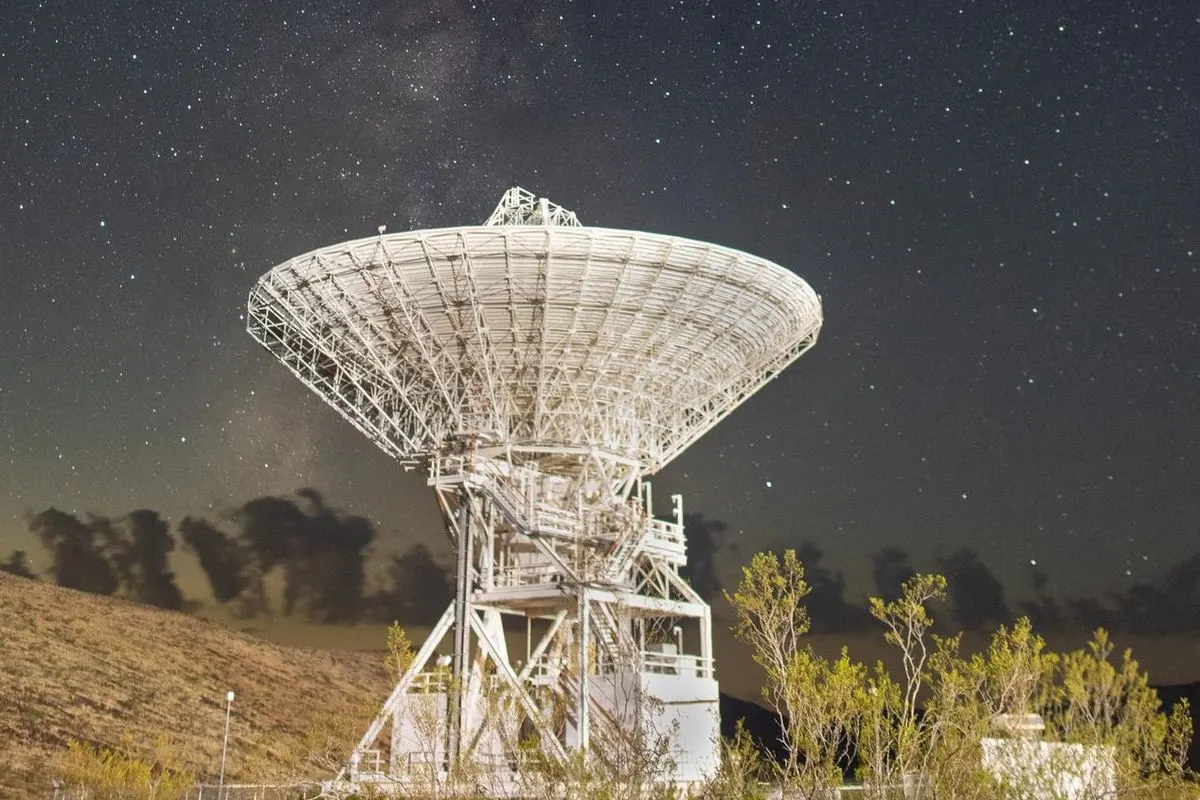
On the evening of 15 August 1977, a radio telescope in a field near Delaware, Ohio, listened to one patch of sky in Sagittarius for about a minute. Nobody in the room knew what it had heard. The telescope was Big Ear, run by Ohio State University, and for four years its job had been to look for artificial signals from other stars. Everything it heard went onto computer printouts, and a volunteer went through them every few days.
That volunteer was Jerry Ehman, a former Ohio State professor who worked on the project as a volunteer. On about 19 August he went through the printout for the run that began on the 15th and found a line of characters unlike anything else on the page: 6EQUJ5. He circled it in red pen and wrote "Wow!" in the margin. The comment became the signal's name, and Ehman's own anniversary report (opens in a new tab) is still the best account of what he saw.
What 6EQUJ5 says
It doesn't spell anything, and it isn't a message. Each character is one reading of how strong the signal was, as a multiple of the background noise. A digit is that number, and letters carry on the scale past nine, so A is 10, B is 11 and U is 30. Read that way, 6EQUJ5 is 6, 14, 26, 30, 19 and 5: a quiet start, a climb to about 30 times the background, and a fade.
That rise and fall is what a steady source does when the sky turns past a telescope that can't move sideways. Big Ear stood still and let the Earth's rotation carry each point of sky through its beam, so anything fixed among the stars would swell, peak and fade over about 72 seconds. The Wow! signal followed that shape. It was loud, it was narrow in frequency, and it behaved like something far beyond the Earth.
Why that frequency matters
The signal sat at 1420.4556 megahertz, within about 50 kilohertz of the natural radio frequency of neutral hydrogen, 1420.406 megahertz. Hydrogen is the most abundant element in the universe, and since Giuseppe Cocconi and Philip Morrison's 1959 paper in Nature (opens in a new tab), that frequency has been the obvious place to listen for a deliberate signal: any civilization that studies the sky in radio would know it too. Big Ear's search ran there from 1973.
The closeness to the hydrogen line is the reason the Wow! signal got famous. It's also the reason for caution, because hydrogen gas is everywhere and radiates there naturally.
| Recorded | 15 August 1977, Big Ear radio telescope, Ohio |
|---|---|
| Length | 72 seconds (the time the sky drifted across the telescope's view) |
| Frequency | close to 1420 MHz, the hydrogen line |
| Direction | in the constellation Sagittarius |
In human terms
- 72 seconds is a little over a minute. The whole case rests on one row of characters on a printout.
Measured: we know this
- A narrow, strong radio signal was recorded and flagged by a volunteer, who wrote "Wow!" on the printout.
- It hasn't been detected again in many follow-up searches.
Inferred: we think this
- The narrow frequency suggests something artificial, but natural sources have been proposed.
- A 2017 comet idea has been rejected by most astronomers.
Unknown: we don't know
- What produced it.
- Whether it was a one-off natural event, a glitch, or a transmission.
What would settle it
- A repeat detection from the same patch of sky.
- Records from other telescopes that were pointed there in 1977, if any exist.
Questions people ask
What was the Wow! signal?
A strong, narrow radio signal recorded by the Big Ear telescope in Ohio on 15 August 1977, near 1420 MHz and in the direction of Sagittarius. A volunteer circled it on the printout and wrote Wow!
How long did the Wow! signal last?
72 seconds, the time the sky took to drift across the telescope's view.
Has the Wow! signal been heard again?
No. It hasn't been detected again in many follow-up searches.
Was the Wow! signal aliens?
Nobody knows. The narrow frequency suggests something artificial, but natural sources have been proposed.
One horn saw it, and that's the problem
Big Ear used two feed horns about 4.69 feet apart, so a source drifting across the sky should have shown up in one horn and then, a few minutes later, in the other. The Wow! signal appeared in only one. The printout doesn't say which, and the telescope's other records couldn't settle it, because a narrow-band source wouldn't show on them.
A signal seen once, in one beam, can't be tested. Ehman's own suggestion was that a beacon might have been seen in one beam and then swept away from Earth. He also checked sidelobes, planets, asteroids, satellites and aircraft as possible sources, and the signal has never been tied to any of them.
Forty years of listening
Astronomers went back to the same sky many times. Ehman's team watched that strip for about 60 days after the detection and heard nothing. Robert Gray searched with the Very Large Array in 1995 and 1996 and with a telescope in Tasmania in 1999. The most targeted search came on 21 May 2022, when Breakthrough Listen pointed two telescopes at the Sun-like star 2MASS 19281982-2640123, 1,788 light years away, one of three Sun-like stars in the signal's patch of sky. It found no technosignature candidates, and the team noted that many other stars could still have been the source.
Every search so far has been a null result. That doesn't rule anything out; it means that if the signal was a rare, brief event, nobody has caught a second one.
Explanations on the table
In 2017 a Florida researcher suggested the signal came from clouds of hydrogen around two comets, 266P/Christensen and 335P/Gibbs. Astronomers, including some of the original Big Ear team, rejected it: the comets weren't in the beam at the right time, comets don't radiate that strongly at those frequencies, and the idea doesn't explain why only one horn saw anything.
A newer proposal came as a 2024 preprint, arXiv:2408.08513 (opens in a new tab). It suggests that a cold cloud of hydrogen was suddenly lit up by a magnetar flare, producing a brief maser-like brightening. The authors point to eight weaker Wow!-like signals in Arecibo data from 2020. The weak points are real: nobody has observed a hydrogen-line maser in space, and magnetars themselves weren't known in 1977. It stays a hypothesis.
The telescope is gone
Big Ear was torn down in early 1998, after developers who had bought the land from Ohio Wesleyan University expanded a golf course and planned housing on the site. What survives is the printout and the questions it raises about how many stars have planets and what would count as proof of anyone else out there, which the fast radio bursts, Tabby's star and 'Oumuamua pages show in other forms.
Sources
Jerry Ehman, The Big Ear Wow! Signal 30th anniversary report (bigear.org). Breakthrough Listen, search for the Wow! signal, Research Notes of the AAS, 2022. Cocconi and Morrison, Searching for interstellar communications, Nature, 1959. Mendez, Ortiz Ceballos and Zuluaga, arXiv:2408.08513, 2024 (preprint).