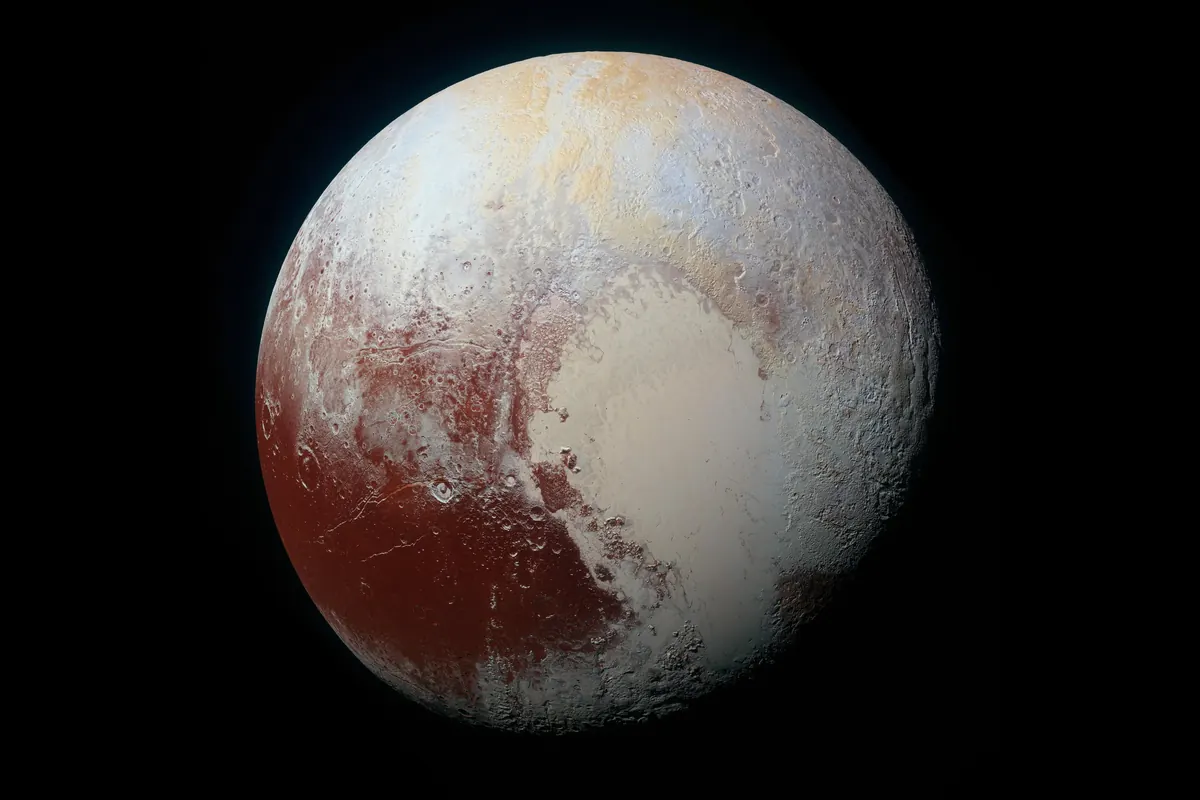
A planet at launch, a dwarf planet on arrival
New Horizons was launched on 19 January 2006 as a mission to the ninth planet. Seven months later, in August 2006, the International Astronomical Union changed the definition of a planet and moved Pluto into the dwarf planet category, while the spacecraft was still on its way. The mission didn't change, but the story around it did. If you want the reasoning, it's on the page about why Pluto isn't a planet.
Pluto was discovered in 1930 by Clyde Tombaugh, and the spacecraft carries a small portion of his ashes. Until New Horizons arrived, even the Hubble Space Telescope could only show Pluto as a blurry few-pixel disc. Everything in the close-up images of mountains of ice and plains of nitrogen came from one pass.
One season of a 248-year year
Pluto takes about 248 years to go around the Sun. That means it hasn't completed a single orbit since Tombaugh found it, and the spacecraft caught it at just one moment in a very long seasonal cycle. It's one reason scientists describe the atmosphere's behavior carefully: a snapshot of a year that long can't tell you what the rest looks like. The Pluto page has the rest of the numbers.
Nine years to a world nobody had seen
New Horizons weighs about 478 kg. Its power came from a spare Cassini generator that gave about 250 watts at launch and about 200 watts by the time it reached Pluto. After a Jupiter boost it spent much of the cruise in hibernation, with the main systems switched off and the computer sending a weekly status tone home.
| Date | Event |
|---|---|
| 19 January 2006 | Launch on an Atlas V 551, the fastest launch of any human-made object relative to Earth, at 58,536 km/h |
| 28 February 2007 | Jupiter gravity assist, which added about 14,000 km/h and cut three years from the trip |
| 14 July 2015 | Pluto flyby at about 12,500 km, Charon at about 28,800 km |
| 25 October 2016 | The last of the Pluto data reaches Earth |
| 1 January 2019 | Arrokoth flyby at about 3,500 km, the most distant object explored up close |
| 1 October 2024 | New Horizons passes 60 times as far from the Sun as Earth is |
What the flyby showed
Three days before closest approach the pictures settled a basic question: Pluto is about 2,370 km across, a little bigger than earlier estimates, and its moon Charon is about 1,208 km. Pluto turned out to be far more active than expected. It has a heart-shaped plain of nitrogen ice about 1,000 km wide, named Sputnik Planitia and described by NASA as the largest known glacier in the solar system. Hazy skies and a lower-than-predicted rate of atmospheric escape forced scientists to revise their models of the system.
Charon had its own surprise: a huge tectonic belt along its equator, which suggests it once had an ocean of water ice that froze and expanded.
A very slow download
Sending the encounter data home took longer than the encounter itself. The spacecraft was about 4.5 light hours from Earth and could send only 1 to 2 kilobits per second, so the roughly 6.25 GB took more than 15 months, finishing on 25 October 2016.
Arrokoth, then the long way out
After Pluto the team steered New Horizons to a Kuiper Belt object then called 2014 MU69, later named Arrokoth, about 6.4 billion km from Earth. It's made of two lobes joined together, about 35 km long and 20 km wide, and the flatter large lobe measures about 22 by 20 by 7 km. The principal investigator, Alan Stern, said the shape sends planetary scientists back to the drawing board on how planetesimals form. The spacecraft is now heading out at about 300 million miles per year and, as of NASA's page, was gathering heliophysics data.
Measured: we know this
- Pluto is about 2,370 km across and Charon about 1,208 km.
- Sputnik Planitia is a nitrogen glacier about 1,000 km wide.
- Arrokoth is about 35 km long and has two joined lobes.
- Pluto's surface shows evidence of vast changes in atmospheric pressure over time.
Inferred: we think this
- Pluto may have an internal ocean of water ice and water today. NASA says there are hints.
- Charon's equatorial belt suggests a long-past ocean of water ice.
Unknown: we don't know
- How the building blocks of the planets, called planetesimals, formed. Arrokoth's shape isn't what theories predicted.
- What else lies in the Kuiper Belt, a region NASA describes as stretching from about 30 to 50 AU from the Sun.
What would settle it
- Another spacecraft at Pluto, ideally in orbit. New Horizons made a single pass.
In human terms
- The spacecraft was about 4.5 light hours away during the encounter, so a command took that long just to arrive.
- On 1 October 2024 it was 60 times as far from the Sun as Earth is.
Questions people ask
When did New Horizons fly past Pluto?
On 14 July 2015, at about 12,500 km above the surface. It was the first spacecraft to explore Pluto up close.
What's Arrokoth?
A Kuiper Belt object made of two joined lobes, about 35 km long. New Horizons flew past it on 1 January 2019, making it the most distant object explored up close at the time.
Why did the Pluto data take so long to arrive?
The spacecraft was about 4.5 light hours from Earth and could send only 1 to 2 kilobits per second, so the 6.25 GB took more than 15 months.
 Travel time to PlutoHow long it takes to get there by different means.
 Voyager 2The only spacecraft to visit Uranus and Neptune.
 TritonA captured moon with a lot in common with Pluto.All probesEvery spacecraft page on the site.
A flyby measured in minutes
The geometry explains why the flyby couldn't be improvised. New Horizons passed Pluto at about 12,500 kilometers, roughly five Pluto diameters out, traveling at around 14 kilometers per second. At that speed the close part of the encounter is over quickly, and with a signal delay of about 4.5 hours each way, nobody on Earth could steer it live. Every observation was written into the spacecraft's command sequence beforehand and run on its own.
The same limits shaped the choice of what to send first. A narrow link means the team had to pick which images and measurements came back soon and which waited for the long download that ended on 25 October 2016. The tiny data rate is the reason the wait was so long, not the amount of data, which is modest by today's standards.
Why Arrokoth mattered
After Pluto, the team aimed New Horizons at a far smaller target. Arrokoth is about 35 kilometers long, and it's one of the most pristine objects ever seen up close, because it has spent billions of years in the cold of the Kuiper Belt without much happening to it. Its two lobes touching gently is the kind of evidence that planetary scientists use to test how the building blocks of planets came together.
By 1 October 2024 the spacecraft was 60 times Earth's distance from the Sun, moving at about 300 million miles per year, or about three times Earth's distance from the Sun each year. For the longer-lived spacecraft that left the planets behind earlier, see Voyager 1 and Voyager 2, or put the whole trip on the scale of the solar system.