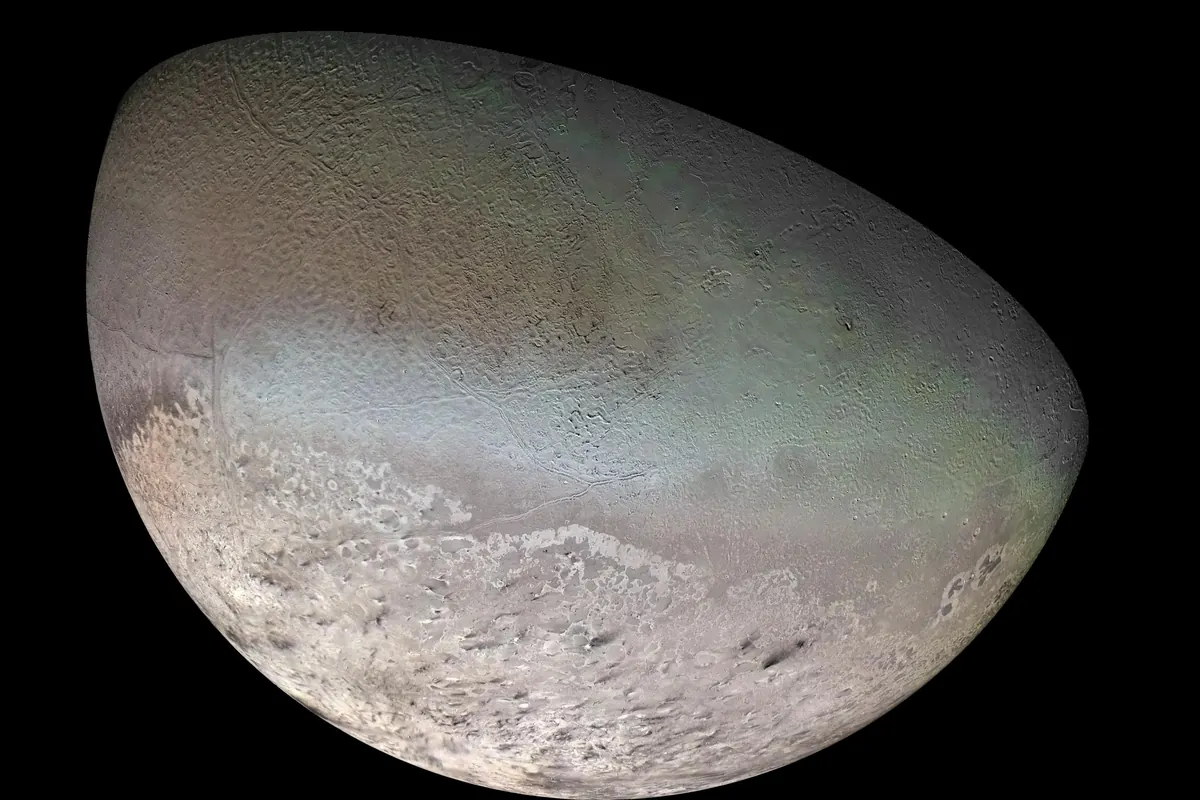
A brewer finds a moon
William Lassell was an English brewer who built telescopes as a second career, and he found Triton 17 days after Neptune was discovered, which tells you how closely observers were watching the new planet. The moon is 2,700 kilometers across, somewhat larger than Pluto, and its density of 2,050 kilograms per cubic meter is high for an icy moon.
Its surface gravity is about 0.78 meters per second squared (my calculation from NASA's mass and radius), roughly eight percent of Earth's. With a temperature of -235 degrees Celsius, the surface is a place where nitrogen freezes out as frost. The atmosphere is mainly nitrogen with small amounts of methane, and it's tens of thousands of times thinner than ours.
Going the wrong way
Triton's orbit is retrograde: it circles Neptune against the direction of the planet's spin, and it's tilted by about 157 degrees. William Lassell found it on 10 October 1846, just 17 days after Neptune itself was discovered. Scientists think it began as a Kuiper Belt object and was captured by Neptune's gravity, and it has much in common with Pluto.
Cold, and active
When Voyager 2 flew past in 1989 it measured a surface temperature of -235 degrees Celsius. Its surface is covered in nitrogen frost that reflects about 70 percent of the sunlight that hits it. The probe photographed about two thirds of the moon, showing smooth volcanic plains, mounds and round pits formed by icy lava, a pitted terrain NASA likens to a cantaloupe, and active geysers. NASA says the only bodies besides Earth known to be volcanically active at present are Triton, Io and Venus.
| What | Value |
|---|---|
| Discovered | 10 October 1846 by William Lassell |
| Radius | 1,353.4 km |
| Mass (units of 10^20 kg) | 214 |
| Density | 2,050 kg per cubic meter, about twice that of water |
| Distance from Neptune | 354,760 km |
| Orbit | 5.876854 days, retrograde |
| Atmosphere | thin, mainly nitrogen with small amounts of methane |
Triton's high density means it holds more rock than the icy moons of Saturn and Uranus. NASA notes only Io and Europa have higher densities among outer-planet satellites.
Measured: we know this
- Triton's surface is about -235 degrees Celsius, and Voyager 2 found active geysers in 1989.
- The moon orbits Neptune retrograde, against its spin.
- Voyager 2 photographed about two thirds of the surface.
Inferred: we think this
- Triton is a captured Kuiper Belt object. NASA says scientists think this.
- Its high density points to an icy mantle around a rocky core.
Unknown: we don't know
- Whether the geysers are still erupting. Voyager 2 saw them in 1989 and no spacecraft has looked since.
- What lies under the surface beyond the icy mantle and rocky core suggested by its density.
What would settle it
- A return mission to Neptune. Voyager 2 is the only spacecraft ever to fly past Neptune and Triton.
In human terms
- Triton is the coldest world Voyager 2 measured, at -235 degrees Celsius.
- It was found just 17 days after Neptune itself.
Questions people ask
Why does Triton orbit backwards?
Its orbit is retrograde, against Neptune's spin. Scientists think Triton was a Kuiper Belt object captured by Neptune's gravity, rather than a moon that formed there.
Is Triton volcanically active?
Voyager 2 found active geysers in 1989, and NASA lists Triton, Io and Venus as the only bodies besides Earth known to be volcanically active at the present time.
How cold is Triton?
About -235 degrees Celsius at the surface, measured by Voyager 2.
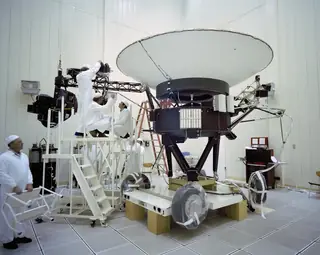 Voyager 2The only spacecraft to fly past Neptune and Triton.
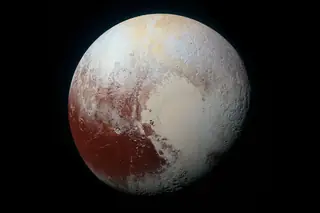 New HorizonsPluto, which Triton resembles.
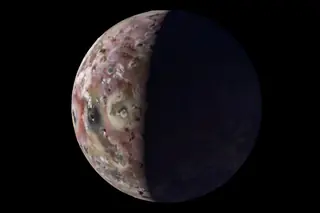 IoAnother volcanically active moon.All moonsEvery moon page on the site.
A captured world, still settling
The backward orbit is the strongest clue that Triton wasn't born around Neptune. A moon that formed from a disk around its planet would circle in the same direction as the planet spins. Triton circles the other way, so the leading explanation is capture of an object that came from the Kuiper Belt, the same region that produced Pluto.
Capture would have been violent. The new moon's orbit would have started out stretched and tilted, and the squeezing from Neptune's tides would have heated it. Some models suggest this could have melted much of the interior. Over time the orbit became nearly circular. The same tidal drag is thought to be pulling Triton slowly inward, and models suggest it could one day be torn apart, though not for billions of years.
One flyby, one season
Everything we know about Triton's surface comes from a single pass by Voyager 2 in 1989. The spacecraft photographed two thirds of the moon, including a pitted terrain that looks like the skin of a melon and dark streaks that run downwind from geyser-like vents. It also arrived during one particular season: Neptune takes about 165 years to go around the Sun, so a visit in 1989 is one frame from a very long film.
Whether the geysers are still erupting is something nobody can say, because no spacecraft has looked since. A new mission would be the first to see Triton in a different season. For the spacecraft that made the flyby, see Voyager 2, and for another large Kuiper Belt world visited once, see Pluto.
A cousin of Pluto
Triton is about 2,700 kilometers across, against roughly 2,370 for Pluto, so it's about 14 percent wider. Both are coated in nitrogen frost and both have a thin nitrogen atmosphere, which is part of why Triton is described as a captured Kuiper Belt object. Pluto was visited by New Horizons in 2015. Triton was seen 26 years earlier by Voyager 2, and those 1989 pictures are still the only close-up record of it. That's why its ledger is full of what's unknown. Every figure for Triton's surface, from the temperature to the geysers, is a snapshot from one flyby in a year that lasts 165 Earth years.