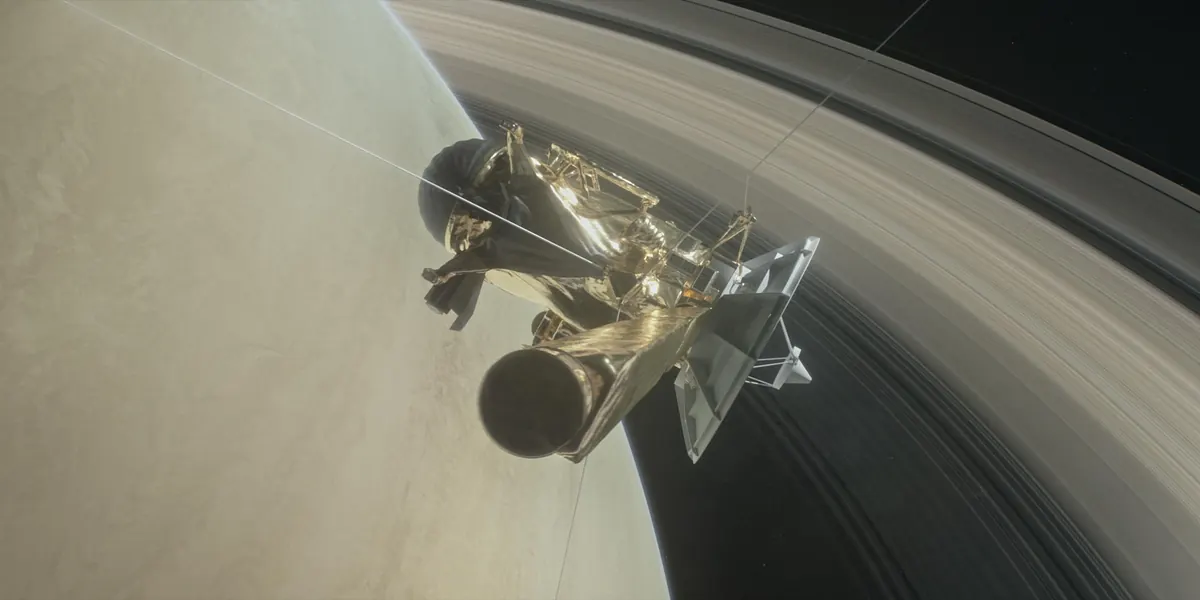
Thirteen years in one place
Most planetary probes get a flyby. Cassini got a residency. It launched on 15 October 1997, and the Saturn system was its home for 13 years, which NASA describes as nearly half a Saturn year. A flyby gives you a snapshot. A long stay gives you seasons, and that's what changed the picture of Saturn. Features that come and go with the seasons, like the faint spokes that appear in the rings, can only be recognized if you're around long enough to see them return.
NASA's account of the mission lists some of what that patience bought. Propeller-shaped patterns in the rings mark the spots where hidden moonlets sit. The outer edges of the A and B rings throw up fluffy peaks as tall as the Rocky Mountains. Cassini also watched a storm that erupts about once every 30 years. None of that would have been caught by a quick pass.
A spacecraft that carried a lander
Cassini wasn't alone on the way out. The European-built Huygens probe rode along and was released toward Titan. NASA says Huygens carried six instruments, against Cassini's twelve, and that it was designed to cope with either hard ground or a liquid surface. The images it sent back, in NASA's words, showed evidence of intermittent, heavy floods. That fits with the rest of the mission's Titan results, which describe a moon that has stable liquid on its surface despite sitting ten times farther from the Sun than Earth.
A mission built by three space agencies
Cassini-Huygens was a partnership of NASA, the European Space Agency (ESA) and the Italian Space Agency (ASI), with 27 nations taking part and more than 5,000 people working on some part of it. The cost came to $3.9 billion, of which $2.5 billion was spent before launch and $1.4 billion on operations and tracking over the years in flight. It carried 12 science instruments on the orbiter and weighed 5,712 kg at launch, of which about 52 percent was propellant; by the end it was down to 2,125 kg.
From launch to the Grand Finale
| Date | Event |
|---|---|
| 15 October 1997 | Launch from Cape Canaveral, Florida, on a Titan IVB/Centaur |
| 26 April 1998 and 24 June 1999 | Two Venus flybys |
| 18 August 1999 | Earth flyby |
| 30 December 2000 | Jupiter flyby, at about 10 million km |
| 1 July 2004 | Arrival at Saturn (UTC) |
| 24 December 2004 | Huygens probe released toward Titan |
| 14 January 2005 | Huygens descends through Titan's atmosphere to the surface |
| 15 September 2017 | Grand Finale: Cassini plunges into Saturn on purpose |
The route to Saturn wasn't direct. Gravity assists at Venus (twice), Earth and Jupiter bent the path outward, and the whole trip from Earth to Saturn covered about 3.4 billion km. Counted against the Sun, Cassini's total distance by the end was about 7.8 billion km.
Why it ended in Saturn
By 15 September 2017 almost all of the rocket propellant was gone: 2,950 kg of 2,978 kg had been used. Rather than leave a dead spacecraft that might one day hit a moon, operators deliberately flew Cassini into the planet. The goal was to keep Enceladus, which has an ocean, and Titan, with its chemistry, pristine for future exploration. At the last moment of contact the craft was moving at about 111,637 km/h relative to Saturn.
What Cassini changed
Before Cassini, scientists had only brief glimpses of Saturn from earlier flybys. Cassini worked there for 13 years, found six named moons, and showed that Enceladus has most of the ingredients needed for life. NASA says that finding pushed planetary science toward what it calls ocean worlds, and the way the Europa Clipper mission tours Jupiter's moon follows an orbital design derived from Cassini's.
Measured: we know this
- Jets of icy water particles and gas erupt from Enceladus at about 400 meters per second, a discovery made in 2005.
- Titan has three seas and hundreds of smaller lakes of liquid methane and ethane.
- The Huygens probe reached Titan's surface on 14 January 2005.
- The orbiter completed 294 orbits and 162 targeted moon flybys, including 127 of Titan and 23 of Enceladus.
Inferred: we think this
- Enceladus has an ocean under its ice. NASA says gravity measurements and the moon's slight wobble point to a global ocean feeding the jets.
- Hydrothermal vents may be at work on Enceladus, because tiny silica grains in Saturn's E ring can only form where liquid water meets rock at about 90 degrees Celsius or more.
Unknown: we don't know
- Whether anything lives in the oceans of Enceladus or Titan. No evidence of life has been found.
- Where all the methane in Titan's atmosphere comes from. Sunlight destroys it, so something must be replacing it.
What would settle it
- A mission that flies through the Enceladus plume or lands on Titan. NASA's Dragonfly rotorcraft is planned to launch to Titan in 2028.
In human terms
- Radio signals took between 67 and 85 minutes to travel one way between Saturn and Earth, depending on where the planets were.
- The mission used about 2.5 million commands over the years.
Questions people ask
When did Cassini arrive at Saturn?
Cassini arrived on 1 July 2004 (UTC). It was the first spacecraft to orbit Saturn.
How did the Cassini mission end?
On 15 September 2017, with the propellant almost gone, operators flew Cassini into Saturn on purpose so that it could never contaminate the moons Enceladus and Titan.
What did Cassini discover about Enceladus?
Jets of water ice and gas spraying from fractures near its south pole, which fed a global ocean and made Enceladus a leading target in the search for life.
 EnceladusThe small moon that sprays its ocean into space.
 TitanSaturn's hazy moon with lakes of liquid methane.
 Voyager 2The only spacecraft to visit Uranus and Neptune.All probesEvery spacecraft page on the site.
See how long the trip to Saturn takes on the Saturn travel time page.
Using Titan as a gas station
One of the less obvious tricks was how Cassini steered. The orbiter made 127 targeted flybys of Titan, and NASA calls those flybys a gas station: each one changed the spacecraft's velocity, and added up they changed it by as much as the big burn that put Cassini into orbit around Saturn in the first place. Fuel is the limit on a long mission, and Titan's gravity meant the spacecraft could keep reshaping its orbit for years without spending much of it.
That's how the same spacecraft could drop in close to Enceladus one year and swing out to look at the rings from another angle the next.
Twenty-two dives
The Grand Finale is the part most people remember. After a last close flyby of Titan on 22 April 2017 reshaped its orbit, Cassini began a series of 22 orbits that each passed between Saturn and its rings, over about five months. The gap is roughly 2,000 kilometers wide, and the spacecraft's height above the cloud tops ranged from about 1,600 to 4,000 kilometers.
The payoff was measurement, not pictures alone. NASA lists detailed maps of Saturn's gravity and magnetic fields, which tell scientists about the planet's interior; better estimates of how much material is in the rings; samples of icy ring particles funneled into the atmosphere by the magnetic field; very close images of rings and clouds; and readings from the mass spectrometer, which kept sampling the atmosphere until contact was lost on 15 September 2017.
The question that's still open
Even after all that, one number wouldn't settle. NASA says the length of a Saturn day is somewhere between 10.6 and 10.8 hours, and that this remains unresolved. Gas giants don't have a surface to time, so scientists infer the rotation from the planet's radio signals and magnetic field, and NASA says the Grand Finale maps may help explain how fast the planet rotates.
What Cassini did settle is where to look next. Enceladus, with its plumes and its ocean, and Titan, with its seas, are the places the Saturn results point to for future exploration, and the Dragonfly rotorcraft is aimed at Titan. The same ocean-worlds thinking applies at Jupiter, where Juno is studying the planet and the Europa mission is aimed at the moon. For the earlier, quicker look at Saturn, see Voyager 2.