Small enough to leak
William Herschel found Enceladus on 28 August 1789, and for almost two centuries it was little more than a bright dot. It measures 257 by 251 by 248 km, so it's about 500 kilometers across. Its mass of 1.08 times 10 to the 20 kilograms gives it a surface gravity of only about 0.11 meters per second squared, roughly one percent of Earth's.
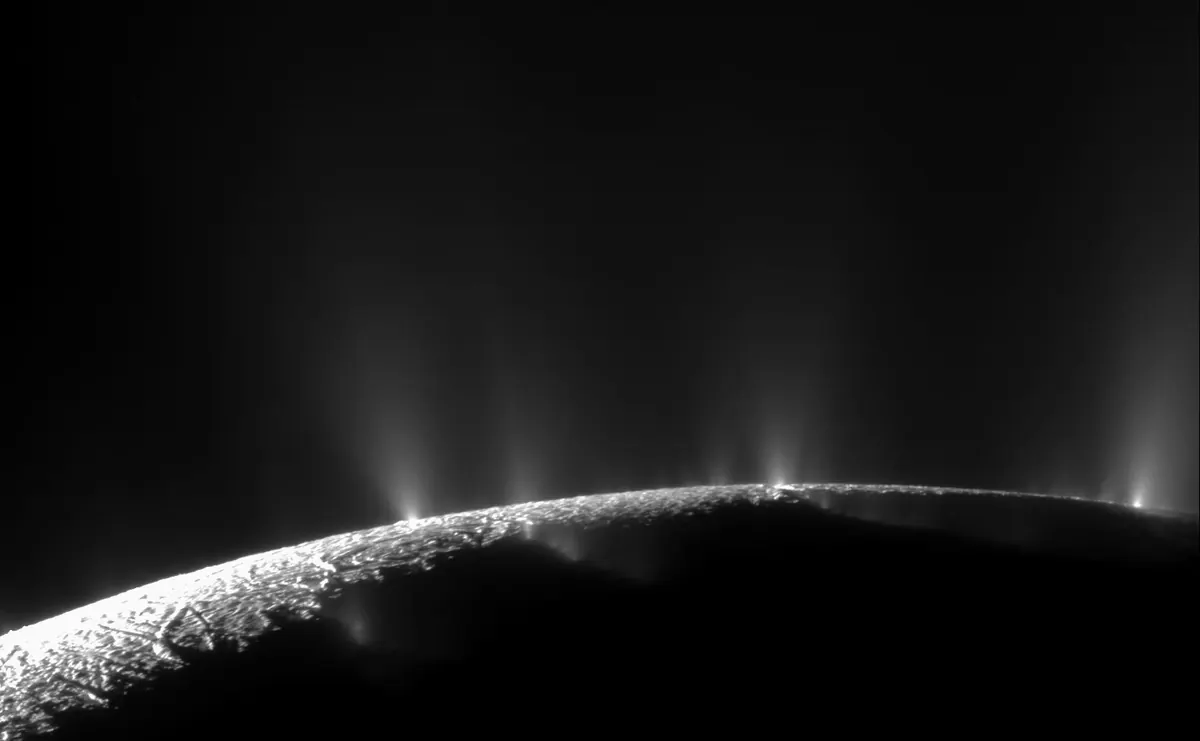
That low gravity is the key to the jets. The speed needed to escape Enceladus entirely works out at only about 239 meters per second (my own calculation from NASA's mass and size). The jets leave at about 400 meters per second, which is faster than that, so a large share of the spray can leave the moon altogether. Some of it becomes Saturn's E ring, and the rest falls back as snow. A bigger moon with the same plumes would hold on to more of them.
Jets from the tiger stripes
In 2005, NASA's Cassini spacecraft found water ice particles and gas gushing from Enceladus at about 400 meters per second. The jets come from warm fractures NASA calls the tiger stripes. The gas includes water vapor, carbon dioxide, methane, perhaps a little ammonia and either carbon monoxide or nitrogen gas, along with salts and silica, and the organic material in the plume was about 20 times denser than scientists expected.
Some of the spray escapes to feed Saturn's E ring, and the rest falls back to the surface as snow.
Why scientists think there's an ocean
Gravity measurements and the moon's slight wobble as it orbits show that a global ocean supplies the jets. The ice shell is thought to be 20 to 25 km thick on average and as thin as 1 to 5 km at the south pole. Tiny silica grains in the E ring can only form where liquid water meets rock at temperatures above about 90 degrees Celsius, which points to hydrothermal vents on the sea floor, like those on Earth.
What keeps it warm
Enceladus is locked in an orbital resonance with the larger moon Dione: it orbits Saturn twice every time Dione orbits once. Dione's gravity stretches Enceladus's orbit into an ellipse, so the moon is sometimes closer and sometimes farther from Saturn, and the flexing creates tidal heating inside.
| What | Value |
|---|---|
| Discovered | 28 August 1789 by William Herschel |
| Size | 257 by 251 by 248 km |
| Mass (units of 10^20 kg) | 1.08 |
| Density | 1,610 kg per cubic meter |
| Distance from Saturn | 238,020 km |
| Orbit | 1.370218 days (32.9 hours) |
| Closest Cassini pass | about 25 km above the surface, on 9 October 2008 |
Measured: we know this
- Jets of ice particles and gas leave Enceladus at about 400 meters per second.
- The plume contains water vapor, carbon dioxide, methane, perhaps a little ammonia and either carbon monoxide or nitrogen gas.
- The surface is about -201 degrees Celsius and reflects almost all the sunlight that hits it.
Inferred: we think this
- A global ocean lies under the ice. NASA says gravity and the moon's wobble show it.
- Hydrothermal vents are likely on the ocean floor, because the silica grains in the E ring form only above about 90 degrees Celsius.
Unknown: we don't know
- Whether life exists in the ocean. NASA says Enceladus has most of the chemical ingredients for life, and scientists don't know whether it has life itself.
- How long the geysers have been active.
What would settle it
- A spacecraft that flies through the plume with instruments built to test for signs of life. Cassini wasn't designed to look for life itself.
In human terms
- About as wide as Arizona, yet its spray feeds a ring around Saturn.
- One orbit takes only 32.9 hours, and the moon orbits Saturn twice for every one orbit of Dione.
Questions people ask
Does Enceladus have an ocean?
Almost certainly. Gravity measurements and the moon's slight wobble show a global ocean under the ice, and jets of water spray into space from the south pole.
What are the tiger stripes?
Warm fractures near Enceladus's south pole from which the jets of water ice and gas erupt.
Could there be life on Enceladus?
Nobody knows. NASA says it has most of the chemical ingredients for life, and probably hydrothermal vents, but no life has been detected.
 CassiniThe mission that found the jets in 2005.
 TitanSaturn's largest moon.
 EuropaAnother ocean world, around Jupiter.All moonsEvery moon page on the site.
Flying through the spray
Cassini found the jets in 2005. On 9 October 2008 it passed about 25 kilometers from the surface, one of its closest approaches to the moon. NASA reports that the organic material in the plume was about 20 times denser than scientists expected.
Cassini wasn't built to look for life, and it couldn't say whether the organic material was made by biology or by chemistry alone. That's the gap the ledger calls unknown. Telling the two apart would need instruments that can measure the details of the molecules, and a spacecraft going back to do it.
A thin spot at the pole
The ice shell is thought to be 20 to 25 kilometers thick on average, and as thin as 1 to 5 kilometers at the south pole, which is where the jets come from. Enceladus is also squeezed by its resonance with Dione, and that squeezing helps keep the ice warm enough to crack.
That thin spot is why Enceladus is so convenient. A future spacecraft wouldn't need to drill through kilometers of ice to sample the ocean, because the ocean sends its samples up to space. Europa might have plumes of its own, but that's disputed. For Enceladus nobody doubts them. For the mission that found them, see Cassini.
The whitest world
The surface reflects almost all the sunlight that hits it, and it sits at about -201 degrees Celsius. The reason is fresh snow: the spray from the jets keeps falling back onto the surface, so it stays clean and bright. The moon orbits Saturn at 238,020 kilometers (148,000 miles) in 32.9 hours, close enough to Saturn that the jets can feed the E ring.