Denali, Gates of the Arctic, Glacier Bay, Katmai, Kenai Fjords, Kobuk Valley, Lake Clark and Wrangell-St. Elias all sit between 59 and 68 degrees north. The core is in the southern part of the sky, about 29 degrees south of the celestial equator. From a latitude of 58.6 degrees north that puts it just 2.4 degrees up at its highest, and only during the weeks when the Sun is close to it.
| Park | Latitude (north) | Highest the core gets | Nights with full darkness in 2027 | Months with full darkness |
|---|---|---|---|---|
| Denali National Park & Preserve (opens in a new tab) | 63.3 | -2.2° | 225 | Aug to Apr |
| Gates of the Arctic National Park & Preserve (opens in a new tab) | 67.8 | -6.7° | 201 | Sep to Mar |
| Glacier Bay National Park & Preserve (opens in a new tab) | 58.8 | 2.3° | 251 | Aug to Apr |
| Katmai National Park & Preserve (opens in a new tab) | 58.6 | 2.4° | 251 | Aug to Apr |
| Kenai Fjords National Park (opens in a new tab) | 59.8 | 1.2° | 244 | Aug to Apr |
| Kobuk Valley National Park (opens in a new tab) | 67.4 | -6.3° | 203 | Sep to Mar |
| Lake Clark National Park & Preserve (opens in a new tab) | 60.6 | 0.5° | 239 | Aug to Apr |
| Wrangell-St. Elias National Park & Preserve (opens in a new tab) | 61.4 | -0.4° | 235 | Aug to Apr |
Full darkness means the Sun is more than 18 degrees below the horizon at some point in the night.
What you can see instead
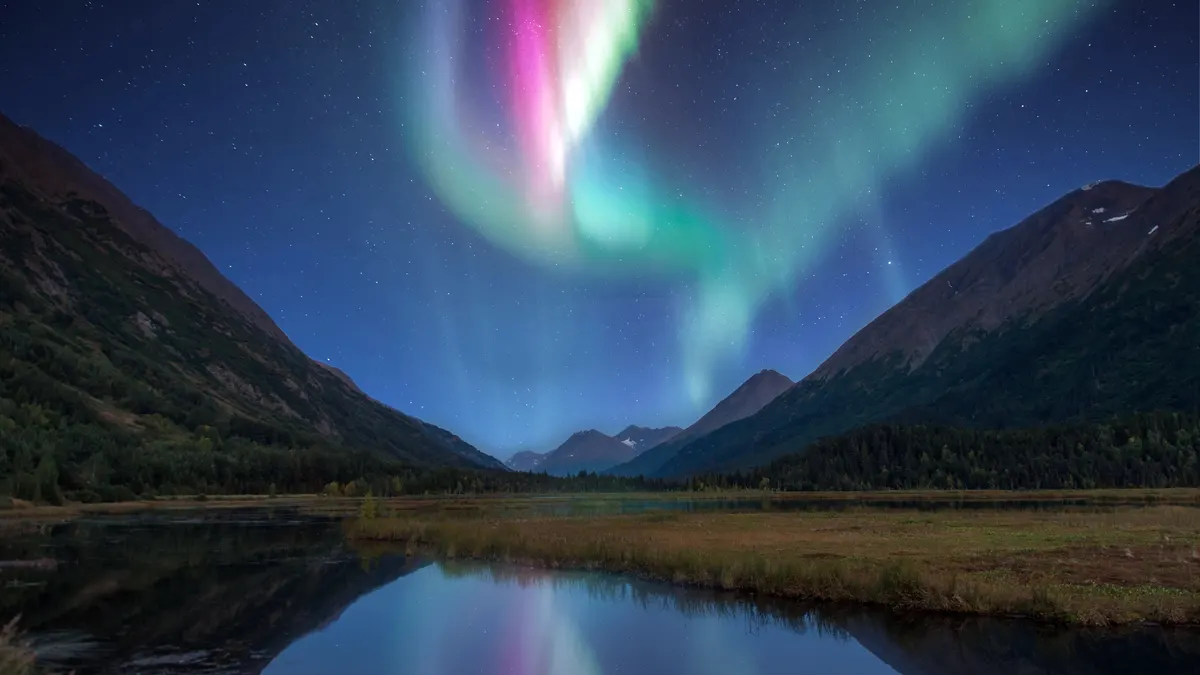
The parts of the Milky Way that are well placed from Alaska are the fainter northern and winter stretches, which run through Cassiopeia, Perseus and Auriga. They're high in the sky on dark autumn, winter and spring nights. Most visitors who come for the night sky in these parks come for the aurora, which has its own forecasts and isn't part of this calculation.