A shower that grew up
The Geminids are a young shower. They first showed up in the mid 1800s with only 10 to 20 meteors an hour, and they have strengthened since. Today NASA counts them among the best and most reliable of the year.
The odd part is the parent. Most showers come from comets. The Geminids come from 3200 Phaethon, a rocky asteroid about 5.1 kilometers across that circles the Sun every 1.4 years. The Infrared Astronomical Satellite found it on 11 October 1983, and Fred Whipple realized it was the source of the meteors.
Dead comet or rock comet?
Phaethon doesn't grow a tail as it passes the Sun, and its spectrum looks like an ordinary rocky asteroid. Yet its very stretched orbit looks like a comet's. NASA says it may be a dead comet, or a rock comet, a newer class of object.
The meteoroids back up the rocky picture. They're about 2 to 3 grams per cubic centimeter, several times denser than the 0.3 of typical comet dust. The meteors are bright and fast, at about 35 kilometers a second, and they tend to be yellow.
Arecibo Observatory took radar images of Phaethon in December 2017. The asteroid is named for the figure in Greek myth who drove the chariot of Helios, the Sun god.
First seen in 1862
The first recorded observation of the Geminids dates to 1862. That's late. The Perseids go back to AD 36 and the Leonids to AD 902, which fits the idea that the Geminid stream is young.
A 2023 study using Parker Solar Probe data suggested the stream may also involve asteroids 2005 UD and 1999 YC, possibly from a breakup. Geminids usually break apart above about 39 kilometers.
The next 8 years
The peak is when Earth passes the densest part of the stream, and it falls on almost the same date each year. What changes is the Moon. The table shows the Moon at the peak and how many hours of dark, moon-free sky there are with the radiant above 20 degrees, on the better of the two nights around the peak.
| Year | Peak | Moon at the peak | Good hours, 40 N | Rating, 40 N | Good hours, 30 S | Rating, 30 S |
|---|---|---|---|---|---|---|
| 2027 | December 14, 2027, 19:52 UTC | 98% (full Moon) | 0.0 h | No dark window | 0.0 h | No dark window |
| 2028 | December 14, 2028, 02:01 UTC | 5% (waning crescent) | 9.7 h | Excellent | 3.5 h | Good |
| 2029 | December 14, 2029, 08:10 UTC | 65% (waxing gibbous) | 4.5 h | Excellent | 2.8 h | Good |
| 2030 | December 14, 2030, 14:20 UTC | 82% (waning gibbous) | 1.2 h | Poor | 0.0 h | No dark window |
| 2031 | December 14, 2031, 20:29 UTC | 0% (new Moon) | 9.7 h | Excellent | 3.5 h | Good |
| 2032 | December 14, 2032, 02:38 UTC | 91% (waxing gibbous) | 1.2 h | Poor | 0.3 h | Poor |
| 2033 | December 14, 2033, 08:48 UTC | 43% (waning crescent) | 5.3 h | Excellent | 1.2 h | Poor |
| 2034 | December 14, 2034, 14:57 UTC | 13% (waxing crescent) | 9.7 h | Excellent | 3.5 h | Good |
Good hours are measured in local solar time and count only times when the Sun is more than 18 degrees below the horizon, the Moon is below the horizon and the radiant is above 20 degrees. Rating: 4 hours or more is excellent, 2 to 4 good, under 2 poor. Peak times are in UTC.
The best and worst year
From 40 degrees north the best of these years is 2031, with 9.7 good hours and the Moon 0% lit at the peak. The worst is 2027, with 0.0 good hours. From 30 degrees south the best is 2031, with 3.5 good hours.
The night of the next peak at 40 degrees north
The better night around the December 14, 2027 peak starts on the evening of December 13, 2027. Times are local solar time.
| What | Local solar time |
|---|---|
| Astronomical darkness | 18:15 to 05:40 |
| Moon above the horizon during the dark hours | 18:15 to 05:40 |
| Radiant above 20 degrees during the dark hours | 20:00 to 05:40 |
| Good window: dark, no Moon, radiant up | none |
The radiant sits at declination +33 degrees and right ascension 7.5 hours. Rating for that night: no dark window, with 0.0 good hours.
What the Geminids are
The parent is asteroid 3200 Phaethon. Phaethon may be a dead comet or a rock comet. It's about 5.1 km across and was found in 1983 by the Infrared Astronomical Satellite. NASA says 40 to 50 meteors an hour under dark skies, and up to 120 an hour at the peak under perfect conditions.
The Geminids first appeared in the mid 1800s with only 10 to 20 meteors an hour, and they have grown stronger since.
The meteors are bright and fast, and they tend to be yellow.
Fred Whipple realized that Phaethon is the source. Radar images of it were made at Arecibo in December 2017.
 Meteor shower calendarEvery major shower with the Moon at its peak.
 Sky calendarEclipses, planets and meteor showers.
 Milky Way seasonThe best nights for the galaxy, park by park.
Questions people ask
When do the Geminids peak?
The next peak is December 14, 2027 at about 19:52 UTC. The shower is active 4 to 20 December.
How many Geminids can you see an hour?
The ZHR, an ideal rate under perfect skies with the radiant overhead, is 150. NASA says 40 to 50 meteors an hour under dark skies, and up to 120 an hour at the peak under perfect conditions.
Will the Moon spoil the Geminids next time?
At the next peak the Moon is 98% lit (full Moon). From 40 degrees north that gives 0.0 dark, moon-free hours with the radiant up on the better night.
Which year is best for the Geminids?
Of the next 8 years, 2031 has the least moonlight problem at 40 degrees north, with 9.7 good hours.
Three weeks after the Geminids come the Quadrantids, a sharp but short January peak.
A strong shower, year by year
The IMO's peak figures show how much one shower varies. The ZHR was 203 in 2015, the highest in the table, and 92 in 2023, the lowest, with 193 in 2011. Wikipedia gives a general range of 120 to 160 under optimal conditions.
The spread is partly real and partly the Moon, the observers and the site. It's a reason to treat any single year's rate as a guide and not a promise.
Watching the Geminids
Activity starts around 9 or 10 p.m., so the shower suits younger viewers, and NASA notes a broad maximum of nearly a day that makes it visible worldwide. Winter nights are cold in the north, so bring a blanket or a sleeping bag and lie flat with your feet pointing south.
The next peak is December 14, 2027, with the Moon 98% lit (full Moon). At 40 degrees north, 5 of the 8 peaks from 2027 to 2034 give four hours or more of dark, moon-free sky with the radiant up: 2028, 2029, 2031, 2033 and 2034. The Moon is under a quarter lit at the peak in 2028, 2031 and 2034. It's three-quarters lit or more in 2027, 2030 and 2032, and in those years only the brightest meteors show.
In the southern half of the world the radiant is lower, and the sky engine's count from 30 degrees south differs. At 30 degrees south, none of the 8 peaks from 2027 to 2034 gives four moon-free hours with the radiant up. The best is 2031, with 3.5.
Reading the rate
NASA expects 40 to 50 meteors an hour under dark skies and up to 120 at the peak in perfect conditions. The International Meteor Organization lists a ZHR of 150, the highest of the major annual showers on this calendar. Treat these as brackets, with the NASA dark sky figure closest to what a good site delivers.
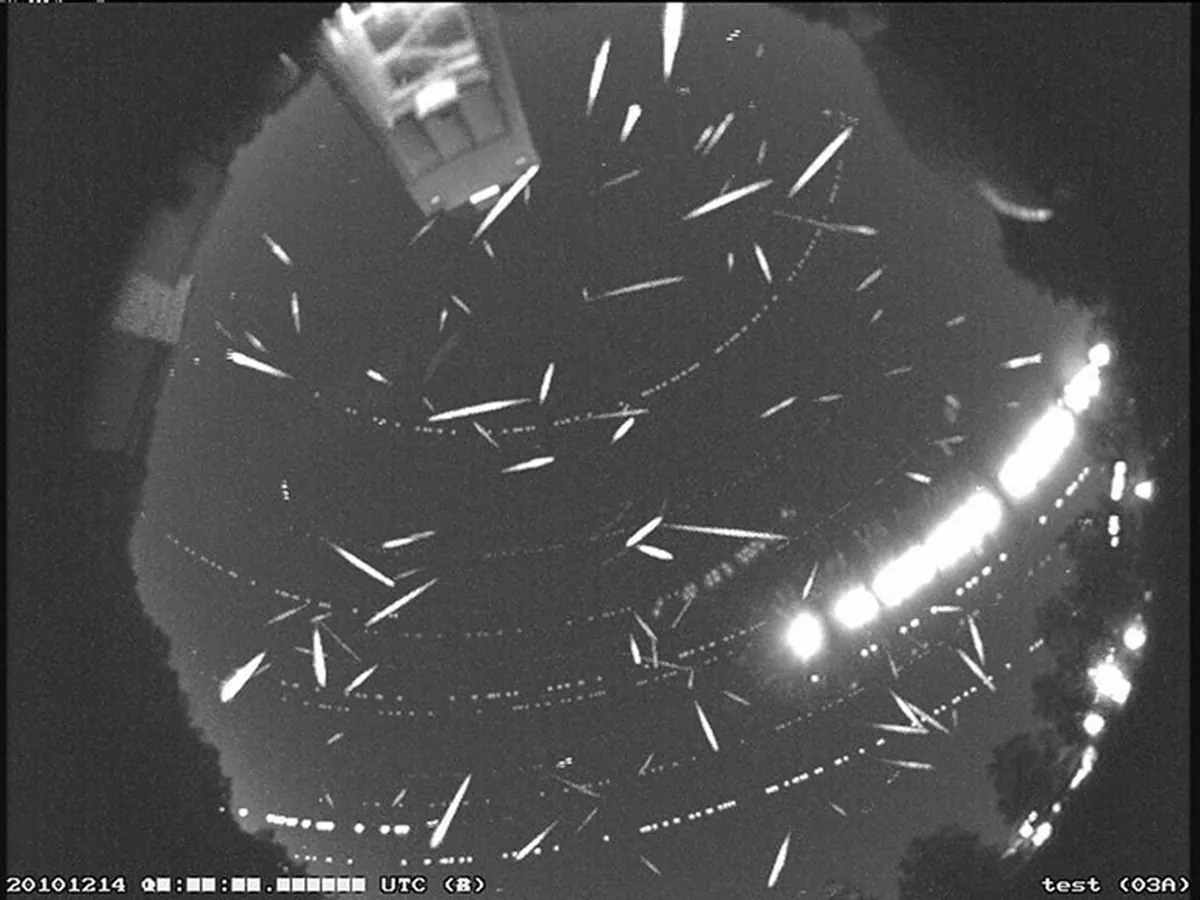
A NASA composite from the 2014 peak stacks more than 100 Geminids in a single frame. That's what a long exposure shows, and the eye sees only a fraction of it. The shower keeps its reputation because it's bright and dependable.
Compare it with the Perseids in August, which are warmer to watch. The Ursids follow about a week later, and the meteor shower calendar shows how the year fits together.
Who's under the peak
The calculated peak is December 14, 2027 at 19:52 UTC. In local solar time that's the middle of the night (10 p.m. to 3 a.m.) for Delhi, and evening, dawn or daytime for London, New York, Los Angeles, Sao Paulo, Johannesburg, Beijing and Sydney.
The hour of the peak moves from year to year, because a calendar year isn't a whole number of Earth orbits. Across 2027 to 2034 it ranges from 02:01 to 20:29 UTC, so the part of the world that sits under the peak changes with it.