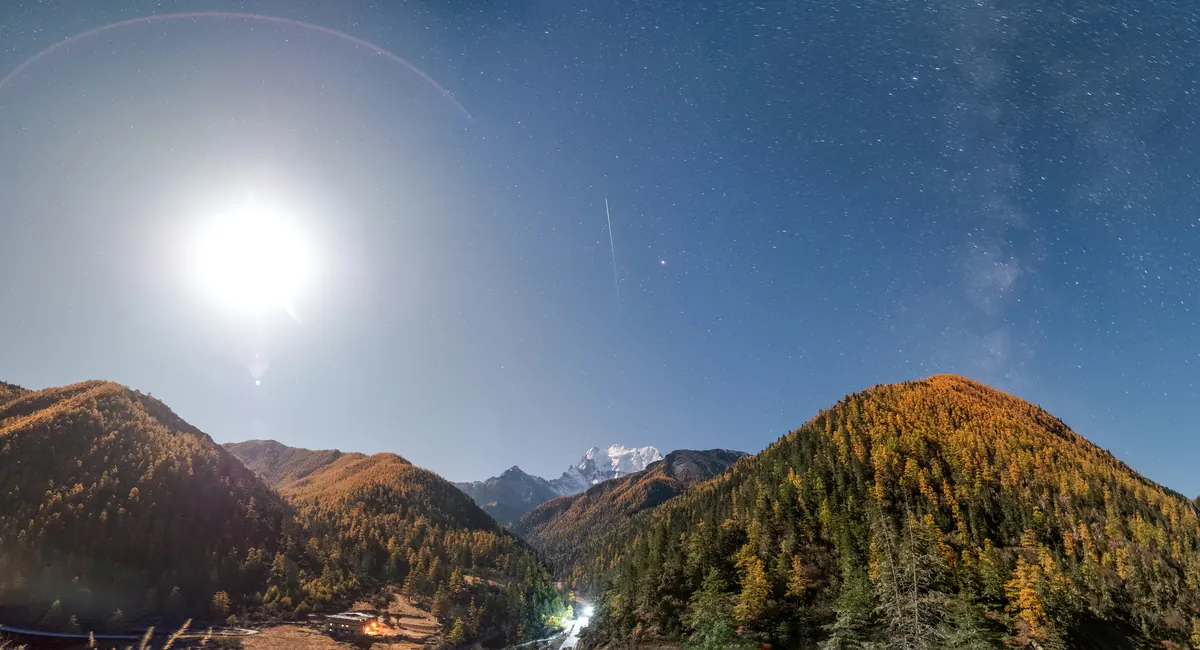
A shower you can see all night
The Ursids radiate from near Kochab, the star Beta Ursae Minoris in the Little Bear. The radiant is so far north that it never sets from most northern sites, so it's a shower for the Northern Hemisphere only.
Coordinated studies began after an outburst in 1945, when European observers saw about 120 meteors an hour, according to NASA.
Tuttle's dust
The parent is comet 8P/Tuttle, a link established through observations in the 1970s and later. Outbursts followed in 1945 and 1986, linked to dust trails the comet left in 1392 and 1378.
Peter Jenniskens and Esko Lyytinen found that outbursts can occur when the comet is at aphelion, its farthest point from the Sun.
The next 8 years
The peak is when Earth passes the densest part of the stream, and it falls on almost the same date each year. What changes is the Moon. The table shows the Moon at the peak and how many hours of dark, moon-free sky there are with the radiant above 20 degrees, on the better of the two nights around the peak.
| Year | Peak | Moon at the peak | Good hours, 40 N | Rating, 40 N | Good hours, 30 S | Rating, 30 S |
|---|---|---|---|---|---|---|
| 2027 | December 23, 2027, 04:18 UTC | 21% (waning crescent) | 10.0 h | Excellent | 0.0 h | No dark window |
| 2028 | December 22, 2028, 10:27 UTC | 36% (waxing crescent) | 7.5 h | Excellent | 0.0 h | No dark window |
| 2029 | December 22, 2029, 16:36 UTC | 97% (waning gibbous) | 0.2 h | Poor | 0.0 h | No dark window |
| 2030 | December 22, 2030, 22:46 UTC | 5% (waning crescent) | 11.5 h | Excellent | 0.0 h | No dark window |
| 2031 | December 23, 2031, 04:55 UTC | 73% (waxing gibbous) | 3.7 h | Good | 0.0 h | No dark window |
| 2032 | December 22, 2032, 11:04 UTC | 72% (waning gibbous) | 4.2 h | Excellent | 0.0 h | No dark window |
| 2033 | December 22, 2033, 17:14 UTC | 1% (new Moon) | 11.5 h | Excellent | 0.0 h | No dark window |
| 2034 | December 22, 2034, 23:23 UTC | 91% (waxing gibbous) | 2.3 h | Good | 0.0 h | No dark window |
Good hours are measured in local solar time and count only times when the Sun is more than 18 degrees below the horizon, the Moon is below the horizon and the radiant is above 20 degrees. Rating: 4 hours or more is excellent, 2 to 4 good, under 2 poor. Peak times are in UTC.
The best and worst year
From 40 degrees north the best of these years is 2033, with 11.5 good hours and the Moon 1% lit at the peak. The worst is 2029, with 0.2 good hours. From 30 degrees south the best is 2033, with 0.0 good hours.
The night of the next peak at 40 degrees north
The better night around the December 23, 2027 peak starts on the evening of December 23, 2027. Times are local solar time.
| What | Local solar time |
|---|---|
| Astronomical darkness | 18:20 to 05:45 |
| Moon above the horizon during the dark hours | 04:20 to 05:45 |
| Radiant above 20 degrees during the dark hours | 18:20 to 05:45 |
| Good window: dark, no Moon, radiant up | 18:20 to 04:20 |
The radiant sits at declination +76 degrees and right ascension 14.5 hours. Rating for that night: excellent, with 10.0 good hours.
What the Ursids are
The parent is comet 8P/Tuttle. Tuttle's Comet. The ZHR is normally about 10, so it's a quiet shower, with occasional outbursts.
Outbursts were recorded in 1945 and 1986, linked to dust trails left by the comet in 1392 and 1378.
In 2000 an outburst peaked at about 90 meteors an hour for a short time.
The radiant is so far north that it never sets from most northern sites, which makes the Ursids a shower for the Northern Hemisphere only.
 Meteor shower calendarEvery major shower with the Moon at its peak.
 Sky calendarEclipses, planets and meteor showers.
 Milky Way seasonThe best nights for the galaxy, park by park.
Questions people ask
When do the Ursids peak?
The next peak is December 23, 2027 at about 04:18 UTC. The shower is active 17 to 26 December.
How many Ursids can you see an hour?
The ZHR, an ideal rate under perfect skies with the radiant overhead, is 10. The ZHR is normally about 10, so it's a quiet shower, with occasional outbursts.
Will the Moon spoil the Ursids next time?
At the next peak the Moon is 21% lit (waning crescent). From 40 degrees north that gives 10.0 dark, moon-free hours with the radiant up on the better night.
Which year is best for the Ursids?
Of the next 8 years, 2033 has the least moonlight problem at 40 degrees north, with 11.5 good hours.
The Quadrantids follow just over a week later and are the first big shower of the year.
Trapped in resonance
Peter Jenniskens and Esko Lyytinen found that some of the comet's meteoroids sit in a resonance with Jupiter. Resonance keeps the dust in bunches, which is why outbursts can recur even though the comet itself is far away.
Watching the Ursids
The shower is active 17 to 26 December, and its meteors move at about 33 kilometers a second. The stream is narrow, so meteor observer Norman McLeod noted that you need to be within about 12 hours of the maximum to see many. The next peak is December 23, 2027, with the Moon 21% lit (waning crescent). At 40 degrees north, 5 of the 8 peaks from 2027 to 2034 give four hours or more of dark, moon-free sky with the radiant up: 2027, 2028, 2030, 2032 and 2033. The Moon is under a quarter lit at the peak in 2027, 2030 and 2033. It's three-quarters lit or more in 2029 and 2034, and in those years only the brightest meteors show.
Wrap up for a long night in the cold. The radiant stays in the northern sky, so you can watch whenever you like.
A quiet shower
The ZHR is normally about 10, so most years are slow. The attraction is the chance of an outburst, and the timing in the table matters because the peak is short. The Geminids about a week earlier are the bigger show.
It's the last major shower of the year. See the meteor shower calendar for the full list, and the sky calendar for the eclipses and planets that fill in the rest.
Who's under the peak
The calculated peak is December 23, 2027 at 04:18 UTC. In local solar time that's the middle of the night (10 p.m. to 3 a.m.) for New York and Sao Paulo, and evening, dawn or daytime for London, Los Angeles, Johannesburg, Delhi, Beijing and Sydney.
The hour of the peak moves from year to year, because a calendar year isn't a whole number of Earth orbits. Across 2027 to 2034 it ranges from 04:18 to 23:23 UTC, so the part of the world that sits under the peak changes with it.