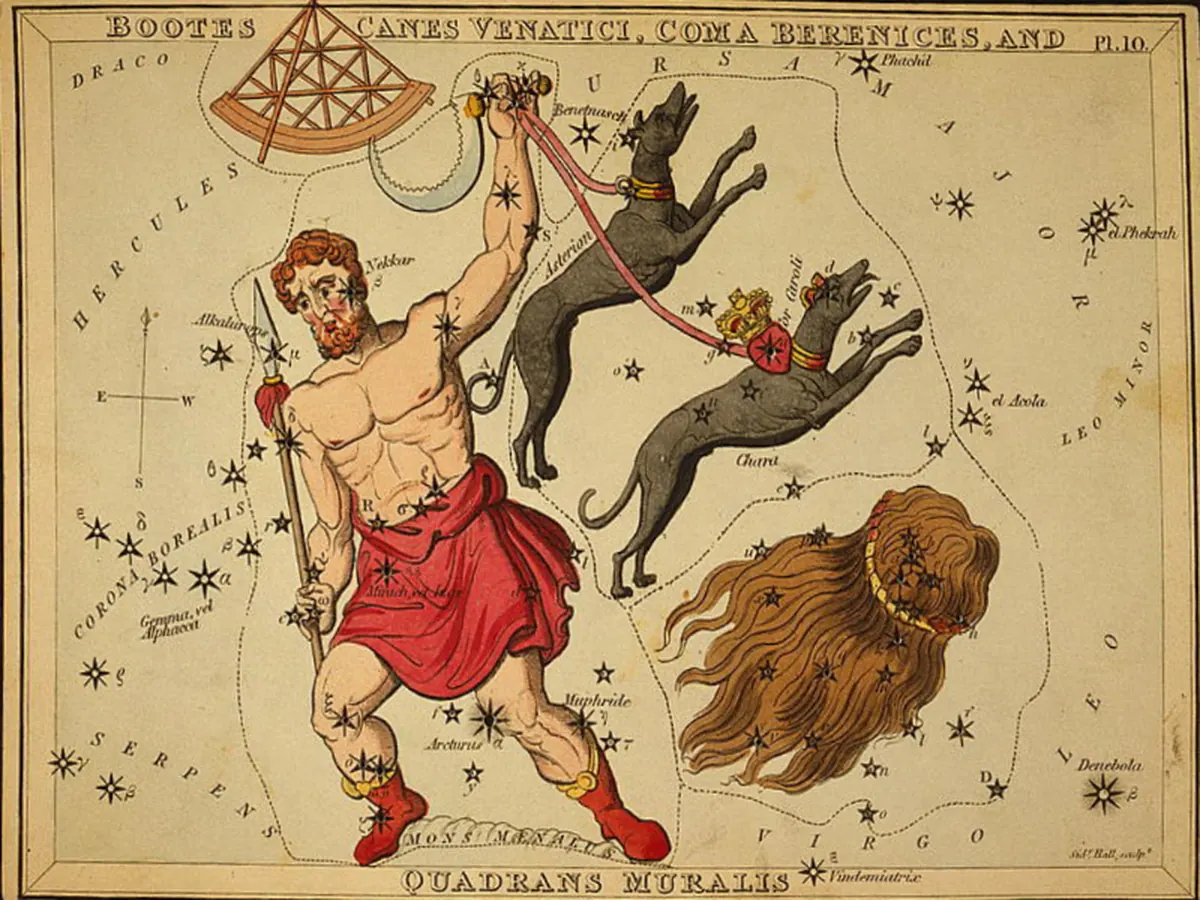
A shower named after a constellation that no longer exists
In 1795 Jerome Lalande made up a constellation, Quadrans Muralis, which lay between Bootes and Draco near the end of the Big Dipper's handle. The International Astronomical Union dropped it from its list in 1922. The shower kept the name, and it's also called the Bootids.
The first Quadrantids were seen in 1825. A modern star map has no Quadrans Muralis, so the shower's own name sends you to a place that isn't on the map.
An asteroid that might be a comet
The parent is 2003 EH1, found by the LONEOS survey at Lowell Observatory on 6 March 2003. It's about 3 kilometers across and orbits the Sun every 5.52 years. Peter Jenniskens identified it as the source. NASA says it may be a dead comet or a rock comet.
The stream is thin, and Earth crosses it at close to a right angle. That gives the Quadrantids their most unusual trait. Most showers peak over about two days. The Quadrantid peak lasts only a few hours.
Who saw it first
Early in January 1825, Antonio Brucalassi in Italy reported a multitude of falling stars that seemed to radiate from Quadrans Muralis. In 1839, Adolphe Quetelet in Brussels and Edward Herrick in Connecticut independently proposed that the Quadrantids are an annual shower. The International Astronomical Union adopted its list of 88 constellations in 1930, and the old name stayed.
In 2004 Jenniskens linked 2003 EH1 to comet C/1490 Y1, which East Asian astronomers recorded about 500 years earlier. If the link holds, the stream may be less than 500 years old.
The next 8 years
The peak is when Earth passes the densest part of the stream, and it falls on almost the same date each year. What changes is the Moon. The table shows the Moon at the peak and how many hours of dark, moon-free sky there are with the radiant above 20 degrees, on the better of the two nights around the peak.
| Year | Peak | Moon at the peak | Good hours, 40 N | Rating, 40 N | Good hours, 30 S | Rating, 30 S |
|---|---|---|---|---|---|---|
| 2027 | January 4, 2027, 03:23 UTC | 12% (waning crescent) | 4.5 h | Excellent | 0.0 h | No dark window |
| 2028 | January 4, 2028, 09:32 UTC | 43% (waxing crescent) | 4.5 h | Excellent | 0.0 h | No dark window |
| 2029 | January 3, 2029, 15:41 UTC | 89% (waning gibbous) | 0.0 h | No dark window | 0.0 h | No dark window |
| 2030 | January 3, 2030, 21:51 UTC | 0% (new Moon) | 4.5 h | Excellent | 0.0 h | No dark window |
| 2031 | January 4, 2031, 04:00 UTC | 82% (waxing gibbous) | 2.2 h | Good | 0.0 h | No dark window |
| 2032 | January 4, 2032, 10:09 UTC | 65% (waning gibbous) | 0.0 h | No dark window | 0.0 h | No dark window |
| 2033 | January 3, 2033, 16:19 UTC | 7% (waxing crescent) | 4.5 h | Excellent | 0.0 h | No dark window |
| 2034 | January 3, 2034, 22:28 UTC | 99% (full Moon) | 0.2 h | Poor | 0.0 h | No dark window |
Good hours are measured in local solar time and count only times when the Sun is more than 18 degrees below the horizon, the Moon is below the horizon and the radiant is above 20 degrees. Rating: 4 hours or more is excellent, 2 to 4 good, under 2 poor. Peak times are in UTC.
The best and worst year
From 40 degrees north the best of these years is 2030, with 4.5 good hours and the Moon 0% lit at the peak. The worst is 2032, with 0.0 good hours. From 30 degrees south the best is 2030, with 0.0 good hours.
The night of the next peak at 40 degrees north
The better night around the January 4, 2027 peak starts on the evening of January 4, 2027. Times are local solar time.
| What | Local solar time |
|---|---|
| Astronomical darkness | 18:25 to 05:50 |
| Moon above the horizon during the dark hours | none |
| Radiant above 20 degrees during the dark hours | 01:15 to 05:50 |
| Good window: dark, no Moon, radiant up | 01:15 to 05:50 |
The radiant sits at declination +49 degrees and right ascension 15.3 hours. Rating for that night: excellent, with 4.5 good hours.
What the Quadrantids are
The parent is asteroid 2003 EH1. NASA says 2003 EH1 may be a rock comet. It orbits the Sun about every 5.5 years and is roughly 3 km across. NASA's fast facts say to expect fewer than 10 meteors an hour under dark skies, and that 60 to 200 an hour can be seen at the peak under perfect conditions.
Most showers peak over about two days. The Quadrantid peak lasts only a few hours, because the stream of particles is thin and Earth crosses it head on.
The radiant is in Bootes, but the shower is named after Quadrans Muralis, a constellation made up by Jerome Lalande in 1795 and left off the International Astronomical Union's 1922 list.
The first Quadrantids were seen in 1825. Asteroid 2003 EH1 was found in 2003 by the LONEOS survey, and Peter Jenniskens identified it as the source.
 Meteor shower calendarEvery major shower with the Moon at its peak.
 Sky calendarEclipses, planets and meteor showers.
 Milky Way seasonThe best nights for the galaxy, park by park.
Questions people ask
When do the Quadrantids peak?
The next peak is January 4, 2027 at about 03:23 UTC. The shower is active 28 December to 12 January.
How many Quadrantids can you see an hour?
The ZHR, an ideal rate under perfect skies with the radiant overhead, is 80. NASA's fast facts say to expect fewer than 10 meteors an hour under dark skies, and that 60 to 200 an hour can be seen at the peak under perfect conditions.
Will the Moon spoil the Quadrantids next time?
At the next peak the Moon is 12% lit (waning crescent). From 40 degrees north that gives 4.5 dark, moon-free hours with the radiant up on the better night.
Which year is best for the Quadrantids?
Of the next 8 years, 2030 has the least moonlight problem at 40 degrees north, with 4.5 good hours.
A narrow peak
Quadrantid rates stay above half their maximum for only about 8 hours, against about 2 days for the Perseids. That's the sign of a narrow stream. The ZHR can match the Perseids and Geminids: 146 in 2009 and a main peak of 245 in 2014, with a brief spike of 315.
Watching the Quadrantids
The shower is best seen from the Northern Hemisphere and is visible north of 51 degrees south. Early January nights are cold, so wrap up and lie with your feet pointing northeast. The meteors move at about 40.4 kilometers a second, and the shower is known for bright fireballs.
The next peak is January 4, 2027, with the Moon 12% lit (waning crescent). At 40 degrees north, 4 of the 8 peaks from 2027 to 2034 give four hours or more of dark, moon-free sky with the radiant up: 2027, 2028, 2030 and 2033. The Moon is under a quarter lit at the peak in 2027, 2030 and 2033. It's three-quarters lit or more in 2029, 2031 and 2034, and in those years only the brightest meteors show. The short peak makes timing matter more than for any other shower here, and the table on this page gives the UTC time of each peak.
A big number that rarely happens
NASA says to expect fewer than 10 meteors an hour under dark skies outside the peak, and 60 to as many as 200 at the peak in ideal conditions. The International Meteor Organization lists a ZHR of 80. All of these can be true at once.
The catch is that the peak is a window of a few hours. If your night falls outside it, you see the low rate. If the peak falls in daylight where you are, a night either side is still worth a look, but expect fewer meteors.
It's the first shower of the year, and the Lyrids in April are the next on the calendar. See the meteor shower calendar for every peak with its Moon, and the sky calendar for the eclipses and planets.
Who's under the peak
The calculated peak is January 4, 2027 at 03:23 UTC. In local solar time that's the middle of the night (10 p.m. to 3 a.m.) for New York and Sao Paulo, and evening, dawn or daytime for London, Los Angeles, Johannesburg, Delhi, Beijing and Sydney.
The hour of the peak moves from year to year, because a calendar year isn't a whole number of Earth orbits. Across 2027 to 2034 it ranges from 03:23 to 22:28 UTC, so the part of the world that sits under the peak changes with it.