Observed for about 2,700 years
The first recorded sighting of the Lyrids was in 687 BC, by Chinese observers, which makes this one of the oldest known showers: about 2,700 years of observations. Heavier displays were seen in 1803 in Virginia, 1922 in Greece, 1945 in Japan and 1982 in the United States.
The parent is comet C/1861 G1 Thatcher, found on 5 April 1861 by A. E. Thatcher. NASA doesn't give its orbital period, and this page doesn't guess one.
A modest shower with a reputation
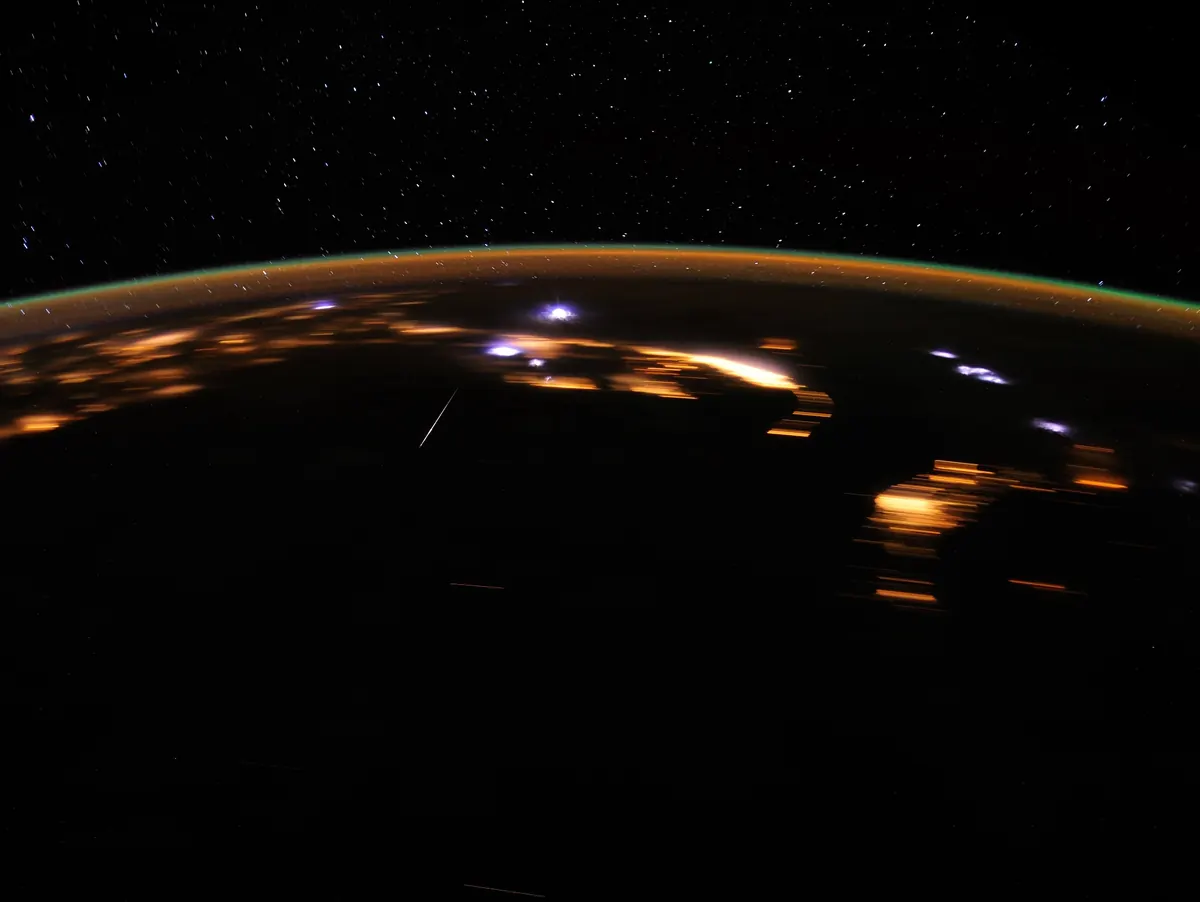
The Lyrids are fast, at about 49 kilometers a second, and bright, but they're less fast and less plentiful than the Perseids in August. They usually leave no long glowing trains, though the occasional fireball turns up. Astronaut Don Pettit photographed Earth at night from the International Space Station during the 2012 peak, catching meteors burning up in the atmosphere below.
Stars falling like rain
The Chinese chronicle Zuo Zhuan records the oldest known Lyrid outburst and says that at midnight "stars fell like rain." Comet Thatcher has an orbital period of about 415 years, according to Wikipedia, which is why the dust it left is so old.
The 1803 display seen from Richmond, Virginia, looks like the strongest on record, with peak rates above 500 meteors an hour, according to the American Meteor Society. The 1982 outburst was seen from the eastern United States, with rates near 100 an hour at maximum. Outbursts like these come when Earth meets the dust trail from one revolution of the comet.
The next 8 years
The peak is when Earth passes the densest part of the stream, and it falls on almost the same date each year. What changes is the Moon. The table shows the Moon at the peak and how many hours of dark, moon-free sky there are with the radiant above 20 degrees, on the better of the two nights around the peak.
| Year | Peak | Moon at the peak | Good hours, 40 N | Rating, 40 N | Good hours, 30 S | Rating, 30 S |
|---|---|---|---|---|---|---|
| 2027 | April 23, 2027, 01:39 UTC | 95% (waning gibbous) | 0.2 h | Poor | 0.0 h | No dark window |
| 2028 | April 22, 2028, 07:49 UTC | 6% (waning crescent) | 5.7 h | Excellent | 3.2 h | Good |
| 2029 | April 22, 2029, 13:58 UTC | 58% (waxing gibbous) | 2.3 h | Good | 3.0 h | Good |
| 2030 | April 22, 2030, 20:07 UTC | 71% (waning gibbous) | 2.2 h | Good | 0.0 h | No dark window |
| 2031 | April 23, 2031, 02:16 UTC | 2% (new Moon) | 5.7 h | Excellent | 3.2 h | Good |
| 2032 | April 22, 2032, 08:25 UTC | 89% (waxing gibbous) | 0.3 h | Poor | 1.8 h | Poor |
| 2033 | April 22, 2033, 14:34 UTC | 49% (last quarter) | 3.5 h | Good | 0.0 h | No dark window |
| 2034 | April 22, 2034, 20:44 UTC | 23% (waxing crescent) | 5.7 h | Excellent | 3.0 h | Good |
Good hours are measured in local solar time and count only times when the Sun is more than 18 degrees below the horizon, the Moon is below the horizon and the radiant is above 20 degrees. Rating: 4 hours or more is excellent, 2 to 4 good, under 2 poor. Peak times are in UTC.
The best and worst year
From 40 degrees north the best of these years is 2031, with 5.7 good hours and the Moon 2% lit at the peak. The worst is 2027, with 0.2 good hours. From 30 degrees south the best is 2031, with 3.2 good hours.
The night of the next peak at 40 degrees north
The better night around the April 23, 2027 peak starts on the evening of April 23, 2027. Times are local solar time.
| What | Local solar time |
|---|---|
| Astronomical darkness | 20:30 to 03:30 |
| Moon above the horizon during the dark hours | 22:05 to 03:30 |
| Radiant above 20 degrees during the dark hours | 21:55 to 03:30 |
| Good window: dark, no Moon, radiant up | 21:55 to 22:05 |
The radiant sits at declination +34 degrees and right ascension 18.1 hours. Rating for that night: poor, with 0.2 good hours.
What the Lyrids are
The parent is comet C/1861 G1 Thatcher. Comet Thatcher was found in 1861. NASA doesn't give its orbital period. NASA says 10 to 20 Lyrids an hour can be seen at the peak, and its fast facts list about 5 to 6 under dark skies. The shower has produced as many as 100 an hour on occasion.
The first recorded sighting was in 687 BC, by the Chinese. That makes the Lyrids about 2,700 years of observations old.
Heavier showers were seen in 1803 in Virginia, in 1922 in Greece, in 1945 in Japan and in 1982 in the United States.
 Meteor shower calendarEvery major shower with the Moon at its peak.
 Sky calendarEclipses, planets and meteor showers.
 Milky Way seasonThe best nights for the galaxy, park by park.
Questions people ask
When do the Lyrids peak?
The next peak is April 23, 2027 at about 01:39 UTC. The shower is active 14 to 30 April.
How many Lyrids can you see an hour?
The ZHR, an ideal rate under perfect skies with the radiant overhead, is 18. NASA says 10 to 20 Lyrids an hour can be seen at the peak, and its fast facts list about 5 to 6 under dark skies. The shower has produced as many as 100 an hour on occasion.
Will the Moon spoil the Lyrids next time?
At the next peak the Moon is 95% lit (waning gibbous). From 40 degrees north that gives 0.2 dark, moon-free hours with the radiant up on the better night.
Which year is best for the Lyrids?
Of the next 8 years, 2031 has the least moonlight problem at 40 degrees north, with 5.7 good hours.
Fireballs and rates
Lyrid fireballs can briefly cast shadows and leave smoky trails that last for minutes. The American Meteor Society lists a ZHR of 18.
Watching the Lyrids
The radiant is near the bright star Vega in Lyra, which is easy to find even in light-polluted skies. NASA says the shower is best seen from the Northern Hemisphere, in the dark hours after moonset and before dawn. Lie with your feet facing east and look at as much sky as you can.
The next peak is April 23, 2027, with the Moon 95% lit (waning gibbous). At 40 degrees north, 3 of the 8 peaks from 2027 to 2034 give four hours or more of dark, moon-free sky with the radiant up: 2028, 2031 and 2034. The Moon is under a quarter lit at the peak in 2028, 2031 and 2034. It's three-quarters lit or more in 2027 and 2032, and in those years only the brightest meteors show.
Looking away from the radiant gives longer, more dramatic meteors. Looking straight at it shortens them, because the meteors are heading toward you.
Expect little, hope for more
NASA gives about 5 to 6 meteors an hour under dark skies and 10 to 20 at the peak. The International Meteor Organization lists a ZHR of 18. The shower has reached as many as 100 an hour on occasion, but that's the exception.
With a usual night of a few meteors an hour, the Moon decides whether a Lyrid night is worth the trip. If it has set, go. If it's bright, wait for a better year in the table on this page.
Next in line are the Eta Aquariids in May. The meteor shower calendar and the Milky Way season guide help plan a dark-sky trip that covers both.
Who's under the peak
The calculated peak is April 23, 2027 at 01:39 UTC. In local solar time that's the middle of the night (10 p.m. to 3 a.m.) for London and Sao Paulo, and evening, dawn or daytime for New York, Los Angeles, Johannesburg, Delhi, Beijing and Sydney.
The hour of the peak moves from year to year, because a calendar year isn't a whole number of Earth orbits. Across 2027 to 2034 it ranges from 01:39 to 20:44 UTC, so the part of the world that sits under the peak changes with it.