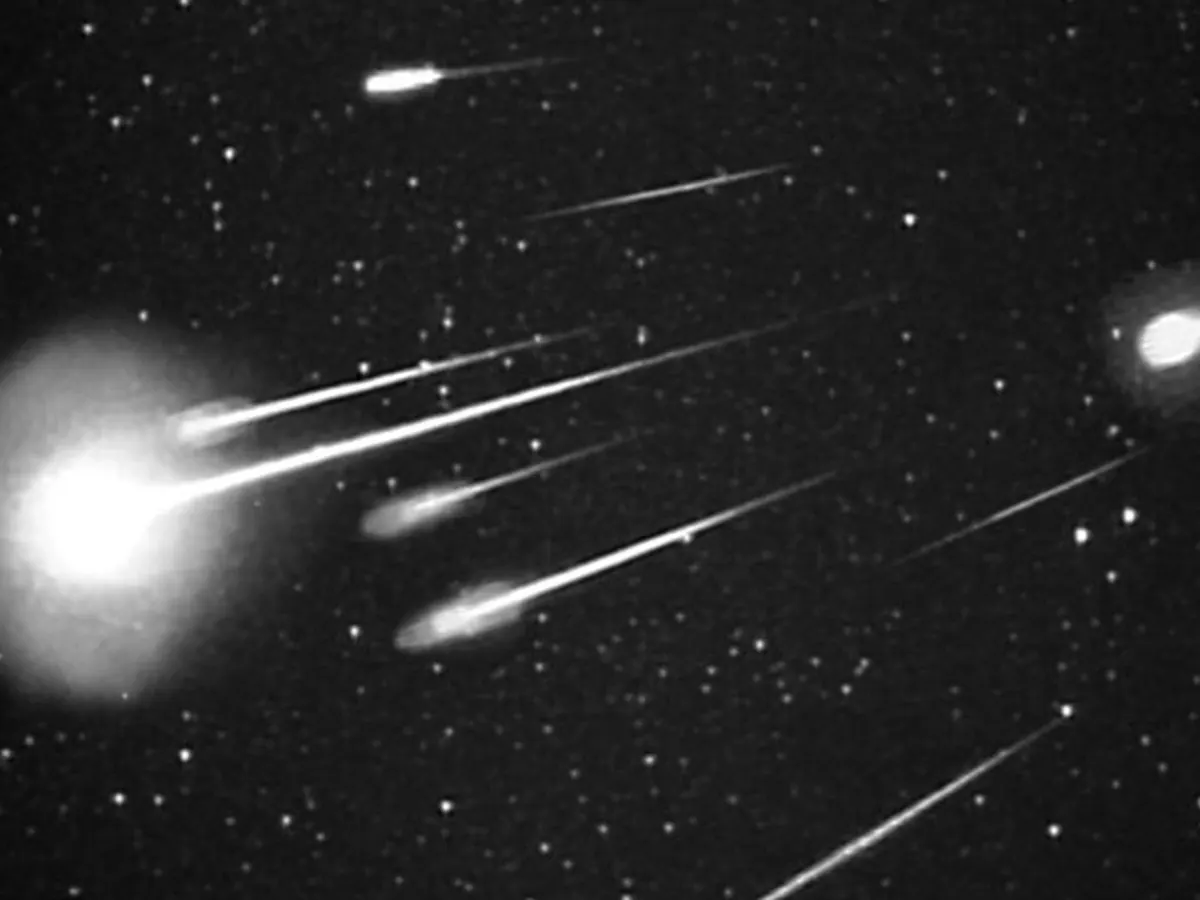
The night the stars fell
On 12 and 13 November 1833 the sky over North America filled with meteors. NASA's Bill Cooke puts the peak at tens of thousands of meteors an hour, perhaps as many as 100,000.
Denison Olmsted collected accounts that autumn and presented his findings in 1834. He noticed that the shower was short, that it wasn't seen in Europe, and that the meteors seemed to come from the constellation Leo. That pointed to a cloud of particles in space rather than something in the air.
A comet with a 33 year clock
Comet Tempel-Tuttle was found twice, by Ernst Tempel in 1865 and by Horace Tuttle in 1866. Its nucleus is only about 3.6 kilometers across and it orbits the Sun every 33 years. Work in 1866 and 1867 tied the comet to the shower.
Leonid storms come about every 33 years. NASA defines a storm as at least 1,000 meteors an hour. In 1966 observers in western North America saw rates as high as 40 meteors a second, according to the American Meteor Society, which looked like rain. The last storm was in 2002.
Those years were studied hard. A NASA aircraft campaign photographed the 1999 shower from 38,000 feet, and in 2001 and 2002 the rate climbed toward 3,000 an hour in two spikes. Researchers traced the spikes to dust the comet shed in 1767 and 1866.
How big was it, really?
Counts of the 1833 storm are estimates, and they vary by observer and place. NASA puts the 1833 peak at tens of thousands an hour, perhaps 100,000. For 1966 the American Meteor Society reports rates as high as 40 meteors a second, about 144,000 an hour. Storm numbers are always approximate, because no one can count that fast.
The next 8 years
The peak is when Earth passes the densest part of the stream, and it falls on almost the same date each year. What changes is the Moon. The table shows the Moon at the peak and how many hours of dark, moon-free sky there are with the radiant above 20 degrees, on the better of the two nights around the peak.
| Year | Peak | Moon at the peak | Good hours, 40 N | Rating, 40 N | Good hours, 30 S | Rating, 30 S |
|---|---|---|---|---|---|---|
| 2027 | November 18, 2027, 05:56 UTC | 80% (waning gibbous) | 0.0 h | No dark window | 0.0 h | No dark window |
| 2028 | November 17, 2028, 12:05 UTC | 1% (new Moon) | 4.5 h | Excellent | 0.3 h | Poor |
| 2029 | November 17, 2029, 18:15 UTC | 90% (waxing gibbous) | 2.0 h | Good | 0.3 h | Poor |
| 2030 | November 18, 2030, 00:24 UTC | 53% (last quarter) | 0.0 h | No dark window | 0.0 h | No dark window |
| 2031 | November 18, 2031, 06:33 UTC | 15% (waxing crescent) | 4.5 h | Excellent | 0.5 h | Poor |
| 2032 | November 17, 2032, 12:42 UTC | 100% (full Moon) | 0.0 h | No dark window | 0.0 h | No dark window |
| 2033 | November 17, 2033, 18:51 UTC | 16% (waning crescent) | 2.7 h | Good | 0.0 h | No dark window |
| 2034 | November 18, 2034, 01:01 UTC | 39% (waxing crescent) | 4.5 h | Excellent | 0.5 h | Poor |
Good hours are measured in local solar time and count only times when the Sun is more than 18 degrees below the horizon, the Moon is below the horizon and the radiant is above 20 degrees. Rating: 4 hours or more is excellent, 2 to 4 good, under 2 poor. Peak times are in UTC.
The best and worst year
From 40 degrees north the best of these years is 2028, with 4.5 good hours and the Moon 1% lit at the peak. The worst is 2030, with 0.0 good hours. From 30 degrees south the best is 2031, with 0.5 good hours.
The night of the next peak at 40 degrees north
The better night around the November 18, 2027 peak starts on the evening of November 17, 2027. Times are local solar time.
| What | Local solar time |
|---|---|
| Astronomical darkness | 18:20 to 05:15 |
| Moon above the horizon during the dark hours | 19:50 to 05:15 |
| Radiant above 20 degrees during the dark hours | 00:55 to 05:15 |
| Good window: dark, no Moon, radiant up | none |
The radiant sits at declination +22 degrees and right ascension 10.1 hours. Rating for that night: no dark window, with 0.0 good hours.
What the Leonids are
The parent is comet 55P/Tempel-Tuttle. Tempel-Tuttle takes 33 years to orbit the Sun once. NASA says rates are often as low as about 3 meteors an hour. The ZHR of 15 is the IMO's figure for a normal year.
A meteor storm is at least 1,000 meteors an hour. The 1966 Leonid storm produced thousands of meteors a minute for about 15 minutes, and the last storm was in 2002, according to NASA.
Storms come roughly every 33 years, when the comet is near the Sun and Earth crosses fresh debris.
Leonids hit the atmosphere at about 71 km/s, the fastest of the major annual showers.
 Meteor shower calendarEvery major shower with the Moon at its peak.
 Sky calendarEclipses, planets and meteor showers.
 Milky Way seasonThe best nights for the galaxy, park by park.
Questions people ask
When do the Leonids peak?
The next peak is November 18, 2027 at about 05:56 UTC. The shower is active 6 to 30 November.
How many Leonids can you see an hour?
The ZHR, an ideal rate under perfect skies with the radiant overhead, is 15. NASA says rates are often as low as about 3 meteors an hour. The ZHR of 15 is the IMO's figure for a normal year.
Will the Moon spoil the Leonids next time?
At the next peak the Moon is 80% lit (waning gibbous). From 40 degrees north that gives 0.0 dark, moon-free hours with the radiant up on the better night.
Which year is best for the Leonids?
Of the next 8 years, 2028 has the least moonlight problem at 40 degrees north, with 4.5 good hours.
Watching the Leonids in an ordinary year
Between storms the Leonids are a quiet shower. NASA says rates are often as low as about 3 an hour, and the IMO's ZHR of 15 is the figure for a normal year. The meteors are quick, at about 71 kilometers a second, the fastest of the major showers, and bright enough to be colorful.
NASA says the best viewing begins around midnight local time. Lie with your feet toward the east and look at as much sky as possible. Looking away from the radiant makes meteors appear longer, and looking straight at it makes them shorter, an effect called foreshortening.
The next peak is November 18, 2027, with the Moon 80% lit (waning gibbous). At 40 degrees north, 3 of the 8 peaks from 2027 to 2034 give four hours or more of dark, moon-free sky with the radiant up: 2028, 2031 and 2034. The Moon is under a quarter lit at the peak in 2028, 2031 and 2033. It's three-quarters lit or more in 2027, 2029 and 2032, and in those years only the brightest meteors show.
The next storm
Storm forecasts come from modeling each dust trail the comet has left. In 1999 two teams, Asher and McNaught and separately Esko Lyytinen, made predictions that narrowed the bursts to ten-minute windows. No storm is forecast on this site, and the last one was in 2002.
Meanwhile the practical habit is to check the meteor shower calendar for a dark-Moon November, go out after midnight, and treat anything extra as a bonus. The Orionids a month earlier and the Geminids a month later bracket the Leonids.
Who's under the peak
The calculated peak is November 18, 2027 at 05:56 UTC. In local solar time that's the middle of the night (10 p.m. to 3 a.m.) for New York, Los Angeles and Sao Paulo, and evening, dawn or daytime for London, Johannesburg, Delhi, Beijing and Sydney.
The hour of the peak moves from year to year, because a calendar year isn't a whole number of Earth orbits. Across 2027 to 2034 it ranges from 00:24 to 18:51 UTC, so the part of the world that sits under the peak changes with it.