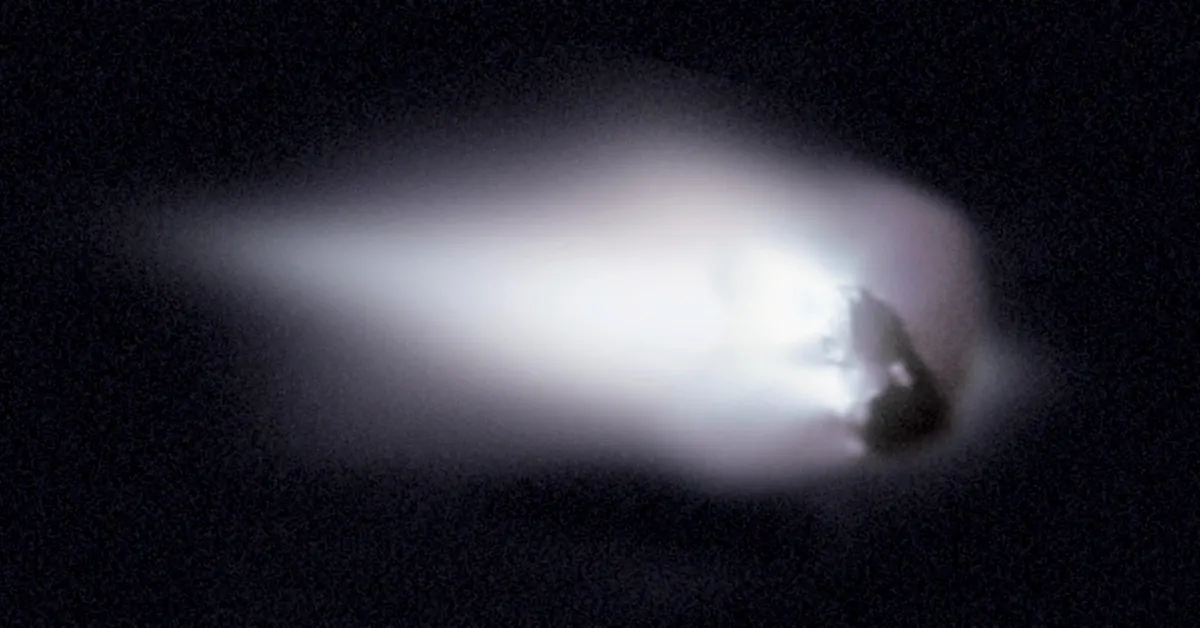
Halley's second shower
The Orionids are the October half of Halley's dust, the other half being the Eta Aquariids in May. Halley takes about 76 years to go around, was last seen by casual observers in 1986 and returns in 2061. Edmond Halley concluded in 1705 that three earlier comets were one object coming back.
The comet appears on the Bayeux Tapestry, which depicts the Battle of Hastings in 1066. The meteors overhead in October are grains of that same body.
Fast and bright
The Orionids hit the atmosphere at about 66 kilometers a second. Meteors that fast can leave glowing trains that last seconds to minutes, and some become fireballs. NASA lists them among the most beautiful showers of the year, set against some of the brightest stars in the night sky.
The radiant sits just north of Betelgeuse, Orion's bright red shoulder star. As with every shower, the constellation only marks the spot, and the meteors cross the whole sky.
A shower with a long memory
E. C. Herrick noted October activity in 1839. Recorded outbursts go back to the years 585, 930, 1436, 1439, 1465 and 1623. On 21 October 2006 the rate topped 100 an hour, from dust streams ejected long before, in 1266 BCE, 1198 BCE and 911 BCE.
Recent peak ZHR figures include 70 in 2007, 45 in 2009, 84 in 2016, 58 in 2018 and 48 in 2023. Wikipedia says the next outburst might come around 2070, from particles in a resonance with Jupiter.
The next 8 years
The peak is when Earth passes the densest part of the stream, and it falls on almost the same date each year. What changes is the Moon. The table shows the Moon at the peak and how many hours of dark, moon-free sky there are with the radiant above 20 degrees, on the better of the two nights around the peak.
| Year | Peak | Moon at the peak | Good hours, 40 N | Rating, 40 N | Good hours, 30 S | Rating, 30 S |
|---|---|---|---|---|---|---|
| 2027 | October 22, 2027, 00:34 UTC | 58% (waning gibbous) | 0.0 h | No dark window | 0.7 h | Poor |
| 2028 | October 21, 2028, 06:43 UTC | 13% (waxing crescent) | 5.7 h | Excellent | 3.3 h | Good |
| 2029 | October 21, 2029, 12:52 UTC | 99% (full Moon) | 0.0 h | No dark window | 0.0 h | No dark window |
| 2030 | October 21, 2030, 19:01 UTC | 29% (waning crescent) | 2.3 h | Good | 1.7 h | Poor |
| 2031 | October 22, 2031, 01:10 UTC | 36% (waxing crescent) | 5.7 h | Excellent | 3.3 h | Good |
| 2032 | October 21, 2032, 07:19 UTC | 92% (waning gibbous) | 0.0 h | No dark window | 0.0 h | No dark window |
| 2033 | October 21, 2033, 13:29 UTC | 3% (new Moon) | 5.7 h | Excellent | 3.3 h | Good |
| 2034 | October 21, 2034, 19:38 UTC | 63% (waxing gibbous) | 5.3 h | Excellent | 3.0 h | Good |
Good hours are measured in local solar time and count only times when the Sun is more than 18 degrees below the horizon, the Moon is below the horizon and the radiant is above 20 degrees. Rating: 4 hours or more is excellent, 2 to 4 good, under 2 poor. Peak times are in UTC.
The best and worst year
From 40 degrees north the best of these years is 2033, with 5.7 good hours and the Moon 3% lit at the peak. The worst is 2027, with 0.0 good hours. From 30 degrees south the best is 2033, with 3.3 good hours.
The night of the next peak at 40 degrees north
The better night around the October 22, 2027 peak starts on the evening of October 21, 2027. Times are local solar time.
| What | Local solar time |
|---|---|
| Astronomical darkness | 18:45 to 04:50 |
| Moon above the horizon during the dark hours | 22:00 to 04:50 |
| Radiant above 20 degrees during the dark hours | 23:10 to 04:50 |
| Good window: dark, no Moon, radiant up | none |
The radiant sits at declination +16 degrees and right ascension 6.3 hours. Rating for that night: no dark window, with 0.0 good hours.
What the Orionids are
The parent is comet 1P/Halley. Halley's Comet, which won't return to the inner solar system until 2061, according to NASA. NASA says about 10 to 20 meteors an hour under dark skies.
Edmond Halley noticed in 1705 that three earlier comets seemed to be one comet returning about every 76 years, and the comet was named for him.
The comet also appears on the Bayeux Tapestry, which shows the 1066 Battle of Hastings.
The shower is named after Orion, where the radiant lies. The constellation isn't the source of the meteors.
 Meteor shower calendarEvery major shower with the Moon at its peak.
 Sky calendarEclipses, planets and meteor showers.
 Milky Way seasonThe best nights for the galaxy, park by park.
Questions people ask
When do the Orionids peak?
The next peak is October 22, 2027 at about 00:34 UTC. The shower is active 2 October to 7 November.
How many Orionids can you see an hour?
The ZHR, an ideal rate under perfect skies with the radiant overhead, is 20. NASA says about 10 to 20 meteors an hour under dark skies.
Will the Moon spoil the Orionids next time?
At the next peak the Moon is 58% lit (waning gibbous). From 40 degrees north that gives 0.0 dark, moon-free hours with the radiant up on the better night.
Which year is best for the Orionids?
Of the next 8 years, 2033 has the least moonlight problem at 40 degrees north, with 5.7 good hours.
Earlier in October, the Draconids arrive, a shower tied to a different comet.
Where Earth meets Halley's orbit
In October Earth is about 0.154 astronomical units, or 23.0 million kilometers, from Halley's orbit, so it samples the dust from a distance. The radiant is about 10 degrees from Betelgeuse. Some years show double peaks or plateaus lasting several days.
Watching the Orionids
Both hemispheres see the shower after midnight. In the Northern Hemisphere lie with your feet pointing southeast, and in the Southern point them northeast. NASA suggests looking 45 to 90 degrees away from the radiant for longer, more dramatic meteors, because the ones near the radiant are foreshortened.
The next peak is October 22, 2027, with the Moon 58% lit (waning gibbous). At 40 degrees north, 4 of the 8 peaks from 2027 to 2034 give four hours or more of dark, moon-free sky with the radiant up: 2028, 2031, 2033 and 2034. The Moon is under a quarter lit at the peak in 2028 and 2033. It's three-quarters lit or more in 2029 and 2032, and in those years only the brightest meteors show.
From the south the count is different. At 30 degrees south, none of the 8 peaks from 2027 to 2034 gives four moon-free hours with the radiant up. The best is 2033, with 3.3.
A long season
NASA gives about 10 to 20 meteors an hour under dark skies, and the International Meteor Organization lists a ZHR of 20. The shower runs 2 October to 7 November, which gives plenty of nights to choose from if the Moon is in the way.
The Taurids are active at the same time and add slow fireballs to the same sky. See the meteor shower calendar for the Moon at every peak.
Who's under the peak
The calculated peak is October 22, 2027 at 00:34 UTC. In local solar time that's the middle of the night (10 p.m. to 3 a.m.) for London and Johannesburg, and evening, dawn or daytime for New York, Los Angeles, Sao Paulo, Delhi, Beijing and Sydney.
The hour of the peak moves from year to year, because a calendar year isn't a whole number of Earth orbits. Across 2027 to 2034 it ranges from 00:34 to 19:38 UTC, so the part of the world that sits under the peak changes with it.