Two branches, one long season
The Taurids come in two branches. The southern branch is active from about September 23 to December 8 and peaks around November 5. The northern runs from about October 13 to December 2 and peaks around November 12. Both average about 5 meteors an hour. Those dates are from Wikipedia and differ from the IMO dates used elsewhere on this page, which is a sign the shower has no sharp peak.
The southern branch comes from comet 2P/Encke. The northern is linked to asteroid 2004 TG10, possibly a large fragment of Encke. The whole complex is thought to be what's left of a comet about 40 kilometers across that broke up roughly 10,000 years ago. The stream is described as the largest in the inner solar system, and Earth takes several weeks to cross it.
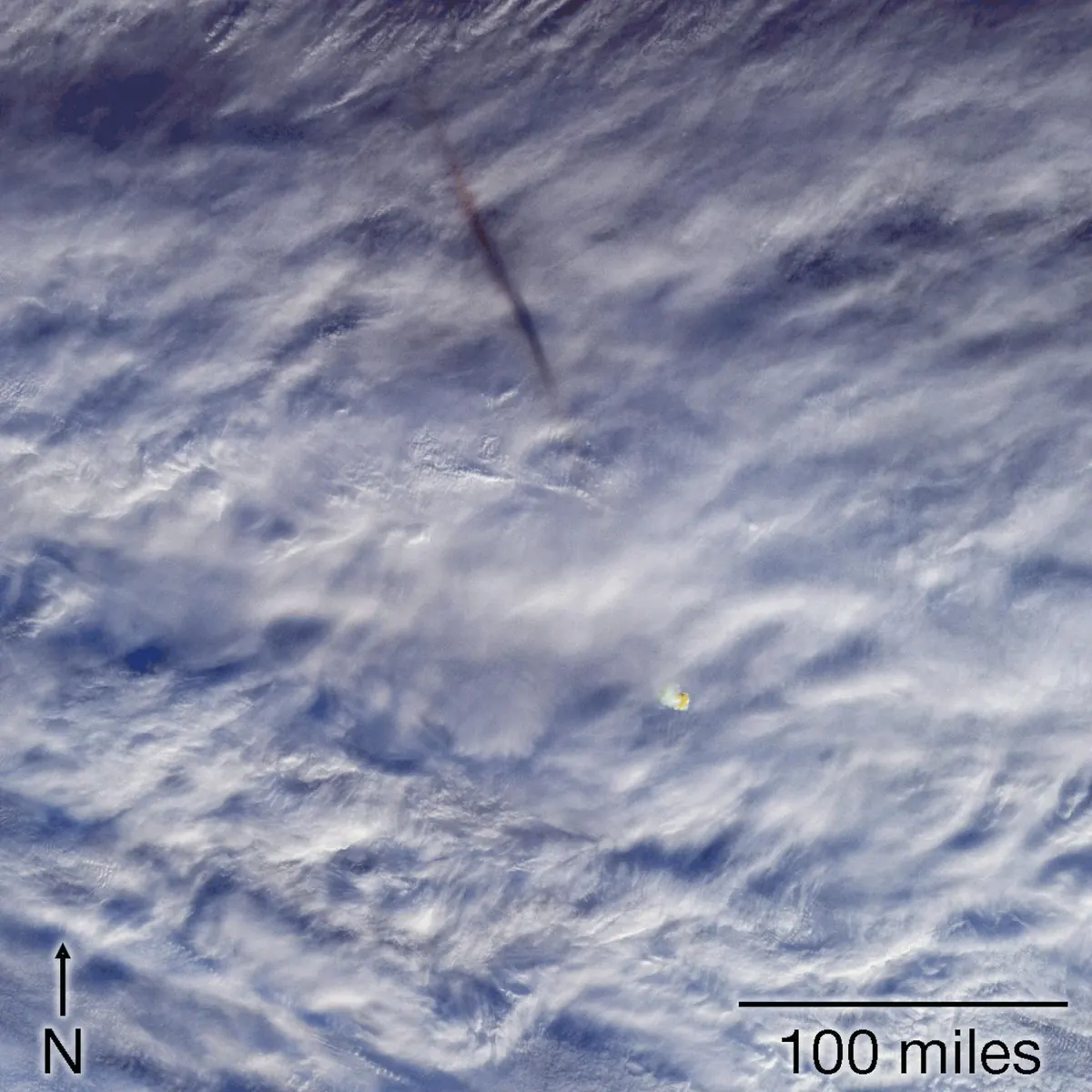
Fireballs are the point
The Taurids are slow, at about 27 kilometers a second, so they aren't flashy. What they have is fireballs. In 1995 the European Fireball Network recorded more Taurid fireballs than usual. In 2005 many fireballs appeared around Halloween, which earned the "Halloween fireballs" name, and a swarm had been predicted in 1993.
Duncan Steel and Bill Napier suggest the Beta Taurids could have caused the 1908 Tunguska event. That's a hypothesis, not a settled cause.
The next 8 years
The peak is when Earth passes the densest part of the stream, and it falls on almost the same date each year. What changes is the Moon. The table shows the Moon at the peak and how many hours of dark, moon-free sky there are with the radiant above 20 degrees, on the better of the two nights around the peak.
| Year | Peak | Moon at the peak | Good hours, 40 N | Rating, 40 N | Good hours, 30 S | Rating, 30 S |
|---|---|---|---|---|---|---|
| 2027 | November 6, 2027, 01:04 UTC | 47% (first quarter) | 6.5 h | Excellent | 3.2 h | Good |
| 2028 | November 5, 2028, 07:13 UTC | 92% (waning gibbous) | 0.0 h | No dark window | 1.0 h | Poor |
| 2029 | November 5, 2029, 13:22 UTC | 1% (new Moon) | 9.7 h | Excellent | 6.8 h | Excellent |
| 2030 | November 5, 2030, 19:31 UTC | 82% (waxing gibbous) | 3.3 h | Good | 1.7 h | Poor |
| 2031 | November 6, 2031, 01:41 UTC | 62% (waning gibbous) | 3.7 h | Good | 3.5 h | Good |
| 2032 | November 5, 2032, 07:50 UTC | 5% (waxing crescent) | 9.7 h | Excellent | 6.8 h | Excellent |
| 2033 | November 5, 2033, 13:59 UTC | 98% (full Moon) | 0.5 h | Poor | 0.0 h | No dark window |
| 2034 | November 5, 2034, 20:08 UTC | 23% (waning crescent) | 6.7 h | Excellent | 5.8 h | Excellent |
Good hours are measured in local solar time and count only times when the Sun is more than 18 degrees below the horizon, the Moon is below the horizon and the radiant is above 20 degrees. Rating: 4 hours or more is excellent, 2 to 4 good, under 2 poor. Peak times are in UTC.
The best and worst year
From 40 degrees north the best of these years is 2029, with 9.7 good hours and the Moon 1% lit at the peak. The worst is 2028, with 0.0 good hours. From 30 degrees south the best is 2029, with 6.8 good hours.
The northern branch peaks about a week later, at a solar longitude of 230.0 degrees. On the same calculation its next peak is November 13, 2027, with the Moon 98% lit (full Moon).
The night of the next peak at 40 degrees north
The better night around the November 6, 2027 peak starts on the evening of November 5, 2027. Times are local solar time.
| What | Local solar time |
|---|---|
| Astronomical darkness | 18:30 to 05:05 |
| Moon above the horizon during the dark hours | 18:30 to 22:40 |
| Radiant above 20 degrees during the dark hours | 19:30 to 05:05 |
| Good window: dark, no Moon, radiant up | 22:40 to 05:05 |
The radiant sits at declination +15 degrees and right ascension 3.5 hours. Rating for that night: excellent, with 6.5 good hours.
What the Taurids are
The parent is comet 2P/Encke. The southern branch comes from Comet Encke. The northern branch is linked to asteroid 2004 TG10, possibly a large fragment of Encke. Rates are low, about 5 an hour at best, but the Taurids are known for bright fireballs.
Fireballs make up about 1 percent of Taurid meteors in most years, and as much as 7 percent in exceptional years, according to the sources listed.
At about 28 km/s the Taurids are among the slowest of the annual showers.
Neither branch has a sharp peak. The dates in the table are the IMO's, and activity is spread over weeks.
 Meteor shower calendarEvery major shower with the Moon at its peak.
 Sky calendarEclipses, planets and meteor showers.
 Milky Way seasonThe best nights for the galaxy, park by park.
Questions people ask
When do the Taurids peak?
The next peak is November 6, 2027 at about 01:04 UTC. The shower is active 20 September to 20 November (southern branch), 20 October to 10 December (northern branch).
How many Taurids can you see an hour?
The ZHR, an ideal rate under perfect skies with the radiant overhead, is 5. Rates are low, about 5 an hour at best, but the Taurids are known for bright fireballs.
Will the Moon spoil the Taurids next time?
At the next peak the Moon is 47% lit (first quarter). From 40 degrees north that gives 6.5 dark, moon-free hours with the radiant up on the better night.
Which year is best for the Taurids?
Of the next 8 years, 2029 has the least moonlight problem at 40 degrees north, with 9.7 good hours.
Another autumn shower worth knowing is the Draconids, which can burst unpredictably.
Watching the Taurids
Don't expect a rain. Plan on a few meteors an hour and, with luck, a bright fireball. By the IMO's date, the next peak is November 6, 2027, with the Moon 47% lit (first quarter). At 40 degrees north, 4 of the 8 peaks from 2027 to 2034 give four hours or more of dark, moon-free sky with the radiant up: 2027, 2029, 2032 and 2034. The Moon is under a quarter lit at the peak in 2029, 2032 and 2034. It's three-quarters lit or more in 2028, 2030 and 2033, and in those years only the brightest meteors show.
Because the season is so long, the Moon decides the best week more than the peak date does. Any dark-Moon week in the Taurid season will do.
The rate isn't the story
The IMO lists a ZHR of 5, the lowest on this calendar. People watch for the exceptions.
The Orionids overlap the early part of the Taurid season, and the Leonids come just after. The meteor shower calendar shows the full year.
Who's under the peak
The calculated peak is November 6, 2027 at 01:04 UTC. In local solar time that's the middle of the night (10 p.m. to 3 a.m.) for London and Johannesburg, and evening, dawn or daytime for New York, Los Angeles, Sao Paulo, Delhi, Beijing and Sydney.
The hour of the peak moves from year to year, because a calendar year isn't a whole number of Earth orbits. Across 2027 to 2034 it ranges from 01:04 to 20:08 UTC, so the part of the world that sits under the peak changes with it.