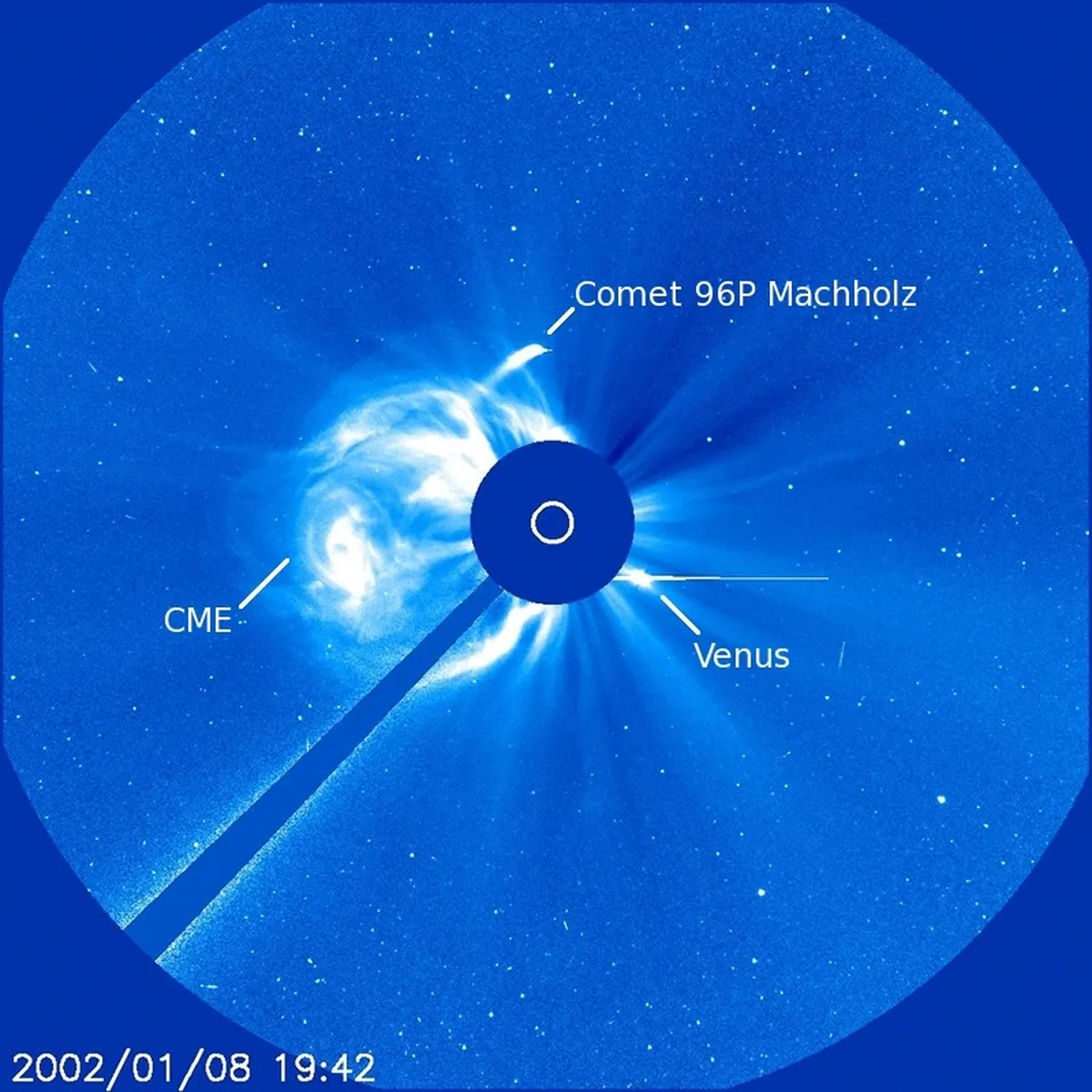
A comet found in 1986
The suspected parent of the Southern Delta Aquariids is comet 96P/Machholz, found by Donald Machholz in 1986. Its nucleus is about 6.4 kilometers across, a little over half the size of the object thought to have killed the dinosaurs. NASA's page gives its orbit as about 5 years in one place and about 6 in another, so this page leaves the number out.
The link between the comet and the shower is still labeled "suspected," which makes this one of the less certain stories on the calendar.
Named for a star
The radiant is in Aquarius, in the southern part of the sky. Delta, the third-brightest star in the constellation, gives the shower part of its name, and the "Delta" separates it from the Eta Aquariids, which peak in May. The constellation only helps you find the spot.
How the shower was pieced together
In 1870 G. L. Tupman plotted 65 meteors seen between 27 July and 6 August, though the shower was still unidentified. In 1952 Mary Almond worked out the velocity and orbit of the Delta Aquariids and connected the southern and northern branches as one extended stream. The Harvard Meteor Project confirmed the orbits photographically from 1952 to 1954 and gave the first evidence that Jupiter shaped the stream.
The shower was once thought to come from the Marsden and Kracht sungrazing comets. Comet 96P/Machholz is now the suspect, and it's still not confirmed.
The next 8 years
The peak is when Earth passes the densest part of the stream, and it falls on almost the same date each year. What changes is the Moon. The table shows the Moon at the peak and how many hours of dark, moon-free sky there are with the radiant above 20 degrees, on the better of the two nights around the peak.
| Year | Peak | Moon at the peak | Good hours, 40 N | Rating, 40 N | Good hours, 30 S | Rating, 30 S |
|---|---|---|---|---|---|---|
| 2027 | July 31, 2027, 19:33 UTC | 4% (waning crescent) | 4.0 h | Excellent | 8.3 h | Excellent |
| 2028 | July 31, 2028, 01:42 UTC | 74% (waxing gibbous) | 3.0 h | Good | 2.7 h | Good |
| 2029 | July 31, 2029, 07:51 UTC | 70% (waning gibbous) | 0.0 h | No dark window | 2.3 h | Good |
| 2030 | July 31, 2030, 14:00 UTC | 1% (new Moon) | 4.0 h | Excellent | 8.3 h | Excellent |
| 2031 | July 31, 2031, 20:09 UTC | 92% (waxing gibbous) | 1.3 h | Poor | 1.5 h | Poor |
| 2032 | July 31, 2032, 02:18 UTC | 32% (waning crescent) | 1.8 h | Poor | 6.0 h | Excellent |
| 2033 | July 31, 2033, 08:27 UTC | 22% (waxing crescent) | 4.2 h | Excellent | 8.2 h | Excellent |
| 2034 | July 31, 2034, 14:36 UTC | 100% (full Moon) | 0.0 h | No dark window | 0.0 h | No dark window |
Good hours are measured in local solar time and count only times when the Sun is more than 18 degrees below the horizon, the Moon is below the horizon and the radiant is above 20 degrees. Rating: 4 hours or more is excellent, 2 to 4 good, under 2 poor. Peak times are in UTC.
The best and worst year
From 40 degrees north the best of these years is 2033, with 4.2 good hours and the Moon 22% lit at the peak. The worst is 2029, with 0.0 good hours. From 30 degrees south the best is 2030, with 8.3 good hours.
The night of the next peak at 40 degrees north
The better night around the July 31, 2027 peak starts on the evening of July 31, 2027. Times are local solar time.
| What | Local solar time |
|---|---|
| Astronomical darkness | 21:05 to 03:10 |
| Moon above the horizon during the dark hours | none |
| Radiant above 20 degrees during the dark hours | 23:05 to 03:10 |
| Good window: dark, no Moon, radiant up | 23:05 to 03:10 |
The radiant sits at declination -16 degrees and right ascension 22.7 hours. Rating for that night: excellent, with 4.0 good hours.
What the Southern Delta Aquariids are
The parent is suspected comet 96P/Machholz. NASA lists 96P/Machholz as the suspected parent. NASA says about 7 to 8 meteors an hour under dark skies.
The Southern Hemisphere and the southern parts of the Northern Hemisphere are where the shower is best seen.
The shower overlaps the start of the Perseids, so late July and early August can show meteors from both.
 Meteor shower calendarEvery major shower with the Moon at its peak.
 Sky calendarEclipses, planets and meteor showers.
 Milky Way seasonThe best nights for the galaxy, park by park.
Questions people ask
When do the Southern Delta Aquariids peak?
The next peak is July 31, 2027 at about 19:33 UTC. The shower is active 12 July to 23 August.
How many Southern Delta Aquariids can you see an hour?
The ZHR, an ideal rate under perfect skies with the radiant overhead, is 25. NASA says about 7 to 8 meteors an hour under dark skies.
Will the Moon spoil the Southern Delta Aquariids next time?
At the next peak the Moon is 4% lit (waning crescent). From 40 degrees north that gives 4.0 dark, moon-free hours with the radiant up on the better night.
Which year is best for the Southern Delta Aquariids?
Of the next 8 years, 2033 has the least moonlight problem at 40 degrees north, with 4.2 good hours.
Two branches
The Southern branch is the stronger one. Wikipedia lists a peak ZHR of 18, against the 25 in the IMO table used on this page. The Northern Delta Aquariids are weaker, peaking in mid-August at about 10 meteors an hour.
Watching the Southern Delta Aquariids
These are faint meteors, at about 40 kilometers a second, and a visible Moon will hide them. NASA says the best views are from the Southern Hemisphere and the southern parts of the Northern. Aim about 45 degrees from Aquarius, halfway between the horizon and straight up, and take in as much sky as you can.
The next peak is July 31, 2027, with the Moon 4% lit (waning crescent). At 40 degrees north, 3 of the 8 peaks from 2027 to 2034 give four hours or more of dark, moon-free sky with the radiant up: 2027, 2030 and 2033. The Moon is under a quarter lit at the peak in 2027, 2030 and 2033. It's three-quarters lit or more in 2031 and 2034, and in those years only the brightest meteors show.
From the south, where the shower is stronger: At 30 degrees south, 4 of the 8 peaks from 2027 to 2034 give four hours or more of dark, moon-free sky with the radiant up: 2027, 2030, 2032 and 2033.
A shower that hides in another
NASA expects about 7 to 8 meteors an hour under dark skies, and the International Meteor Organization lists a ZHR of 25. The shower runs 12 July to 23 August, overlapping the start of the Perseids.
That overlap is useful. Perseid meteors radiate from the northern sky, so a meteor that points back toward Aquarius in the south is a Delta Aquariid. If you miss the peak, NASA suggests looking during the Perseids in August.
The meteor shower calendar lines up both with the Moon, and the Milky Way season guide covers the dark-sky parks where the summer sky is best.
Who's under the peak
The calculated peak is July 31, 2027 at 19:33 UTC. In local solar time that's the middle of the night (10 p.m. to 3 a.m.) for Delhi, and evening, dawn or daytime for London, New York, Los Angeles, Sao Paulo, Johannesburg, Beijing and Sydney.
The hour of the peak moves from year to year, because a calendar year isn't a whole number of Earth orbits. Across 2027 to 2034 it ranges from 01:42 to 20:09 UTC, so the part of the world that sits under the peak changes with it.