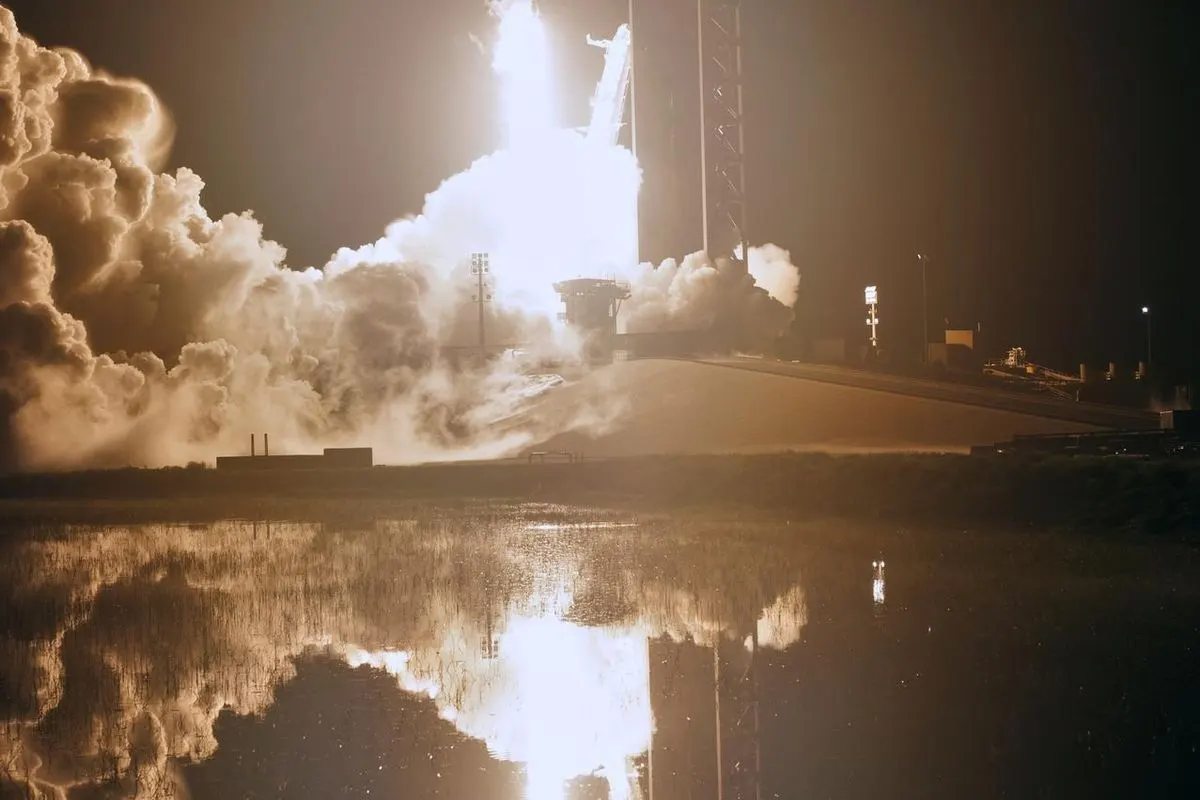
A pause before the climb
102 launches in 2019 is 12 fewer than the 114 of 2018, so this was a dip, not the start of the surge. China flew the most, 34 launches to Russia's 22 and the United States' 21, and 97 of the 102 attempts reached orbit. The total hides what the year set in motion. SpaceX launched the first 60 Starlink satellites on May 23, Florida time, and flew 13 launches in all. Crew Dragon flew to the space station with nobody aboard. Two missions tried to land on the Moon. A Chinese company reached orbit for the first time with a privately built rocket. The rest of this page follows those threads.
544 payloads were carried into orbit. 5 launches failed. 0 Starship test flights are included in the total.
Launches by month
By country
By launch site
By rocket
Launches in every year since 1957.
The landmark flights
Crew Dragon. SpaceX's capsule launched on March 2, 2019 and docked with the station the next day, the first orbital flight of the spacecraft that would carry NASA astronauts. Boeing's Starliner flew its own uncrewed test on December 20, 2019, on an Atlas V that GCAT logs as a debut for that rocket configuration. It never reached the station and landed 2 days after launch. GCAT counts that launch as a success because the rocket did its job. Falcon Heavy twice. The big SpaceX rocket flew the Arabsat-6A communications satellite on April 11, 2019 and a military rideshare mission, STP-2, on June 25, 2019. Everything else SpaceX launched that year was a Falcon 9.
Starlink begins. The first batch of 60 satellites left Florida on May 23. Starlink launched only 2 times in 2019, carrying 120 satellites, and our catalogue counted 120 of them in orbit at year end. By the end of 2025 it counted 9,388. The Starlink page has the full count.
Two attempts on the Moon. Our mission ledgers list 2 Moon and Mars missions that launched in 2019: 1 partial, 1 failure. Israel's Beresheet launched on February 22, 2019 and crashed during its landing, so it never became the first privately funded landing. India's Chandrayaan-2 launched on July 22, 2019. Its orbiter kept working, but the Vikram lander crashed. The Moon mission count grades them a failure and a partial success.
China's private rockets. OS-M1, the first rocket from the company OneSpace, failed on its first flight on March 27. Months later iSpace's Hyperbola-1 reached orbit on July 25, 2019, which Space.com reported as the first successful orbital launch by a private Chinese company. GCAT lists it as Shuang Quxian 1. The China launch page shows how many companies followed.
The end of Soyuz-FG. Russia flew its last Soyuz-FG on September 25, 2019, carrying the first Emirati astronaut to the station, according to NASASpaceflight. The Soyuz-2 family took over crew launches after it.
Five failures
Five launches failed in 2019, which makes 95% successful. Iran lost a Simorgh on January 15 and a Safir on February 5. OS-M1 followed on March 27. A Chang Zheng 4C failed on May 22, and Europe's Vega failed on July 11, a launch from French Guiana that GCAT credits to France. The rate was lower in 2020, 2021 and 2023.
A debris footnote
The most argued-over event of 2019 wasn't a launch. India destroyed one of its own satellites with a missile on March 27, 2019. NASA's administrator said it created about 400 pieces of debris, 60 of them big enough to track, and that 24 of those traveled higher than the space station. NASA put the added risk of a debris strike on the station at 44 percent over 10 days. Debris from tests like this ends up in the tallies on our space debris page.
Rockets and launch sites
Falcon 9 flew 11 of the 102 launches (11%), ahead of Chang Zheng 3B with 8 and Electron with 6. By site, Xichang had 13, Baikonur 13, Cape Canaveral 13 and Taiyuan 10. Eight countries launched at least once in all, counting the launching country the way GCAT does. The launches put 544 satellites into orbit, an average of 5 per launch. 120 of them, 22%, were Starlink satellites. The rest, 424, came from every other operator in the world put together.
New rockets and shifting shares
GCAT logs ten rocket types flying for the first time in 2019: Simorgh (January 15), PSLV-DL (January 24), OS-M1 (March 27), PSLV-QL (April 1), LVM3 (July 22), Shuang Quxian 1 (July 25), Ariane 5ECA+ (August 6), Jielong-1 (August 17), Antares 230+ (November 2), Atlas V N22 (December 20). Two of them failed on that first flight. Some are new versions of a rocket that already existed, which GCAT lists under a new name. Against 2018, the biggest gain was Russia, up 5 to 22, and the biggest fall was the United States, down 10 to 21.
The shape of the year
February was the quietest full month with 5 launches and December the busiest with 15. By quarter the counts run 20, 21, 29 and 32, so 31% of the year's launches came in the final three months.
Two ways to count the winner
Wikipedia's list for 2019 gives the United States 27 launches, against 21 here. The difference is 6 Rocket Lab Electron launches from New Zealand, which GCAT credits to New Zealand because the pad is there, and which other lists credit to the American company. 21 plus 6 is 27. The same choice moves the totals on the Rocket Lab page and in every year below.
December was the busiest month with 15 launches. The year after, 2020 grew to 115 despite the pandemic.