More launches than satellites
France owns 102 active satellites as of October 17, 2026, 0.6% of the world total and the sixth largest national fleet. But rockets that GCAT credits to France have made 354 orbital launch attempts, 3.5 times the number of satellites it owns. The two numbers measure different things.
A satellite counts for its owner. A launch counts for the launch vehicle's country, and for France that covers the Ariane and Vega rockets flying from French Guiana, along with some Russian-built Soyuz flights. Most of the satellites those rockets lift belong to other countries and companies.
What they do
Communications accounts for 52 of France's active satellites (51%).
Where they orbit
Who operates them
The largest operators, and the largest families of satellites, owned by France.
By operator
By satellite family
Operator names are as written in GCAT, usually transliterated from the original language. Families group satellites by the first word of their name.
How the fleet has grown
At the end of 2005, France had 65 payloads in Earth orbit. By the end of 2025 it had 177.
Launches
France has made 354 orbital launch attempts since its first in 1965, and 7 of them in 2025. Its busiest year was 1999 with 16.
Who flew the launches
Of the 354 launches, 257 were Ariane rockets, 21 were Vega, and 12 were the early French Diamant. Another 40 were Soyuz rockets, which are Russian-built; GCAT credits them to France. By agency, 305 are listed under Arianespace (code AE), 37 under the code STSM and 12 under the French space agency CNES, founded on December 19, 1961 and headquartered in Paris.
France's busiest year was 1999 with 16 launches, and in 2025 it had 7. The satellites on board are mostly other people's. The Italy page shows how the same launch-credit rule moved the 2026 Vega C flights to another country.
From the Sahara to French Guiana
France became the third country to launch a satellite on its own rocket. Asterix flew on November 26, 1965 on a Diamant A from Hammaguir in Algeria; the fairing damaged the telemetry antennas and signals were soon lost. France left Hammaguir by mid-1967 under the Evian Accords.
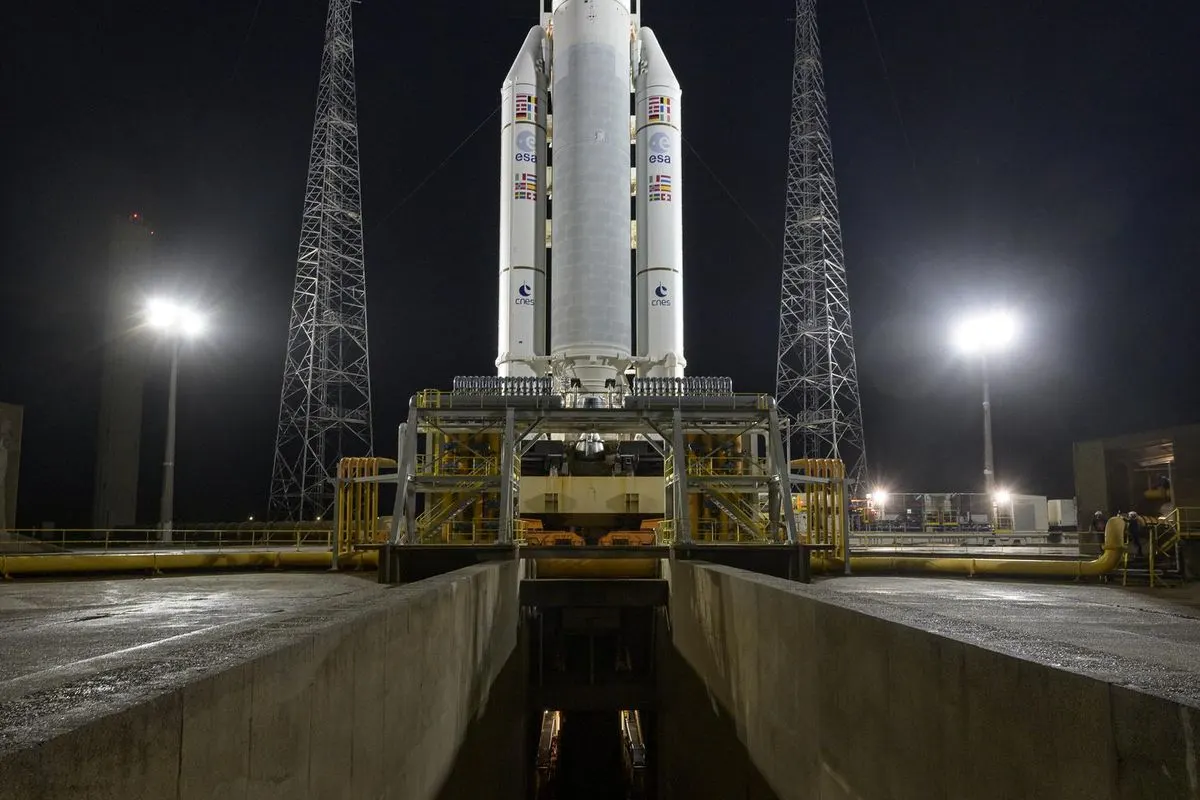
The replacement was already being built. The Guiana Space Centre at Kourou was chosen in 1964 and was operating by 1968, with its first launch on March 10, 1970 (Diamant-B). At about 5 degrees north the site sits close to the equator, where Earth's rotation gives a rocket its biggest push. The European Space Agency owns the launch infrastructure and pays about two thirds of the annual budget; CNES manages the land. Ariane 5 flew for the last time on July 5, 2023, and Ariane 6 first flew on July 9, 2024. Soyuz first launched from Kourou on October 21, 2011 and Vega on February 13, 2012.
What France owns in orbit
The French fleet is mostly commercial. The biggest operator is Kineis with 25, then EutelsatSA with 23 and Unseen Labs with 19. CNES itself has 8 and the defense procurement agency DGA has 3 on its own, with 6 more listed jointly.
A small company shows up in the intelligence category. Unseen Labs says its satellites detect radio frequency signals from ships across large sea areas, then geolocate them to help find so-called dark vessels. GCAT files 23 French satellites under signals intelligence, so most of that category appears to be this one fleet. Communications account for 52, 51% of the total, and Earth imaging for 6.
Orbits and what comes next
France doesn't launch most of what it owns: 37 of its 102 active satellites flew on American rockets, 29 on rockets credited to France, 26 on Electron rockets credited to New Zealand and 6 on Russian rockets. Of the 102, 39 fly in the upper low Earth band, 36 in the lowest band, 17 in geosynchronous orbit and 6 in highly elliptical orbits. Avio, the Italian builder, took over marketing and management of Vega C launches after Member States approved the split from Arianespace in late 2023 and the terms were finalised in July 2024.
The merger of the French operator Eutelsat with OneWeb in 2023 hasn't moved the OneWeb satellites onto the French list, because GCAT still credits them to the United Kingdom. For the German neighbor, see Germany.