From four tries to a launch every two days
SpaceX has made 728 orbital launch attempts, 29% of all 2,483 American attempts, and 719 succeeded. Falcon 9 accounts for 695 of them. In 2025 it flew 170, 51.7% of all launches worldwide, which works out to a launch every 2.1 days.
The company was founded in March 2002. Its first Falcon 1 attempt, on March 24, 2006, failed, and so did the next two. Its first success came on September 28, 2008, on the fourth attempt.
Launches per year
Data table
| Year | Attempts | Successful | Starlink launches |
|---|---|---|---|
| 2006 | 1 | 0 | 0 |
| 2007 | 1 | 0 | 0 |
| 2008 | 2 | 1 | 0 |
| 2009 | 1 | 1 | 0 |
| 2010 | 2 | 2 | 0 |
| 2011 | 0 | 0 | 0 |
| 2012 | 2 | 2 | 0 |
| 2013 | 3 | 3 | 0 |
| 2014 | 6 | 6 | 0 |
| 2015 | 7 | 6 | 0 |
| 2016 | 8 | 8 | 0 |
| 2017 | 18 | 18 | 0 |
| 2018 | 21 | 21 | 0 |
| 2019 | 13 | 13 | 2 |
| 2020 | 25 | 25 | 14 |
| 2021 | 31 | 31 | 19 |
| 2022 | 61 | 61 | 34 |
| 2023 | 98 | 96 | 63 |
| 2024 | 138 | 137 | 90 |
| 2025 | 170 | 168 | 127 |
| 2026 | 120 | 120 | 85 |
Which rockets
Starship flights are counted here because GCAT counts them as launch attempts. They're test flights that don't all reach orbit.
Where they launch from
127 of SpaceX's 2025 launches carried Starlink satellites, 75% of its flights that year.
For a single year, see the 2023 launch totals. The 2022 page shows the year before the fleet scaled up.
The milestones
Falcon 9 first flew on June 4, 2010. A Dragon capsule went to the International Space Station on May 22, 2012. The first successful landing of a booster came on December 21, 2015 at Landing Zone 1, and a landed booster flew again in March 2017 (booster B1021, SES-10).
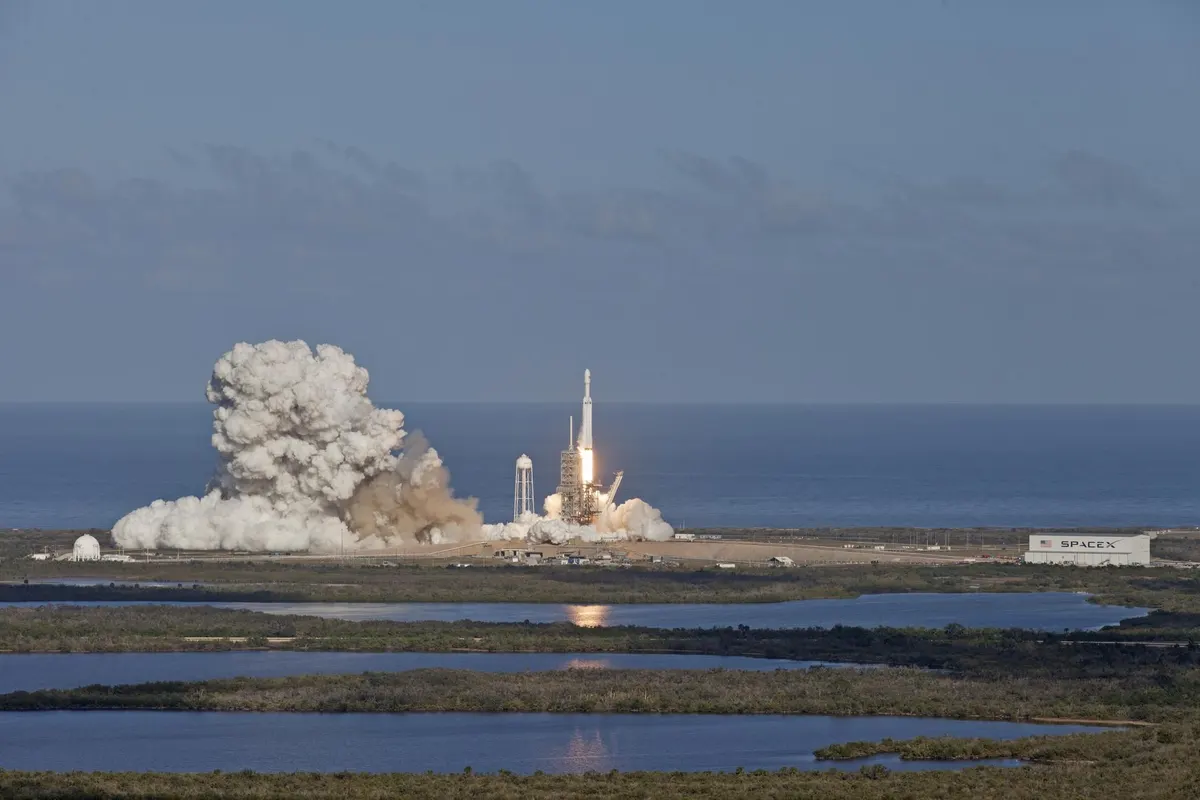
Falcon Heavy first flew on February 6, 2018, and crewed flights began in May 2020. GCAT doesn't track landings or reuse, so those milestones come from SpaceX's own history and not from the log.
A rapid climb
In 2019 SpaceX flew 13 launches. By 2022 it was 61, by 2023 it was 98, and by 2025 it was 170. The year-on-year rise was 41% in 2024 and 23% in 2025. 127 of the 170 in 2025 carried Starlink satellites, 75% of its flights.
2026 stands at 120 through October 16, 2026, against 135 at the same point in 2025. The launches in 2025 page shows how that compares with the rest of the world.
Failures
GCAT logs 9 failures in 728 attempts: 3 on Falcon 1, 2 on Falcon 9 and 4 on Starship. The two Falcon 9 failures were on June 28, 2015 and July 12, 2024, which puts Falcon 9's success rate at 99.7%.
Starship's 14 flights are counted because GCAT counts them as launch attempts, but they're test flights. The log marks 4 of them as failures, on April 20, 2023, November 18, 2023, January 16, 2025 and March 6, 2025.
The rest of the world
In 2025 the world flew 329 orbital launches, and SpaceX flew 170. That leaves 159 for everyone else, up from 126 the year before.
Inside the United States, SpaceX's 170 were 94% of the country's 181. The next largest national totals are 92 for China and 17 for Russia. The whole picture is on the launches per year page.
Falcon Heavy and the doubling year
Falcon Heavy has 14 launches in the log, after its first flight on February 6, 2018. That first flight left Launch Complex 39A, the pad described on the Florida page.
The biggest jump in the record is 2022, when the count went from 31 to 61. Each year since has grown by at least 23 percent through 2025, and 2026 is on a somewhat slower pace through October 16, 2026.
Starship
Starship's 14 entries in the log began on April 20, 2023. Flight 5, on October 13, 2024, was the first booster catch by the launch tower. On May 27, 2025, on Flight 9, the first reused booster was lost before splashdown, and the ship lost attitude control after a propellant leak. Block 2 flew from Flight 7 and was retired after Flight 11. Block 3 is 124.4 meters tall with a 100 tonne payload target, and its test flights began in 2026.
GCAT marks 4 Starship flights as failures. SpaceX has flown 14 test flights through September 28, 2026. Whether a test flight counts as a failure is a judgment call, and a test vehicle is a different thing from the Falcon 9 that carries customers.
Where the rockets leave from
Cape Canaveral has 347 launches and the Kennedy Space Center 127, which puts 65% of SpaceX's flights in Florida. California's Vandenberg accounts for 235 and Starbase in Texas for 14.
The two coasts have their own pages: Florida and Vandenberg. SpaceX's biggest customer is itself, but it also launches for Amazon.