How to read these records
Every table below leaves out planets the archive flags as controversial, and every number comes from the archive's composite table. Records in astronomy depend on the paper behind each number and move as new work comes in. The lists show the planets we have found, not a ranking of everything out there.
Hottest
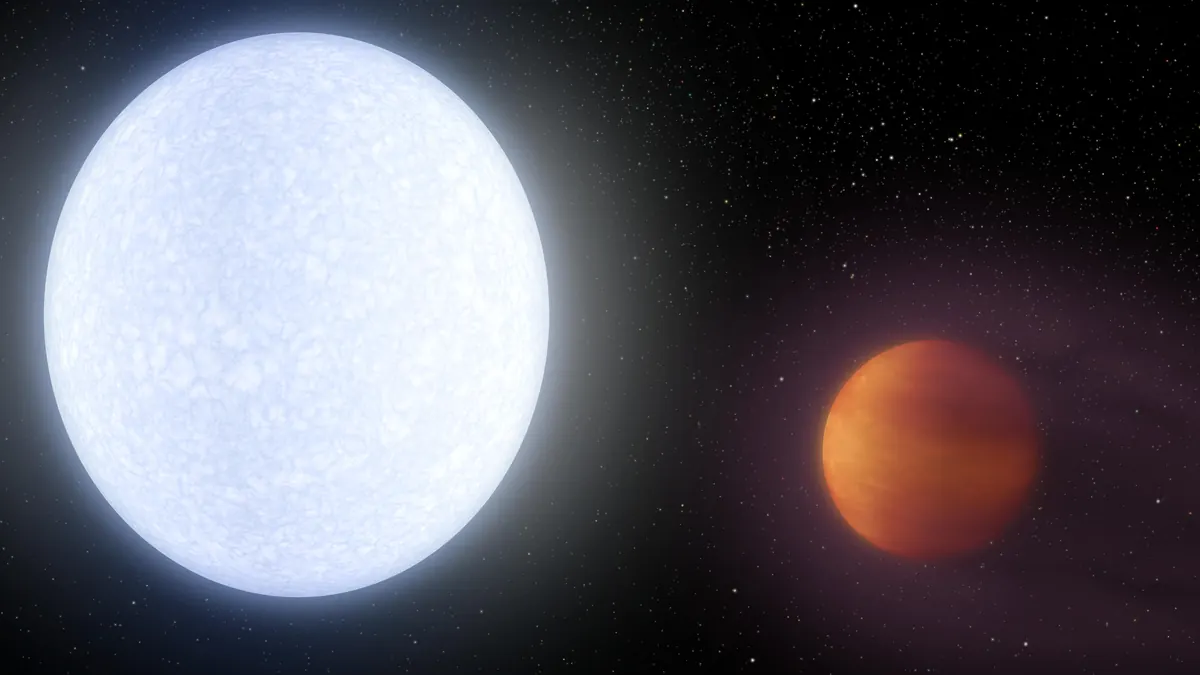
The archive column here is equilibrium temperature, calculated from the star's heat and the planet's distance. It isn't a thermometer reading and ignores any atmosphere. A measured day-side temperature can be higher: NASA describes the day side of KELT-9 b as hotter than 7,800 degrees Fahrenheit (4,600 kelvin), which is hotter than most stars.
KELT-9 b was found by the KELT-North survey telescope in Arizona and described in Nature in 2017 by Scott Gaudi and colleagues. Its star is a hot blue-white star of about 9,270 K, far hotter than the Sun, and the planet circles it every 1.48 days. The heat is enough to break molecules apart on the day side, leaving atoms of metals such as iron and titanium in its atmosphere. In the table, 4 of the five hottest planets have an equilibrium temperature above 3,000 K. For comparison, the hottest planet in our own solar system is Venus. See the hottest planet page.
| Planet | Temperature (K) | Found by | Year |
|---|---|---|---|
| KELT-9 b | 3,921 | Transit | 2017 |
| TOI-2109 b | 3,646 | Transit | 2021 |
| WASP-189 b | 3,353 | Transit | 2020 |
| Kepler-1547 b | 3,186 | Transit | 2016 |
| ZTF J1230-2655 b | 2,950 | Transit | 2025 |
Why the records keep moving
The five hottest planets in the table were announced between 2016 and 2025, so the title has changed hands more than once as surveys found hotter stars to hunt around. The three shortest years are 2.2, 2.7 and 3.2 hours. Each of the six tables is a snapshot of the archive on October 15, 2026, and a single new paper can reorder it.
The planets in these tables are also not the best-studied. A world with a famous temperature or a tiny size can have a signal that's hard to confirm, and the archive keeps the controversial ones out of these lists for that reason. See the multi-planet systems page for a different kind of record, the busiest families.
The six lists aren't equally reliable. An imaged planet's radius comes from a model of how bright and hot it should be, and its orbit is guessed from how far it sits from its star. Distances to microlensing planets rest on models of where stars lie in the galaxy. Equilibrium temperatures assume how much light a planet reflects. Treat each record as the best current estimate, not a closed case.
Shortest and longest years
The shortest orbits belong to objects that skim very close to their stars. Names that start with PSR are pulsars, the dense remnants of dead stars, so those planets are very different places from worlds around ordinary stars. The longest orbits all belong to planets found by direct imaging, far from their stars.
The shortest year in the table, 2.2 hours, belongs to PSR J1719-1438 b, found in 2011 by a pulsar survey. It's probably the stripped remnant of a star, not a planet that formed the usual way. Mercury, by comparison, takes 88 days to circle the Sun. Planets with a year shorter than a day are called ultra-short-period planets, and the first group of them turned up in Hubble's 2006 survey of the Sagittarius Window, covered below under the most distant planets.
| Planet | Orbit (days) | Found by | Year |
|---|---|---|---|
| PSR J1719-1438 b | 0.091 | Pulsar Timing | 2011 |
| ZTF J1828+2308 b | 0.112 | Transit | 2025 |
| M62H b | 0.133 | Pulsar Timing | 2024 |
| KOI-1843.03 | 0.177 | Transit | 2013 |
| K2-137 b | 0.18 | Transit | 2017 |
The longest orbits belong to planets photographed far from their stars, and their periods aren't measured. The listed period for COCONUTS-2 b is 402,000,000 days, about 1.1 million years. Nobody has watched even a tiny fraction of an orbit like that. Astronomers estimate such periods from how far the planet sits from its star, so treat them as informed guesses. Mercury's year is 88 days for contrast. The methods page explains why imaging favors distant planets.
| Planet | Orbit (days) | Found by | Year |
|---|---|---|---|
| COCONUTS-2 b | 402,000,000 | Imaging | 2021 |
| CFHTWIR-Oph 98 b | 8,040,000 | Imaging | 2020 |
| Oph 11 b | 7,300,000 | Imaging | 2006 |
| VHS J125601.92-125723.9 b | 5,800,000 | Imaging | 2015 |
| b Cen AB b | 1,790,000 | Imaging | 2021 |
Smallest and largest
The smallest 3 planets in the table are smaller than Mercury, which is 0.38 Earth radii across, and the smallest is close to the Moon, at 0.27. The largest values are probably young gas giants that are still shrinking as they cool, and their radii are uncertain.
Kepler-37 b was announced in Nature on February 20, 2013 as a sub-Mercury-sized planet. Its radius of 0.31 Earth radii is a little bigger than the Moon's 0.27 and smaller than Mercury's 0.38. It orbits a Sun-like star in 13.4 days, close enough to be far too hot for liquid water. The second smallest entry is a pulsar planet.
| Planet | Radius (Earth radii) | Found by | Year |
|---|---|---|---|
| Kepler-37 b | 0.31 | Transit | 2013 |
| PSR B1257+12 b | 0.34 | Pulsar Timing | 1994 |
| Kepler-37 e | 0.37 | Transit | 2014 |
| Kepler-879 c | 0.4 | Transit | 2024 |
| Kepler-444 b | 0.4 | Transit | 2015 |
The largest listed radii mostly belong to young planets photographed in infrared, such as GQ Lup b, and their sizes are estimated from models of how bright and hot they should be, not measured by a transit. A few transiting planets, for example Kepler-1979 b, are listed at more than twice Jupiter's size (Jupiter is 11.2 Earth radii). Heat and uncertain star sizes can both swell a result. The exoplanet sizes page puts them in context.
| Planet | Radius (Earth radii) | Found by | Year |
|---|---|---|---|
| V2376 Ori b | 87.2 | Imaging | 2025 |
| GQ Lup b | 33.6 | Imaging | 2004 |
| DH Tau b | 30.3 | Imaging | 2004 |
| Kepler-1979 b | 29.3 | Transit | 2023 |
| TOI-1408 b | 25 | Transit | 2023 |
Farthest away
The most distant planets are listed below. The farthest is about 27,723 light years from us.
The farthest planets in the table, SWEEPS-4 b and SWEEPS-11 b, were found by Hubble in 2006. The Sagittarius Window Eclipsing Extrasolar Planet Search stared at 180,000 stars in the galaxy's central bulge for seven days with Hubble's Advanced Camera for Surveys and flagged 16 candidates. Two had stars distinct enough for follow-up velocity measurements. The bulge is about 27,000 light years away, so these planets sit near the center of the Milky Way. The microlensing planets that follow them in the table lie about as far. To see what that distance means in light-travel time, try the light travel time calculator.
| Planet | Distance (light years) | Found by | Year |
|---|---|---|---|
| SWEEPS-11 b | 27,723 | Transit | 2006 |
| SWEEPS-4 b | 27,723 | Transit | 2006 |
| KMT-2024-BLG-0176L b | 27,201 | Microlensing | 2026 |
| KMT-2021-BLG-1077L b | 26,875 | Microlensing | 2022 |
| KMT-2021-BLG-1077L c | 26,875 | Microlensing | 2022 |