The four main methods
Transit. A planet passing in front of its star causes a small dip in the star's light. The size of the dip shows how big the planet is compared with its star, and the time between dips gives its orbit. It only works when the orbit happens to line up with our view, so it misses most planets that exist.
Radial velocity. A planet's gravity makes its star wobble slightly toward and away from us, which stretches and squeezes the starlight's wavelengths. The method gives a planet's mass, or a lower limit on it, and it finds big planets in tight orbits most easily. It found the first planet around a Sun-like star, 51 Pegasi b.
Direct imaging. Telescopes capture light from the planet itself, usually after blocking the star's glare. It has mainly shown giant planets that are young and still hot from forming, far from their stars.
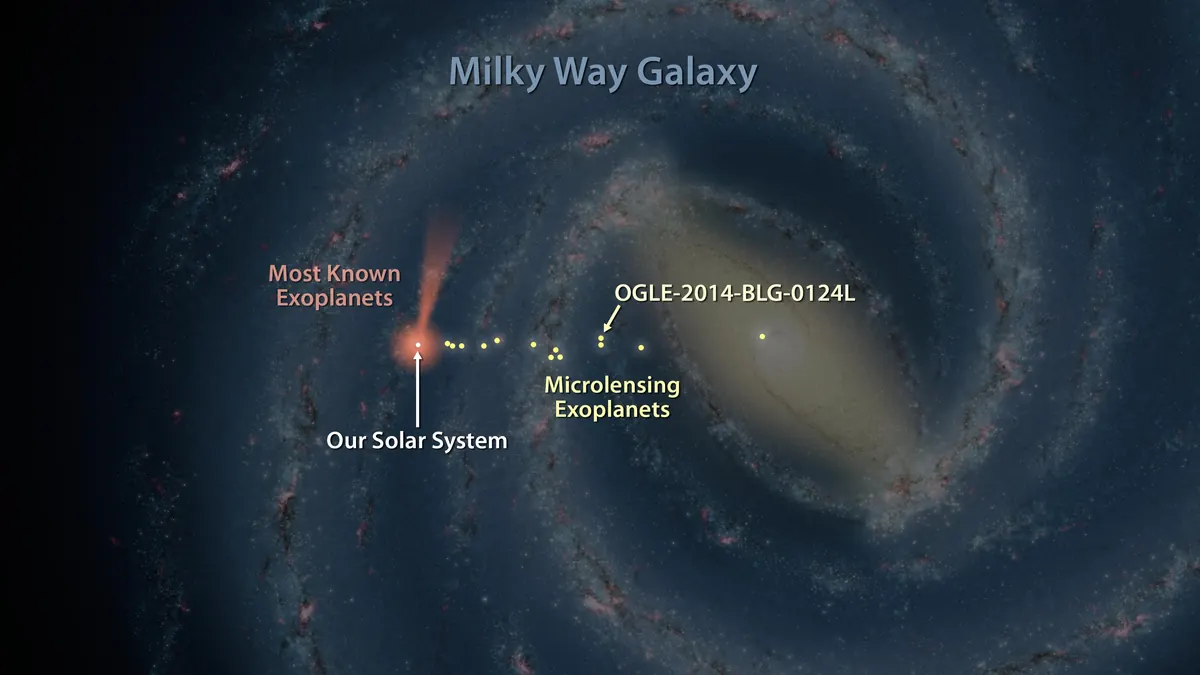
Microlensing. A star's gravity can magnify the light of a more distant star behind it. If the nearer star has a planet, the planet adds a second, smaller brightening. A microlensing event happens once and never repeats, but it can find planets thousands of light years away.
All the methods side by side
The last three columns show the bias of each method. Compare the typical orbit, size and distance of the planets each one has found.
| Method | Planets | Share | First year | Median orbit (days) | Median radius (Earth radii) | Median distance (light years) |
|---|---|---|---|---|---|---|
| Transit | 4,785 | 74.2% | 2002 | 8 | 2.5 | 1,498 |
| Radial Velocity | 1,204 | 18.7% | 1995 | 306.7 | 12.6 | 144 |
| Microlensing | 292 | 4.5% | 2004 | 3,042 | 12.5 | 20,450 |
| Imaging | 98 | 1.5% | 2004 | 33,100 | 12.4 | 309 |
| Transit Timing Variations | 29 | 0.4% | 2011 | 41.3 | 9.7 | 1,108 |
| Eclipse Timing Variations | 17 | 0.3% | 2009 | 3,160 | 12.9 | 1,293 |
| Orbital Brightness Modulation | 9 | 0.1% | 2011 | 0.8 | 13.4 | 4,015 |
| Pulsar Timing | 8 | 0.1% | 1992 | 25.3 | 1.9 | 1,957 |
| Astrometry | 6 | 0.1% | 2013 | 334.8 | 12.2 | 125 |
| Pulsation Timing Variations | 2 | 0.0% | 2007 | 1,005 | 12.8 | 4,206 |
| Disk Kinematics | 1 | 0.0% | 2019 | n/a | 13.3 | 600 |
Transits and the lucky alignment
A transit survey needs luck first. For an Earth-like orbit around a Sun-like star, only about one orbit in 215 is edge-on enough for a planet to cross the star's face. A planet that does cross dims it by a small amount: roughly 1.1% for a Jupiter-sized planet and 0.0084% for an Earth-sized one. Space telescopes can measure the second number and ground telescopes struggle with it.
Charbonneau's team first saw a planet cross its star in 1999, with HD 209458 b, which astronomers already knew about from its wobble. The first planet discovered by watching for dips, OGLE-TR-56 b, followed in 2002. The Kepler and TESS space telescopes did the rest.
Radial velocity and what a wobble costs
Radial velocity measures a star's speed along our line of sight. Jupiter makes the Sun move at about 13 meters per second. Earth moves the Sun at about 9 centimeters per second, which is why Earth twins are still out of reach. Because the tilt of the orbit is usually unknown, the method gives only a minimum mass. A planet that transits and also shows a wobble has its true mass and its size, and those are the ones scientists know best. The archive flags 1,332 planets as seen both ways.
The method found 51 Pegasi b, described on the first exoplanets page, and it still delivers the nearest planets, which transits miss.
Imaging, microlensing and the rest
A Sun-like star outshines the reflected light of its planets by about a billion times, so direct imaging only works for young, hot giants far from their stars. The 2008 images of the HR 8799 system were an early success. The James Webb Space Telescope has since photographed planets in the infrared. Microlensing runs on a different luck. It needs a star to drift across a more distant one, so each planet is seen once, and there's no repeat. The first microlensing planet in the archive dates from 2004. The Gaia mission, launched in 2013, is expected to find thousands of planets by astrometry, the tiny sideways motion a planet causes, and the archive credits it with only 6 so far.
The smaller methods
Pulsar timing, transit timing variations, eclipse timing variations, orbital brightness modulation, astrometry, pulsation timing variations and disk kinematics each find planets from small changes in timing, brightness or position. Together they account for 72 planets, and pulsar timing found the very first confirmed ones.
The timing methods
The smaller methods share one trick: they treat something in the sky as a clock. A pulsar is the best clock there is, which is why pulsar timing found the first confirmed planets and has 8 in the archive. Transit timing variations use the fact that planets tug on each other, so a transit that should happen on schedule arrives a few minutes early or late. The method has 29 planets, and it has found worlds that never cross their star at all, such as Kepler-19 c. Eclipse timing variations do the same for eclipsing binary stars, and the archive credits them with 17.
Orbital brightness modulation (9 planets) looks for the slow brightening and dimming as a planet's lit side turns toward us. Pulsation timing (2) tracks a pulsating star's rhythm. Disk kinematics (1) reads the motion of gas in a young star's disk for the dent a planet makes. Each is rare, and each reaches stars the main methods can't.
What the mix is blind to
Put the methods together and the bias is plain. Of the 6,097 planets with a listed orbit, 2,937 (48%) circle their star in 10 days or less, and only 658 (11%) take as long as a year. Counted the same way, our own system has none of the first and six of the second. The list is a catalogue of what's easy to find. The most extreme cases are on the extremes page.
Why transits lead
Two space telescopes built to watch huge numbers of stars for transits, Kepler and TESS, did most of the work. Of the 4,785 transit planets, 4,319 (90%) were found by Kepler, its K2 mission or TESS. Kepler and TESS has the detail.