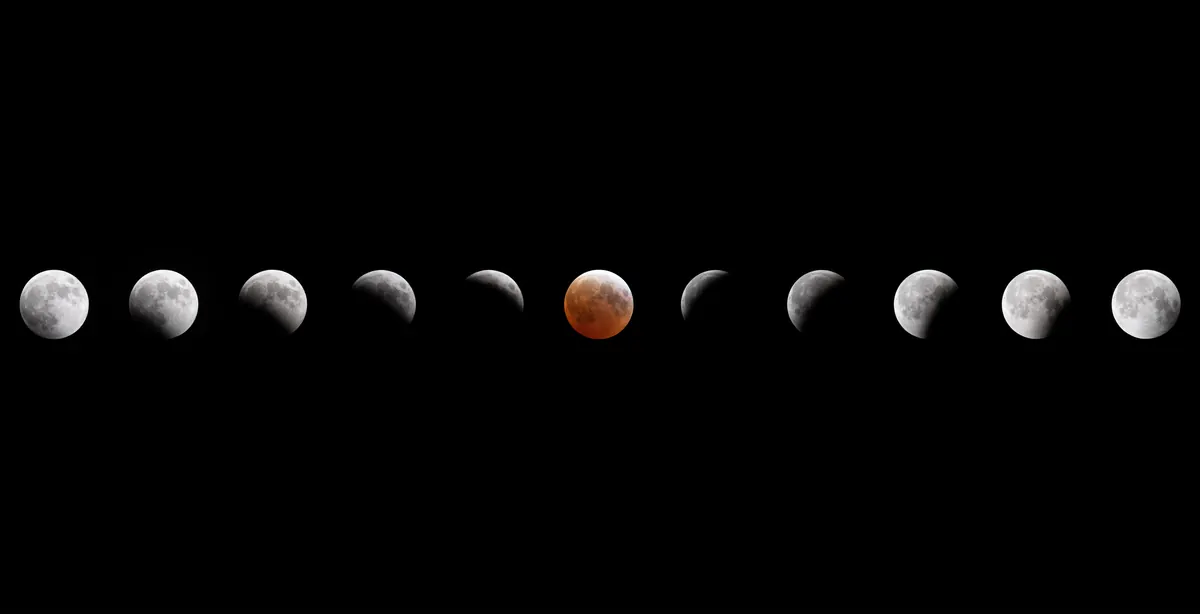
Every total lunar eclipse
| Date | Greatest eclipse | Totality | Partial phases | Umbral magnitude | Saros | Moon overhead at |
|---|---|---|---|---|---|---|
| December 31, 2028 | 16:51 UTC | 71 min | 209 min | 1.246 | 125 | 23N 108E |
| June 26, 2029 | 03:22 UTC | 102 min | 220 min | 1.844 | 130 | 23S 50W |
| December 20, 2029 | 22:41 UTC | 54 min | 213 min | 1.117 | 135 | 23N 19E |
| April 25, 2032 | 15:13 UTC | 66 min | 211 min | 1.191 | 122 | 14S 131E |
| October 18, 2032 | 19:02 UTC | 47 min | 196 min | 1.103 | 127 | 10N 71E |
| April 14, 2033 | 19:12 UTC | 49 min | 215 min | 1.094 | 132 | 9S 72E |
| October 8, 2033 | 10:55 UTC | 79 min | 202 min | 1.350 | 137 | 6N 167W |
| February 11, 2036 | 22:11 UTC | 74 min | 202 min | 1.300 | 124 | 14N 31E |
| August 7, 2036 | 02:51 UTC | 95 min | 231 min | 1.454 | 129 | 16S 41W |
| January 31, 2037 | 14:00 UTC | 64 min | 198 min | 1.207 | 134 | 18N 153E |
| May 26, 2040 | 11:44 UTC | 92 min | 211 min | 1.535 | 131 | 21S 177W |
| November 18, 2040 | 19:03 UTC | 88 min | 220 min | 1.397 | 136 | 20N 70E |
| March 25, 2043 | 14:30 UTC | 53 min | 215 min | 1.114 | 123 | 2S 144E |
| September 19, 2043 | 01:50 UTC | 72 min | 206 min | 1.256 | 128 | 2S 29W |
| March 13, 2044 | 19:37 UTC | 66 min | 209 min | 1.203 | 133 | 2N 68E |
| September 7, 2044 | 11:19 UTC | 34 min | 206 min | 1.046 | 138 | 5S 171W |
| January 12, 2047 | 01:24 UTC | 70 min | 209 min | 1.234 | 125 | 22N 19W |
| July 7, 2047 | 10:34 UTC | 101 min | 218 min | 1.751 | 130 | 23S 157W |
| January 1, 2048 | 06:52 UTC | 56 min | 214 min | 1.128 | 135 | 23N 102W |
| May 6, 2050 | 22:30 UTC | 43 min | 206 min | 1.077 | 122 | 17S 21E |
| October 30, 2050 | 03:20 UTC | 34 min | 193 min | 1.054 | 127 | 14N 54W |
| April 26, 2051 | 02:14 UTC | 70 min | 221 min | 1.202 | 132 | 13S 34W |
| October 19, 2051 | 19:10 UTC | 84 min | 204 min | 1.412 | 137 | 10N 69E |
| February 22, 2054 | 06:49 UTC | 72 min | 201 min | 1.277 | 124 | 10N 99W |
| August 18, 2054 | 09:24 UTC | 83 min | 226 min | 1.306 | 129 | 13S 140W |
| February 11, 2055 | 22:44 UTC | 66 min | 198 min | 1.225 | 134 | 14N 22E |
| June 6, 2058 | 19:13 UTC | 97 min | 213 min | 1.661 | 131 | 23S 71E |
| November 30, 2058 | 03:14 UTC | 90 min | 221 min | 1.426 | 136 | 22N 52W |
Partial phases is the whole time any part of the Moon is inside the dark core of Earth's shadow, including totality. Saros is the number of the family of eclipses the event belongs to.
What you will see
In a total lunar eclipse the Moon goes through three stages. It dims in the pale outer shadow, a dark bite then spreads across it, and in totality the whole Moon sits inside the umbra and glows a dim red. Totality in this list runs from 34 min to 102 min. Unlike a solar eclipse, it's safe to watch with your eyes, and everyone on the night side of Earth where the Moon is up can see it.
Why the Moon turns red
A total lunar eclipse doesn't make the Moon vanish. Earth's atmosphere bends some sunlight around the planet and onto the Moon, and as it passes through the air it loses most of its blue and keeps the red. The light that reaches the Moon is, in effect, every sunrise and sunset on Earth at once.
That's why no two eclipses look the same. A Moon that sits near the middle of Earth's shadow gets less of that light than one clipping the edge, and clouds, dust and volcanic haze in our air can darken the glow further. The eclipse in this list with the deepest pass through the shadow is on June 26, 2029, with an umbral magnitude of 1.84, and the briefest total one in 2001 to 2100 (April 4, 2015) grazed the shadow for only 5 minutes.
A five-step scale for the color
In the twentieth century the French astronomer Andre Danjon devised a scale from L0 to L4 to describe how an eclipsed Moon looks, and observers still use it, according to NASA's eclipse site. L0 is a very dark eclipse, with the Moon almost invisible at mid-totality. L2 is a deep red or rust color with a dark center. L4 is a bright copper-red or orange with a bluish rim to the shadow.
You can use it as a game. Note the time, look at the Moon with your eyes and then through binoculars, and give it a number. The ratings won't match from one observer to the next, but they'll show you how much the same eclipse changes through totality as the Moon crosses the shadow.
The night Columbus used one
An eclipse once helped to save a crew. Christopher Columbus and his men had been stranded on Jamaica since June 25, 1503, and by early 1504 the islanders had grown unwilling to keep feeding them. According to accounts of the voyage, Columbus had an almanac that predicted a lunar eclipse on the evening of February 29, 1504, and he warned the islanders that his god was angry with them. When the Moon rose red, they came back with food.
A rescue ship didn't arrive until June 29, 1504, but the eclipse had kept the crew fed in the meantime. The story lasts because it shows what a reliable prediction was worth.
How long you get
There are 28 total lunar eclipses in the list above. The longest totality in the list is 1 hour 42 minutes on June 26, 2029, and the shortest is 34 minutes on September 7, 2044. Totality reaches an hour or more in 20 of the 28. With the partial phases on either side included, the longest of them keeps part of the Moon inside the dark shadow for about 3.7 hours.
Over the whole century the range is wider: from 4.7 minutes on April 4, 2015 to 1 hour 43 minutes on July 27, 2018. A total lunar eclipse is long because Earth's shadow at the Moon's distance is more than two and a half times the Moon's width, so the Moon takes a good while to cross it.
What it takes to watch
You need no equipment. A lunar eclipse is safe to look at, and everything you see is faint sunlight on a distant rock. Binoculars show the edge of the shadow and more color, and a telescope on a steady mount gives crater detail near the shadow's edge. A camera on a tripod works well, but the Moon is far dimmer in totality than at full Moon, so it needs much longer exposures than you would normally use.
The only real planning is the weather and the Moon's height. The next total eclipse is on December 31, 2028, and the list above says where the Moon is overhead, but what you see also depends on your own horizon. The next lunar eclipse page shows how high the Moon stands from eight large cities at greatest eclipse.
The Moon seen from the Moon
A lunar eclipse looks different from the Moon itself. On April 24, 1967, NASA's Surveyor 3 lander, sitting on the Moon, photographed Earth passing in front of the Sun, which is what an eclipse looks like from the Moon's surface. The planet's atmosphere shows up as a thin ring of light. A total lunar eclipse in our sky is a solar eclipse in the Moon's, as the solar and lunar eclipse comparison explains.
The eclipse seasons page explains why lunar eclipses cluster in pairs with solar ones. Eclipses also taught people the shape of their own planet. The Greek philosopher Aristotle argued that the curved edge of Earth's shadow on the Moon during an eclipse showed that Earth is round. In this century's catalog, 85 of the 228 lunar eclipses are total.
 Next lunar eclipseThe next eclipse of any kind, with timings.
 Eclipse seasonsWhy eclipses come in pairs about every six months.
 How often eclipses happenThe counts behind the calendar.
Questions people ask
When is the next total lunar eclipse?
December 31, 2028, with 71 min of totality.
How many total lunar eclipses are there before 2060?
28 fall between October 19, 2026 and the end of 2060.
How long can a total lunar eclipse last?
In this period the longest totality is 102 min, on June 26, 2029.
Do I need special glasses to watch a lunar eclipse?
No. It's only the Moon in Earth's shadow and is safe to watch with your eyes, binoculars or a telescope.