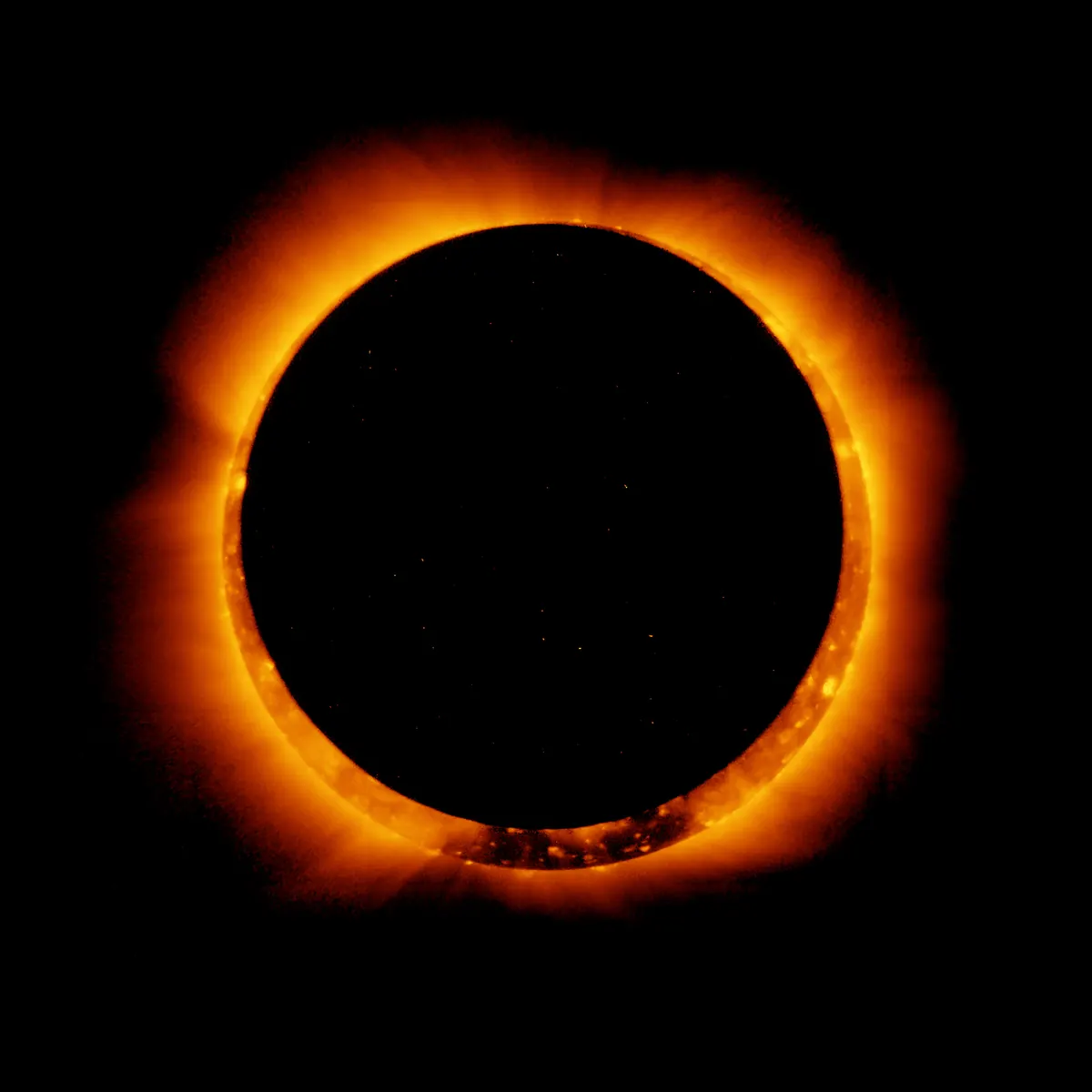
Every annular solar eclipse
| Date | Type | Greatest eclipse | Magnitude | Longest totality or annularity | Path width | Where the path crosses |
|---|---|---|---|---|---|---|
| February 6, 2027 | Annular | 15:59 UTC | 0.928 | 7m 51s | 282 km | Chile, Argentina, Uruguay, Brazil, Côte d'Ivoire, Ghana, Togo, Benin and Nigeria |
| January 26, 2028 | Annular | 15:07 UTC | 0.921 | 10m 27s | 323 km | Ecuador, Peru, Brazil, Colombia, Suriname, French Guiana, Portugal, Spain and Morocco |
| June 1, 2030 | Annular | 06:27 UTC | 0.944 | 5m 21s | 250 km | Algeria, Tunisia, Libya, Greece, Turkey, Bulgaria, Russia, Ukraine, Kazakhstan, China and Japan |
| May 21, 2031 | Annular | 07:14 UTC | 0.959 | 5m 26s | 152 km | Angola, Namibia, Zambia, Democratic Republic of the Congo, Tanzania, Malawi, India, Sri Lanka, Thailand, Malaysia and Indonesia |
| May 9, 2032 | Annular | 13:25 UTC | 0.996 | 0m 22s | 44 km | open ocean or ice, with no country on the path |
| September 12, 2034 | Annular | 16:18 UTC | 0.974 | 2m 58s | 102 km | Chile, Bolivia, Argentina, Paraguay and Brazil |
| March 9, 2035 | Annular | 23:04 UTC | 0.992 | 0m 48s | 31 km | New Zealand |
| January 5, 2038 | Annular | 13:45 UTC | 0.973 | 3m 18s | 107 km | Cuba, Haiti, Dominican Republic, Saint Lucia, Liberia, Côte d'Ivoire, Ghana, Togo, Benin, Burkina Faso, Niger, Nigeria, Chad, Libya, Egypt and Sudan |
| July 2, 2038 | Annular | 13:31 UTC | 0.991 | 1m 00s | 31 km | Colombia, Venezuela, Grenada, Barbados, Morocco, Western Sahara, Mauritania, Mali, Algeria, Niger, Chad, Sudan, South Sudan, Ethiopia, Kenya and Somalia |
| June 21, 2039 | Annular | 17:11 UTC | 0.945 | 4m 05s | 365 km | United States, Canada, Greenland, Norway, Sweden, Finland, Estonia, Åland Islands, Russia, Latvia, Lithuania and Belarus |
| October 25, 2041 | Annular | 01:34 UTC | 0.947 | 6m 07s | 213 km | Russia, Mongolia, China, North Korea, Japan and Kiribati |
| October 14, 2042 | Annular | 01:59 UTC | 0.930 | 7m 44s | 273 km | Thailand, Malaysia, Indonesia, Timor-Leste, Australia and New Zealand |
| October 3, 2043 | Annular | 03:00 UTC | 0.950 | n/a | n/a | See NASA's path table |
| February 28, 2044 | Annular | 20:23 UTC | 0.960 | 2m 27s | n/a | open ocean or ice, with no country on the path |
| February 16, 2045 | Annular | 23:54 UTC | 0.928 | 7m 47s | 281 km | New Zealand |
| February 5, 2046 | Annular | 23:04 UTC | 0.923 | 9m 42s | 310 km | Indonesia, Papua New Guinea, Solomon Islands and United States |
| June 11, 2048 | Annular | 12:57 UTC | 0.944 | 4m 58s | 272 km | United States, Canada, Greenland, Iceland, Faroe Islands, Norway, Sweden, Estonia, Latvia, Lithuania, Russia, Belarus, Ukraine, Kazakhstan, Uzbekistan, Turkmenistan, Tajikistan, Afghanistan and Pakistan |
| May 31, 2049 | Annular | 13:58 UTC | 0.963 | 4m 45s | 134 km | Peru, Ecuador, Colombia, Brazil, Venezuela, Guyana, Suriname, Cabo Verde, Senegal, Gambia, Mali, Guinea, Côte d'Ivoire, Burkina Faso, Ghana, Togo, Benin, Nigeria, Cameroon, Gabon, Congo, Central African Republic, Democratic Republic of the Congo and Burundi |
Some entries name no country because the path runs over open ocean or ice.
Where the ring of fire passes most
Why the Sun shows a ring
The Moon's orbit isn't a circle, so its size in the sky changes. When an eclipse happens while the Moon is far from Earth, it looks a little too small to cover the Sun and a bright ring is left around it. The magnitude in the table is below 1 for exactly that reason. At the middle of these eclipses the Moon covers between 92% and 100% of the Sun's width.
There's no safe moment to look without protection, because the ring is still bright. Use certified eclipse glasses or a solar filter for the whole eclipse, as NASA's eclipse safety page (opens in a new tab) explains.
The ring is a matter of distance
The Sun looks about 32.5 arcminutes wide when Earth is closest to it in January and 31.5 when Earth is farthest in July, a small difference. The Moon changes far more. NASA's fact sheet gives its distance as about 363 thousand kilometers at the nearest point and 406 thousand at the farthest, which makes its disk 32.9 arcminutes wide at best and 29.4 at worst. When the Moon is nearer than about 373 thousand kilometers it covers the Sun, and farther out a ring is left.
The Moon's average distance is a bit farther than that crossover, so rings should be slightly more common than total eclipses, and NASA's catalog agrees: for 2001 to 2100 it lists 72 annular and 68 total eclipses, plus 7 hybrids.
What it looks like
An annular eclipse doesn't turn day into night. The Moon never covers the Sun completely, so there's no totality, no corona to see and no moment when it's safe to look. The ring of bare Sun is still far too bright for the naked eye. For everyone who can't be in the path, tiny gaps between leaves work like pinholes and scatter small crescents across the ground.
NASA suggests a safer way to watch: poke a small hole in a piece of card, stand with the Sun behind you, and look at the projected image on a surface. Never look at the Sun through the hole.
Safety isn't negotiable
NASA is clear that, except during the brief total phase of a total eclipse, it's never safe to look directly at an eclipse without proper eye protection. That includes annular eclipses from the first bite to the last. Use eclipse glasses that meet the ISO 12312-2 standard, not sunglasses, and never use glasses with a camera, binoculars or a telescope, where the filter must go on the front of the optics. The full guidance is on NASA's eclipse safety page.
The record ring
The annular eclipse of January 15, 2010 lasted 11 minutes 8 seconds at its longest, and NASA says a longer one won't occur until December 23, 3043. Its path was 333 kilometers wide. The runners-up follow the same logic as long total eclipses, explained on the longest solar eclipses page. Among those still to come before 2051, the longest is 10 minutes 27 seconds, on January 26, 2028.
Recent rings and the next one
On October 14, 2023 the Moon's shadow crossed the Americas, from the United States through Mexico and Central America into South America, according to NASA. The most recent annular eclipse in the catalog before this page's data date was on February 17, 2026. The next one is on February 6, 2027, crossing Chile, Argentina, Uruguay, Brazil, Côte d'Ivoire, Ghana, Togo, Benin and Nigeria, with up to 7 minutes 51 seconds of annularity.
When a ring turns into a total eclipse
Some eclipses switch type along their own path. In a hybrid eclipse, the tip of the Moon's dark shadow only just reaches Earth. Because Earth is curved, places near the middle of the path are slightly closer to the Moon and see totality, while places toward the ends are slightly farther and see a ring. The next hybrid eclipse in the catalog is on November 14, 2031, crossing Panama, with 1 minute 8 seconds of totality at its longest point.
All the eclipse types, and how they relate to the Moon's orbit, are laid out on the solar and lunar eclipse comparison, and the cycle that brings similar eclipses back is explained on how often eclipses happen.
The next three rings
The next three annular eclipses after October 19, 2026 are on February 6, 2027 (across 9 countries), January 26, 2028 (across 9 countries) and June 1, 2030 (across 11 countries). In all, the catalog lists 18 annular eclipses between then and the end of 2050. Because the path of a ring is long and thin, each reaches only a few countries, and some cross mostly ocean.
If you plan to travel for one, pick the eclipse by its path and its season, as well as its date. The best choice is a path over a place with a good record of clear skies in that month, with a Sun high enough to clear the horizon. The table above lists the countries on each path, and the same advice applies as for totality: stand on the center line, and keep a second site in reach in case of cloud.
 Total solar eclipsesEvery total eclipse through 2050.
 Next solar eclipseThe next eclipse of any kind.
 Solar vs lunar eclipseHow the two kinds differ.
Questions people ask
When is the next annular solar eclipse?
February 6, 2027, with up to 7m 51s of annularity.
How many annular solar eclipses are there before 2050?
18 fall between October 19, 2026 and the end of 2050.
Why does an annular eclipse show a ring?
The Moon is too far away to cover the whole Sun, so a ring of sunlight is left around it.
Is it safe to look at an annular eclipse?
No. The ring is bright, so you need certified eclipse glasses or a solar filter for the whole eclipse.